
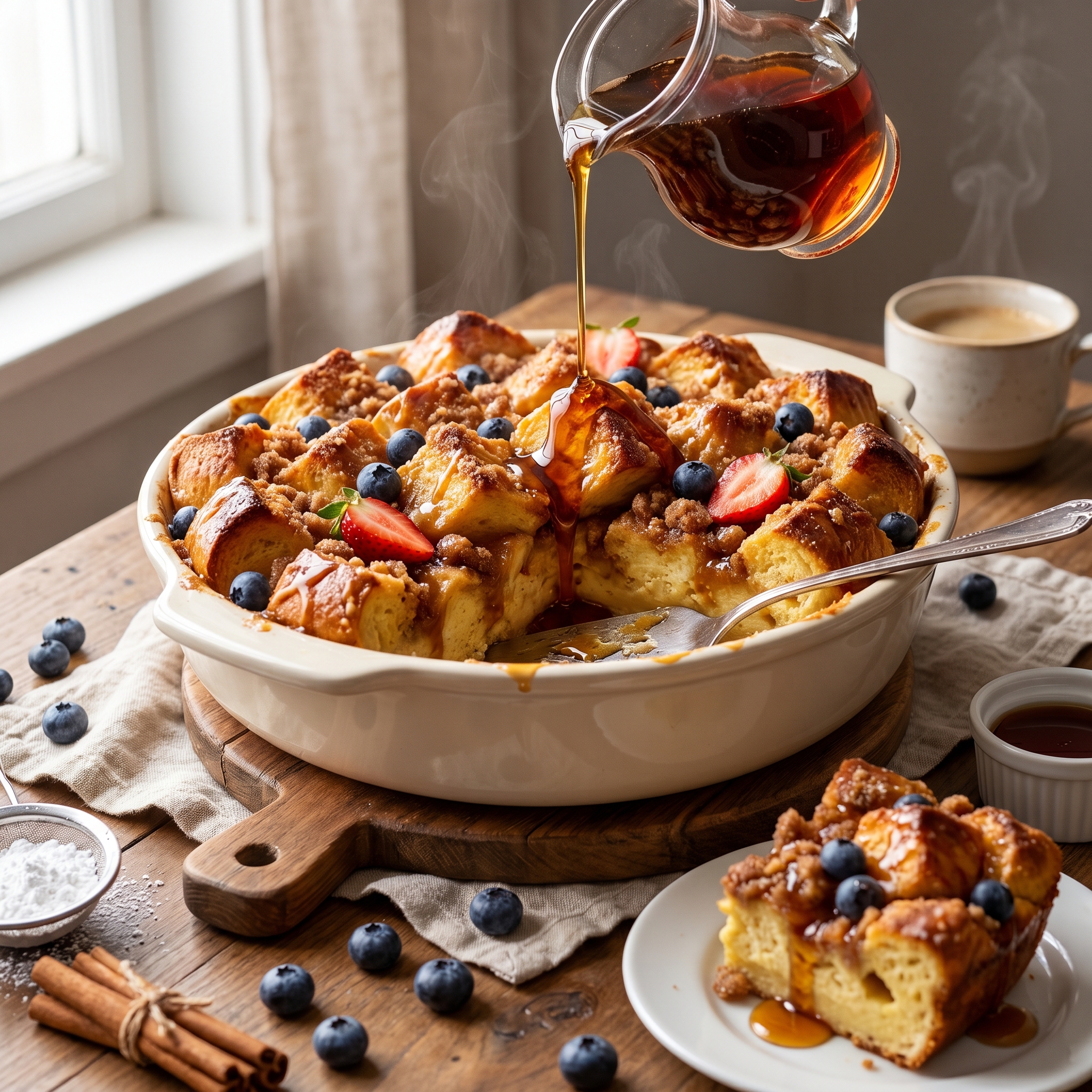
The Best Make-Ahead Sourdough French Toast Casserole That Feeds a Crowd Without the Morning Chaos
Imagine waking up on Christmas morning — or Easter Sunday, or a random gorgeous Saturday in October — walking into the kitchen in your pajamas, sliding a pan into a preheated oven, and forty-five minutes later pulling out the most gloriously golden, custardy, cinnamon-scented breakfast casserole your family has ever tasted. No standing at the stove flipping individual slices. No juggling four pans while everyone is already starving. No stress, no mess, no chaos — just a kitchen that smells like a bakery and a table full of people who cannot believe you pulled this off. That is exactly what this make-ahead sourdough French toast casserole delivers, every single time.
Let me ask you something — has feeding a hungry crowd on a holiday morning ever felt like a second job? Because between the gifts to open, the family coming through the door, the coffee to brew, and the twelve other things happening all at once, standing at the stovetop individually flipping French toast for eight people is nobody’s idea of a good morning. What if the entire thing was assembled the night before, tucked into the refrigerator while you slept, and all you had to do in the morning was preheat the oven and pour yourself a cup of coffee? Because that is exactly the magic of this recipe — the hard work happens the night before, and the morning is entirely yours to enjoy.
The secret that sets this casserole completely apart from every other French toast bake you have ever tried is the bread. Thick-cut sourdough soaks up the vanilla-spiced custard overnight and bakes into something extraordinary — crispy and caramelized on the outside, impossibly soft and bread-pudding-tender on the inside, with that subtle tang from the sourdough cutting right through the richness of the custard and the sweetness of the brown sugar streusel on top. This is the sourdough French toast casserole that gets requested at every holiday, every weekend gathering, and every single brunch where someone new tastes it for the very first time. Keep reading — I am walking you through every step, every tip, and every trick that makes this recipe completely foolproof.
Table of Contents
Why This Recipe Works
There are French toast casserole recipes everywhere on the internet. Here is exactly why this sourdough French toast casserole is the one worth making this weekend — and every special morning after that:
- ✔ Entirely make-ahead by design — assemble it the night before, refrigerate, and bake fresh in the morning while you drink your coffee and enjoy your family instead of standing at the stove
- ✔ Sourdough bread is the game-changing difference — the slight tang, the sturdy crumb, and the thick slices hold up beautifully under the custard overnight without turning to mush, producing a texture that regular sandwich bread simply cannot replicate
- ✔ Feeds 8 to 10 people from one pan — the ultimate crowd-pleasing, holiday-table-ready breakfast that scales effortlessly and requires zero individual cooking or flipping
- ✔ The brown sugar pecan streusel on top — it bakes into a deeply caramelized, crunchy, buttery crown that makes every single bite feel like a special occasion
- ✔ Ready in 45 minutes once it hits the oven — which means the actual active morning effort is preheating the oven and removing foil. That is it. That is the whole job.
- ✔ Budget-friendly and cheaper than any brunch restaurant — feeds a full table for the cost of a single restaurant order, and tastes dramatically better than anything on their menu
- ✔ Perfect for every occasion year-round — Christmas morning, Easter brunch, Thanksgiving weekend, Mother’s Day, Father’s Day, baby showers, holiday houseguests — this casserole fits every single one of them
Convinced this is exactly what your holiday morning has been missing? Good. Let’s talk about what goes into this — and the Chef’s Notes below contain two details that make an enormous difference between a casserole that is good and one that is genuinely unforgettable.
What You’ll Need
For the Casserole
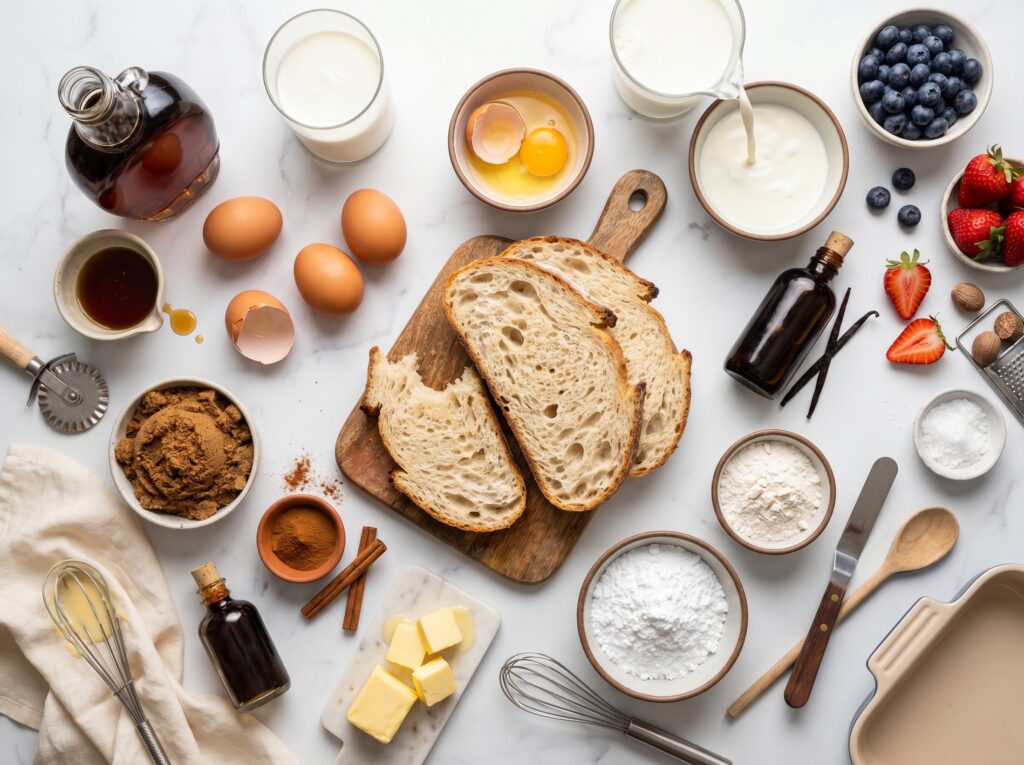
- 1 large loaf sourdough bread (about 1 lb), cut into 1-inch thick slices, then cubed
- 8 large eggs
- 2 cups whole milk
- ½ cup heavy whipping cream
- ⅓ cup granulated sugar
- ¼ cup pure maple syrup, plus more for serving
- 1 tablespoon pure vanilla extract
- 1½ teaspoons ground cinnamon
- ¼ teaspoon ground nutmeg
- ¼ teaspoon fine sea salt
- Butter or non-stick spray, for greasing the pan
For the Brown Sugar Pecan Streusel Topping
- ½ cup all-purpose flour
- ½ cup packed light brown sugar
- ¼ cup granulated sugar
- 1 teaspoon ground cinnamon
- ¼ teaspoon fine sea salt
- 6 tablespoons cold unsalted butter, cut into small cubes
- ½ cup chopped pecans (or walnuts)
For Serving
- Pure maple syrup, warmed
- Powdered sugar, for dusting
- Fresh berries
- Whipped cream or crème fraîche
- Extra butter, softened
Substitutions
No sourdough bread? A thick-cut brioche loaf, a good challah bread, or a sturdy French baguette all make excellent substitutes. The key is using bread that is substantial enough to soak up all that custard overnight without completely disintegrating by morning. Avoid thin, soft sandwich bread — it absorbs too quickly, breaks down into a dense, uniform paste, and loses all the beautiful texture contrast that makes this casserole so exceptional.
No heavy cream? All whole milk works perfectly fine — use a full 2½ cups total. The cream adds richness and a slightly more luxurious custard, but the casserole is genuinely delicious made entirely with whole milk. Do not substitute low-fat or skim milk — the fat is what gives the custard its silky, creamy texture after baking.
No pecans? Chopped walnuts, sliced almonds, or even a plain streusel without any nuts at all work beautifully. The nuts add wonderful crunch and a toasty, buttery flavor to the topping, but if nut allergies are a concern at your table, simply leave them out — the brown sugar and butter streusel is still spectacular on its own.
No maple syrup in the custard? An equal amount of honey or an additional two tablespoons of granulated sugar substitutes perfectly. The maple syrup adds a gentle, warm depth to the custard that is wonderful but not irreplaceable — the casserole is delicious either way.
🧑🍳 Chef’s Note — Day-Old or Slightly Stale Sourdough Is Your Best Friend: This is the single most important ingredient insight in this entire recipe and I want you to take it seriously. Fresh sourdough bread is wonderful for sandwiches, but for a French toast casserole that soaks overnight, it is actually too moist and tender. It absorbs the custard too quickly, breaks down during the overnight soak, and bakes into something dense and uniformly soft rather than the gorgeous, varied texture — crispy edges, tender center, slightly chewy chunks — that makes this casserole so extraordinary. Day-old sourdough that has been left out on the counter to dry slightly, or sourdough that has been cut into cubes and left uncovered on a baking sheet overnight, absorbs the custard slowly and evenly without disintegrating. If you only have fresh bread, spread the cubes on a baking sheet and bake at 300°F for 15 minutes to dry them out slightly before using. This one step is genuinely the difference between good and legendary.
🧑🍳 Chef’s Note — The Overnight Soak Is Not Optional: I know the temptation is real to make this in the morning, bake it immediately, and skip the overnight step entirely. Please resist that temptation. A two-hour soak produces a casserole where the top layer of bread cubes is well-saturated but the inner pieces are still somewhat dry and dense — you end up with an uneven result where some bites are perfectly custardy and others feel bread-heavy and under-saturated. The overnight soak — a minimum of 8 hours, ideally 10 to 12 — allows the custard to penetrate every single bread cube all the way through to the center, producing a uniformly creamy, perfectly saturated casserole that bakes into something genuinely breathtaking. Plan ahead. It is absolutely worth every hour.
Ingredients on your counter and Chef’s Notes committed to memory? Perfect. Let’s build the most magnificent breakfast casserole you have ever pulled out of your oven — and there is a streusel technique tip coming up in the instructions that gives you that extraordinary bakery-quality topping every single time.
How to Make Sourdough French Toast Casserole — Step by Step
The Night Before — Assembly
- Prepare the sourdough bread cubes. Cut the sourdough loaf into thick 1-inch slices, then cut each slice into roughly 1-inch cubes. You want substantial, chunky pieces — not thin little scraps that will dissolve overnight. If your bread is fresh, spread the cubes in a single layer on a baking sheet and bake at 300°F for 12 to 15 minutes until they feel slightly dry and stiff on the outside but not toasted through. Let them cool completely before using. If your bread is already day-old or slightly stale, skip this step entirely and go straight to assembly.
- Grease your baking dish generously. Butter a 9×13-inch baking dish thoroughly on the bottom and all the way up the sides — do not be shy with the butter here. A well-greased pan means the caramelized bottom and edges lift out cleanly rather than sticking stubbornly to the sides and leaving the most delicious parts behind in the pan. Spread the sourdough bread cubes evenly across the bottom of the greased dish in a single, relatively even layer.
- Whisk the custard base. In a large bowl, whisk together the eggs, whole milk, heavy cream, granulated sugar, maple syrup, vanilla extract, cinnamon, nutmeg, and salt until completely smooth and uniformly combined — the eggs should be fully broken down with no streaks of white or yolk visible and the spices distributed evenly throughout. Taste the custard at this point — it should taste warmly spiced, gently sweet, and richly eggy. Adjust the cinnamon or vanilla if needed before it goes anywhere near the bread.
- Pour the custard evenly over the bread. Pour the entire custard mixture slowly and evenly over the bread cubes, moving the bowl around the pan to ensure every section gets thoroughly covered rather than pouring it all into one spot and hoping it spreads. Once poured, use a spatula or the back of a large spoon to gently press down on the bread cubes, submerging any that are floating above the custard level. Every cube needs to be in contact with the custard to soak properly overnight.
- Make the brown sugar pecan streusel. In a medium bowl, combine the flour, brown sugar, granulated sugar, cinnamon, and salt. Add the cold butter cubes and use your fingertips to work the butter into the dry ingredients, pinching and pressing until the mixture resembles coarse, clumpy crumbs with pieces ranging from the size of a pea to the size of a small grape — this varied texture is exactly what you want. Some large, buttery clumps will caramelize in the oven into crunchy, golden nuggets of absolute perfection. Stir in the chopped pecans. The butter must be cold for this step — warm or softened butter will cream smoothly into the flour and produce a paste rather than the crumbly, clumpy streusel texture you need.
- Store the streusel separately overnight. Transfer the prepared streusel to a zip-top bag or a small covered container and refrigerate it alongside the casserole overnight. Do not add the streusel to the casserole before refrigerating — it will absorb moisture from the custard overnight, losing its crumbly texture and becoming dense and wet rather than the light, crunchy, caramelized topping it is meant to be. Add it cold, straight from the refrigerator, right before the casserole goes into the oven.
- Refrigerate overnight. Place the tightly covered casserole dish and the streusel container in the refrigerator for a minimum of 8 hours and ideally 10 to 12 hours. Set your coffee maker on a timer, lay out your serving dishes, and go to bed knowing that the hardest part of tomorrow morning’s breakfast is already completely done.
The Next Morning — Baking
- Remove the casserole from the refrigerator. Take the casserole dish out of the refrigerator 20 to 30 minutes before baking and let it sit on the counter while the oven preheats. Bringing it slightly closer to room temperature before it goes in the oven helps it bake more evenly — cold straight from the fridge can result in a casserole that is perfectly done on the outside but still slightly under-baked and wet in the very center.
- Preheat the oven to 350°F. While the casserole rests on the counter, preheat your oven to 350°F and pour yourself a cup of coffee. You have earned it entirely.
- Add the streusel topping. Remove the plastic wrap from the casserole. Take the streusel out of the refrigerator and scatter it evenly and generously across the entire top surface of the casserole — every inch should have some streusel coverage. Do not leave large gaps or pile it all in the center. Even distribution means every serving gets that incredible crunchy, caramelized topping rather than some servings getting all the good stuff and others getting none.
- Bake covered, then uncovered. Cover the casserole dish tightly with aluminum foil and bake at 350°F for 25 minutes — this covered phase allows the custard to cook through gently and evenly without the top browning too quickly before the center is set. After 25 minutes, carefully remove the foil and continue baking uncovered for another 20 to 25 minutes until the streusel is deeply golden brown, the edges are caramelized and pulling slightly away from the sides of the pan, and the center feels set — not jiggly or wet — when you give the pan a gentle shake.
- Rest before serving. Remove the casserole from the oven and let it rest on a wire rack or a folded kitchen towel for 10 minutes before cutting into it. This resting time allows the custard to fully set from a loose, custardy texture into something sliceable and cohesive — cutting in immediately produces servings that are soft and runny at the edges rather than holding together beautifully on the plate. Ten minutes of patience produces a casserole that looks as magnificent as it tastes.
- Dust, drizzle, and serve. Dust the surface generously with powdered sugar for that final touch of visual magic, set a small pitcher of warm maple syrup alongside, and bring the pan directly to the table for a family-style presentation that makes everyone feel like they are sitting down to something genuinely special. Serve with fresh berries, whipped cream, and extra softened butter on the side for a complete, stunning holiday breakfast spread that required almost no morning effort whatsoever.
You just produced a genuinely show-stopping holiday breakfast with virtually zero morning stress. Let’s talk about all the wonderful ways to put it on the table.
How to Serve It
This sourdough French toast casserole is a complete breakfast centerpiece all on its own, but here are five ways to build an unforgettable morning spread around it:
- 🎄 Christmas and holiday morning tradition — this is the recipe that turns a hectic holiday morning into a genuinely joyful, relaxed, everyone-at-the-table experience. Set the casserole in the center of a big wooden board surrounded by small pitchers of warm maple syrup, a bowl of fresh berries, a dish of softened butter, and whipped cream in a pretty bowl. Let everyone serve themselves family-style while gifts are opened or stockings are sorted. The fact that everything was done the night before means you are present for every single moment of the morning instead of stuck in the kitchen missing it all.
- 🌸 Easter and Mother’s Day brunch centerpiece — pair the casserole with a fresh fruit salad, a platter of crispy bacon, fresh-squeezed orange juice, and a mimosa bar for a brunch spread that looks like you spent all morning cooking when the reality is you spent fifteen minutes the night before. The combination of effortless elegance and crowd-feeding practicality makes this the single smartest choice for spring holiday entertaining.
- 🏡 Holiday houseguest breakfast — when family is staying with you over Thanksgiving weekend or the Christmas holidays, the last thing you want is to cook a full breakfast from scratch every single morning while still bleary-eyed and in your robe. Make this casserole the night before guests arrive, bake it the first morning, and let the extraordinary smell wafting from the oven do all the welcoming for you. Guests will feel deeply taken care of and you will feel completely in control.
- ☀️ Summer weekend brunch party — add fresh strawberries, blueberries, and a handful of raspberries over the top of the baked casserole right before serving for a beautiful burst of fresh color and bright fruit flavor that cuts through the richness of the custard. Serve alongside a light green salad with a citrus vinaigrette for a brunch spread that manages to feel both indulgent and fresh at the same time.
- 🧁 Potluck and community breakfast contribution — this casserole travels remarkably well, holds its temperature beautifully, and serves a large group from a single pan with zero individual plating required. Bake it at home, cover with foil, and transport in a casserole carrier. Set it up with a small ladle or wide serving spoon and a bottle of maple syrup alongside, and watch it become the most sought-after dish at every church breakfast, school fundraiser breakfast, or neighborhood holiday gathering you bring it to.
Let me cover the make-ahead strategy and storage details that make this casserole one of the most practical, most reliable recipes in your entire holiday entertaining repertoire.
Storage & Make-Ahead Tips
Make-ahead timeline — maximum advance prep: The assembled, unbaked casserole keeps beautifully in the refrigerator for up to 24 hours before baking. Beyond 24 hours, the bread begins to break down further and the texture of the finished casserole becomes progressively denser and less varied. For the best possible result, assemble the evening before you plan to serve it and bake the following morning.
Fridge — baked leftovers: Cover the baked casserole tightly with foil or transfer individual portions to airtight containers. Leftovers keep in the refrigerator for up to 4 days and reheat remarkably well — the flavors actually deepen and the texture becomes even more rich and custardy after a day in the fridge, making day-two leftovers a genuinely wonderful weekday breakfast treat.
Reheating — oven method: For the best results and the crispiest streusel topping, reheat individual portions or the whole remaining casserole covered with foil at 325°F for 15 to 20 minutes until warmed through. Remove the foil for the last five minutes to re-crisp the streusel. This method restores the casserole to something very close to its freshly baked glory.
Reheating — microwave method: For individual portions on a weekday morning, microwave on medium power for 60 to 90 seconds until heated through. The streusel will be softer than freshly baked, but the custard interior is just as warm, creamy, and delicious. Drizzle with a little extra maple syrup after reheating to freshen it up.
Freezer — baked casserole: The fully baked casserole freezes well for up to 2 months. Let it cool completely, then wrap the entire pan tightly in a double layer of plastic wrap followed by a layer of foil. Thaw overnight in the refrigerator and reheat covered in a 325°F oven for 25 to 30 minutes until heated all the way through. The streusel will be softer after freezing and thawing, but the custard interior remains beautifully creamy and delicious.
Freezer — unbaked casserole: You can freeze the assembled, unbaked casserole before the overnight soak stage — pour the custard over the bread, cover tightly, and freeze immediately before the bread absorbs too much liquid. Thaw in the refrigerator overnight (this also serves as the soaking time), add the streusel in the morning, and bake as directed. This extends your make-ahead window significantly for holiday planning.
🗓️ Holiday Make-Ahead Game Plan: Here is the exact timeline that makes this recipe the ultimate stress-free holiday breakfast. Two days before: buy the sourdough bread and let it sit out on the counter uncovered to become slightly stale — or cube it and dry it in a low oven. The evening before: assemble the casserole, make the streusel, cover both, and refrigerate. Morning of: remove from the fridge 25 minutes before baking, preheat the oven, scatter the streusel over the top, and bake for 45 to 50 minutes. Total active morning time: under 5 minutes. Total result: a holiday breakfast that makes everyone at your table feel like they are the most loved, most taken-care-of people in the world. This is make-ahead entertaining at its absolute finest.
Almost done — let me walk you through the five most important mistakes to avoid so your casserole comes out of the oven absolutely perfect, the very first time and every time after that.
Helpful Tips & Common Mistakes
This casserole is generous and forgiving, but a handful of avoidable mistakes can stand between you and perfection. Here is how to sidestep every single one of them:
✗ Mistake: Using fresh, soft bread without drying it first
✓ Fix: Fresh sourdough absorbs custard so rapidly it breaks down into mush before it ever reaches the oven, producing a dense, overly wet casserole with no texture variation whatsoever. Always use day-old bread or dry fresh bread in a low oven for 12 to 15 minutes before cubing and assembling. This single step is responsible for more of the recipe’s success than any other technique. Stale bread equals perfect casserole. Fresh soft bread equals disappointment.
✗ Mistake: Skipping the overnight soak and baking immediately
✓ Fix: A two-hour soak leaves the inner bread cubes under-saturated and dry while the outer pieces are fully soaked — you end up with an uneven, two-texture casserole where some bites are perfectly custardy and others taste like plain dry bread. The overnight soak gives the custard time to penetrate every single cube all the way to the center, producing the uniformly creamy, consistently magnificent result this recipe is known for. Plan ahead. You will not regret a single hour of waiting.
✗ Mistake: Adding the streusel to the casserole before refrigerating overnight
✓ Fix: Streusel added to the casserole before the overnight refrigeration absorbs moisture from the custard, losing its crumbly texture and becoming a dense, wet paste that sits on top of the bread rather than baking into the crunchy, caramelized crown it is meant to become. Always store the streusel separately overnight in the refrigerator and add it cold, directly from the fridge, right before the pan goes into the oven.
✗ Mistake: Baking at too high a temperature or skipping the foil cover
✓ Fix: Baking uncovered at too high a temperature produces a casserole with a beautifully browned top that is still wobbly and under-baked in the center — the outside sets before the interior has a chance to cook through properly. Always start covered at 350°F for the first 25 minutes to allow the custard to cook gently and evenly, then uncover for the final 20 to 25 minutes to brown and caramelize the streusel. Covered then uncovered is the formula for a casserole that is perfectly set all the way through with a gorgeous top.
✗ Mistake: Cutting into the casserole immediately out of the oven
✓ Fix: A casserole cut the moment it comes out of the oven has custard that is still loose and mobile — the first few servings will collapse and spread on the plate rather than holding their shape cleanly. Ten minutes of resting on the counter allows the custard to fully set and the structure to stabilize so every serving lifts out cleanly and holds together beautifully from the first piece to the last. Set a timer, step away, and let the casserole do its final quiet work before you serve it.
You now have everything you need to make this casserole absolutely perfectly. Here are four spectacular flavor variations that make this recipe work for every season and every taste.
Recipe Variations
🍎 Apple Cinnamon Version: Toss 2 cups of peeled, diced Granny Smith apples with 2 tablespoons of brown sugar, 1 teaspoon of cinnamon, and a pinch of nutmeg. Scatter them between the layers of sourdough cubes as you assemble the casserole before pouring the custard over everything. Add 1 teaspoon of apple pie spice to the custard base in place of the plain cinnamon. The tart apple pieces soften beautifully overnight and bake into jammy, caramelized pockets of warm fruit throughout the casserole — this is the fall and Thanksgiving version that will be requested by name at every November gathering for the rest of your life.
🫐 Blueberry Lemon Version: Fold 1½ cups of fresh or frozen blueberries into the bread cubes before pouring the custard over them. Add 1 tablespoon of fresh lemon zest and a teaspoon of lemon juice to the custard mixture. Replace the pecans in the streusel with sliced almonds and add a teaspoon of lemon zest to the streusel as well. The blueberries burst during baking and create gorgeous pockets of jammy, jewel-bright fruit throughout the casserole — bright, fresh, and absolutely spectacular for a spring brunch, Mother’s Day, or Easter morning table.
🍫 Chocolate Hazelnut Version: Spread 3 tablespoons of Nutella or another chocolate hazelnut spread between layers of the sourdough cubes as you assemble the casserole. Add 2 tablespoons of unsweetened cocoa powder and an extra tablespoon of sugar to the custard. Replace the pecans in the streusel with chopped hazelnuts. Finish the baked casserole with a drizzle of warm chocolate sauce and a dusting of powdered sugar. This is the version that absolutely silences a table of teenagers and convinces even the most confirmed breakfast skeptics that this is the greatest thing they have ever eaten before noon.
🥧 Pumpkin Spice Version: Whisk ½ cup of pure pumpkin purée directly into the custard base along with 1 teaspoon of pumpkin pie spice and an extra tablespoon of brown sugar. Reduce the milk by ¼ cup to account for the extra moisture from the pumpkin. Add a handful of pepitas (pumpkin seeds) to the streusel alongside the pecans. Serve with warm maple syrup and a generous dollop of cinnamon whipped cream. This is the October and November version that makes the whole house smell like a fall candle and fills every seat at the breakfast table without anyone needing a second invitation.
Make It Tonight, Love It Tomorrow
This make-ahead sourdough French toast casserole is everything a perfect holiday breakfast should be — spectacular enough to feel truly special, practical enough to make completely without stress, and delicious enough that it will be requested at every single gathering where it makes an appearance from here on out. You deserve a holiday morning where you are sitting at the table with the people you love, not standing over a hot stove missing it. Make it tonight. Wake up to something extraordinary. You have completely earned it.
If you make this recipe, I would love to hear all about it — leave a comment and a star rating below, or tag me on Pinterest with your gorgeous golden pan fresh out of the oven! Nothing makes my holiday morning brighter than seeing this casserole on your tables. Happy baking and even happier eating! 🍞✨
Frequently Asked Questions
Can I assemble this casserole more than one day ahead?
The sweet spot for assembling ahead is 8 to 24 hours before baking. Beyond 24 hours in the refrigerator, the bread continues to break down under the weight of the custard and can become overly dense and mushy rather than maintaining that wonderful custardy-yet-textured result. For the absolute best outcome, assemble the evening before and bake the following morning. If you need to plan even further ahead, freeze the unbaked assembled casserole immediately after pouring the custard over the bread — before significant absorption happens — and thaw overnight in the refrigerator before adding the streusel and baking.
How do I know when the casserole is fully cooked?
Three reliable signals tell you the casserole is done: the streusel topping is deeply golden brown and fragrant, the edges of the casserole are set and pulling slightly away from the sides of the pan, and the center no longer jiggles when you give the pan a gentle shake. If you want absolute certainty, insert an instant-read thermometer into the center of the casserole — it should read at least 160°F. If the top is browning too quickly before the center is set, tent the pan loosely with foil and continue baking until the center is fully done.
Can I make this recipe gluten-free?
Yes — with the right bread substitution. Use a good gluten-free sourdough or a sturdy gluten-free artisan-style bread, cut it into cubes, and dry it slightly in a low oven before assembling. Replace the all-purpose flour in the streusel with a gluten-free 1-to-1 baking flour blend. All other ingredients in the custard are naturally gluten-free. The texture of a gluten-free version will be slightly different — typically a bit more dense and less chewy — but the flavor is just as wonderful and the casserole is every bit as satisfying.
Can I make this dairy-free?
Yes. Replace the whole milk with full-fat oat milk or full-fat canned coconut milk for the richest result. Use a dairy-free heavy cream alternative or simply use all oat milk. Substitute the butter in the streusel with cold dairy-free butter sticks — Earth Balance and Miyoko’s both work well for the cold-butter streusel technique. The casserole will be slightly less rich than the dairy version but still genuinely delicious and deeply satisfying.
My casserole came out soggy in the middle. What went wrong?
Three possible culprits: the bread was too fresh and moist going in, the casserole was under-baked, or it was cut into before resting fully. Make sure your bread is properly dried before assembling, bake until the center is fully set with no jiggle, and always rest for a full 10 minutes before serving. If your oven runs cool, add 5 to 10 minutes to the uncovered baking time and check for doneness using the shake test or an instant-read thermometer reading of at least 160°F in the center.
Can I make individual portions instead of one large casserole?
Absolutely — and individual portions are wonderful for a brunch party or a smaller household. Divide the assembled bread and custard among greased individual ramekins, cover each one with plastic wrap, and refrigerate overnight. The next morning, add a spoonful of streusel to the top of each ramekin and bake at 350°F for 25 to 30 minutes until set and golden. Individual portions bake faster than the full casserole and look absolutely charming served on individual plates with a dusting of powdered sugar and fresh berries alongside.
What if I don’t have a 9×13-inch baking dish?
Two 8×8-inch or 9×9-inch square baking dishes work perfectly and are actually great for a make-ahead situation where you want to serve one and freeze the other. The baking time may be slightly shorter for smaller dishes — start checking for doneness about 5 minutes earlier than the recipe suggests. A large oval or round ceramic baking dish with similar capacity also works beautifully for a more rustic, family-style presentation.
Can I skip the streusel topping to make it simpler?
You can, and the casserole will still be delicious — but I would genuinely encourage you not to. The streusel is what transforms this from a very good baked French toast into something truly spectacular. It adds textural contrast that makes every bite more interesting, a caramelized sweetness that balances the custard, and a visual drama that makes the pan look genuinely impressive when it comes out of the oven. If you are short on time, make a simpler streusel with just brown sugar, butter, and cinnamon — no flour, no nuts — and sprinkle it over the top. Even that simplified version adds tremendous value to the finished casserole.