
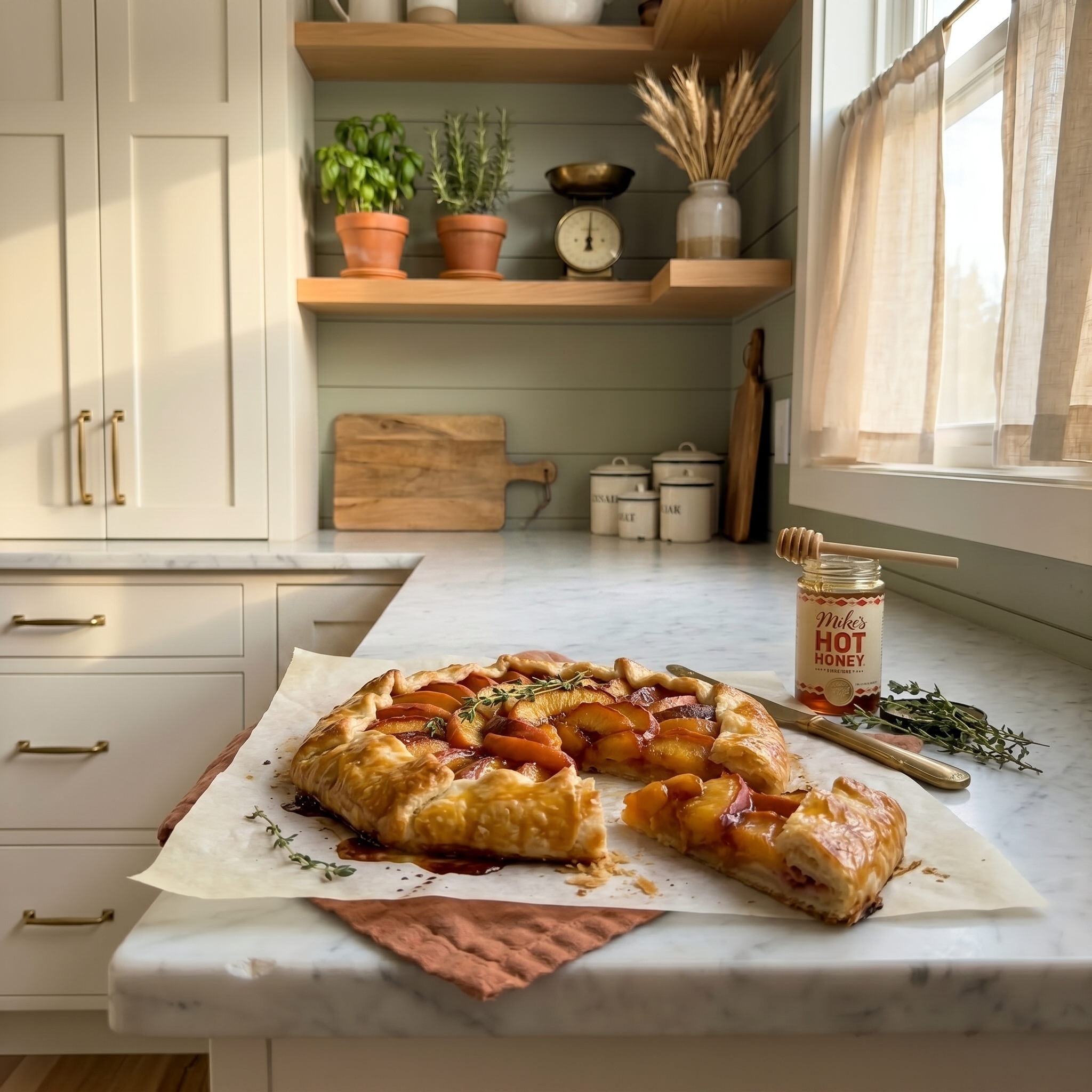
Show-Stopping Hot Honey Peach Galette: 9 Reasons This Foolproof Summer Stone Fruit Dessert Will Make You Look Like a Pastry Chef
It started with a farmers market haul that got slightly out of hand on a Saturday morning in late July. I had gone in for tomatoes and came out with three pounds of peaches, a paper bag of plums, and a flat of blackberries that the vendor had practically given me because they needed to move them before the heat got to them. I stood at my kitchen counter surrounded by more stone fruit than I could reasonably eat in a week and thought: I need to make something with this today, something that does justice to how good all of it is, and I need to do it without spending three hours in the kitchen. I had made pie exactly twice in my life and both experiences had left me with a deep respect for anyone who makes pie regularly and a quiet personal policy of never attempting it again. But then I remembered a galette I’d seen in a French cookbook years ago — free-form, intentionally imperfect, made with the same buttery pastry but requiring none of the precision of a pie — and I made one. The crust was flaky and golden and slightly caramelized at the edges from the butter. The fruit was jammy and bubbling with the most intensely summer flavor I could imagine. I drizzled hot honey over the whole thing when it came out of the oven and the kitchen smelled like something a very good bakery would charge fourteen dollars a slice for. It was gone by Sunday evening.
Have you ever wanted to make a proper fruit dessert in the summer but felt shut out by the technical demands of pie — the blind baking, the crimping, the fear of a soggy bottom, the whole exhausting business of lattice tops — and ended up with store-bought ice cream again because it was easier? A hot honey peach galette is the answer to all of that. It is a free-form tart made on a baking sheet, not in a pie dish — you roll the dough into a rough circle, pile the sliced stone fruit in the center, fold the edges over in whatever rustic configuration pleases you, and bake it. The imperfection is the point. The crust is the same buttery, flaky pastry as any pie, but it requires none of the fitting and trimming and blind baking anxiety. The hot honey finish is a two-second drizzle that adds a sweet-heat complexity to the fruit that makes every bite taste like it was very deliberately seasoned. This is the summer dessert that makes people think you have skills you may not quite have yet — and by the time you’ve made it twice, you actually will.
Whether you’re a nervous beginner baker who has been told pie is hard and believed it, a confident home cook looking for a summer dessert that photographs beautifully and requires no special equipment, or someone who came home from the farmers market with more peaches than they know what to do with and a Sunday afternoon to fill — keep reading. This recipe was made for every single one of you, and it is going to be your most-made summer dessert from now until the first frost.
Table of Contents
Why This Recipe Works
A galette works because it removes every technical anxiety from pastry-making while preserving everything that makes pastry worth making. The free-form shape means there is no wrong way to fold the edges — rustic and imperfect is not a failure, it is the aesthetic. The hot honey finish is the element that takes a good summer fruit galette and makes it genuinely remarkable — the warmth of the chili amplifies the sweetness of the ripe peaches in a way that is deeply interesting and completely impossible to stop eating.
- ✔ Forgiving, free-form pastry that rewards imperfection — Unlike a pie, a galette has no right shape, no required crimping technique, and no possibility of failure from a poorly fitted crust. You fold the edges over however they want to go and call it rustic. The imperfect folds caramelize beautifully and look intentional every single time.
- ✔ The hot honey finish changes everything — A drizzle of hot honey over the warm fruit right out of the oven adds a sweet-heat complexity that makes the peach flavor more vivid, more interesting, and more sophisticated than plain honey or no honey at all. It is the finishing touch that makes people ask what you did differently.
- ✔ Peak-season stone fruit needs almost no help — A ripe July or August peach, plum, or nectarine is already extraordinary. The galette format concentrates and amplifies that flavor rather than obscuring it — you taste the fruit first, the pastry second, and the honey finish third, and all three are exactly where they should be.
- ✔ Made in one bowl with no special equipment — The pastry comes together in a food processor or by hand in a bowl, gets rolled out on a lightly floured surface, and bakes on a parchment-lined sheet pan. No pie dish, no pie weights, no pastry brush required — though if you have one, the egg wash goes on more evenly.
- ✔ Looks completely stunning with almost no effort — A properly baked galette with golden pastry edges, jewel-colored bubbling stone fruit, and a glistening hot honey drizzle is one of the most beautiful things you can pull out of an oven. It looks like a French patisserie made it. It takes about forty-five minutes of total work.
- ✔ Works with any stone fruit combination in season — Peaches alone, peaches and plums, nectarines and blackberries, plums and cherries — the galette format handles any combination of summer stone fruit beautifully without any recipe modification beyond adjusting the sugar slightly for tartness.
- ✔ Excellent warm, at room temperature, and the next day — Unlike many baked fruit desserts that need to be eaten immediately, a galette is genuinely good at any temperature. Room-temperature galette the morning after it was baked is one of the best breakfast pastries of the entire summer.
Let’s talk about what goes into the pastry and the filling and what every ingredient is doing to earn its spot in this dessert.
What You’ll Need
This recipe makes one large galette that serves 6 to 8 people generously. Everything here is available at any grocery store or Trader Joe’s, and the quality of the butter and the ripeness of the fruit are the two most important variables in the entire recipe. Use the best butter you can find and buy your peaches at the farmers market if at all possible — the difference in flavor is significant enough to be worth the trip.
For the Galette Pastry
- 1¼ cups all-purpose flour — King Arthur is the most reliable and consistent brand for pastry
- 1 tablespoon granulated sugar
- ½ teaspoon kosher salt
- ½ cup (1 stick) unsalted butter, very cold — cut into ½-inch cubes and returned to the freezer for 10 minutes before use; cold butter is non-negotiable for flaky pastry
- 3 to 4 tablespoons ice water — added one tablespoon at a time; the exact amount depends on the humidity and the flour
- 1 teaspoon apple cider vinegar — added to the ice water; it inhibits gluten development and produces a more tender crust
For the Stone Fruit Filling
- 3 to 4 large ripe but firm peaches — about 1½ lbs — halved, pitted, and sliced into ½-inch wedges; freestone peaches are easiest to work with
- Optional additions: 1 cup of fresh plum slices, blackberries, or cherries mixed in with the peaches for a mixed stone fruit galette
- 3 tablespoons granulated sugar — adjust up or down depending on the sweetness of your fruit
- 1 tablespoon cornstarch or tapioca starch — thickens the fruit juices so they don’t run out and make the pastry soggy
- 1 teaspoon pure vanilla extract
- Zest of 1 lemon
- 1 tablespoon fresh lemon juice
- ¼ teaspoon cinnamon
- Pinch of kosher salt — always salt the fruit filling; it amplifies the fruit flavor dramatically
For the Almond Cream Base
- 2 tablespoons almond flour or finely ground almonds
- 2 tablespoons granulated sugar
- 1 tablespoon unsalted butter, softened
- 1 egg yolk
- ¼ teaspoon almond extract
- Pinch of salt
For the Egg Wash and Finishing
- 1 large egg beaten with 1 tablespoon of whole milk — for brushing the pastry edges
- 2 tablespoons turbinado sugar — sprinkled over the egg-washed pastry edges for sparkle and crunch
- 3 to 4 tablespoons hot honey — Mike’s Hot Honey is the most widely available brand and is outstanding here; Trader Joe’s also sells a good hot honey
- Flaky sea salt — Maldon — a pinch over the hot honey drizzle right before serving
For Serving
- Vanilla ice cream or crème fraîche alongside — Häagen-Dazs Vanilla Bean or a good crème fraîche from Trader Joe’s
- Fresh mint sprigs for garnish
- Additional hot honey for the table for those who want more
Optional Add-Ins and Upgrades
- A tablespoon of bourbon stirred into the fruit filling with the sugar and cornstarch — the bourbon caramelizes during baking and adds a warm, oaky depth that is extraordinary with peaches
- A thin layer of ricotta mixed with honey and lemon zest spread over the almond cream base for a richer, more indulgent filling layer
- Fresh thyme leaves — about 1 teaspoon — tossed with the peach filling; the herbal, slightly floral note of thyme against ripe peaches and hot honey is one of the great unexpected flavor combinations of summer baking
- Sliced fresh figs layered between the peach slices in late summer when both are simultaneously available
- A drizzle of aged balsamic reduction alongside the hot honey over the finished galette
- Toasted sliced almonds scattered over the top of the warm galette right after the hot honey goes on
Substitutions
What if I can’t find hot honey or don’t want the heat? Hot honey is increasingly available at most grocery stores — look for Mike’s Hot Honey near the regular honey or in the specialty foods section; Trader Joe’s carries their own version seasonally, and Walmart carries it in some locations. If you genuinely cannot find it, make your own in two minutes by warming ¼ cup of good honey in a small saucepan over low heat with ½ teaspoon of red pepper flakes for 5 minutes, then straining — the heat level is fully adjustable. Plain good-quality honey is a perfectly beautiful finish if the heat element isn’t for you or your crowd — the complexity comes slightly down but the galette is still wonderful. What you don’t want to use is generic processed honey, which lacks the floral complexity that makes a honey finish on warm fruit extraordinary.
Can I use store-bought pie dough to save time? Pillsbury refrigerated pie crust works well as a shortcut and produces a genuinely good galette — unroll it on a parchment-lined sheet pan, add the filling, fold the edges, and proceed exactly as written. The flavor and flakiness of homemade pastry are noticeably better, but a store-bought crust galette made on a Tuesday evening is dramatically better than no galette at all. If you’re going to use store-bought, let the dough come to room temperature for 15 minutes so it’s pliable enough to fold without cracking at the edges.
What if my peaches are underripe? Underripe peaches lack the sugar content that produces a jammy, concentrated filling and the fragrance that makes a baked peach galette smell extraordinary. If your peaches are firm and starchy, leave them on the counter in a paper bag for one to two days until they’re fragrant and yield slightly when pressed at the shoulder. If you must bake with underripe peaches, increase the sugar in the filling to 4 tablespoons, add an extra teaspoon of vanilla, and increase the bake time by 5 minutes to give the fruit more time to soften and concentrate its flavor.
🧑🍳 Chef’s Note — Cold Butter: The temperature of your butter is the single most important variable in galette pastry. Butter must be genuinely cold — not cool, not room temperature, but straight from the freezer or refrigerator and kept cold throughout the mixing process. When cold butter meets the heat of the oven, the water in the butter converts to steam and creates the layers that produce a flaky, shattering crust. Warm butter melts into the flour before the oven can do its job, producing a crumbly, greasy, dense pastry with no flake and no lift. Keep the butter cold, work quickly, and if the dough starts to feel warm and greasy at any point, refrigerate it for 15 minutes before continuing. Cold hands, cold butter, cold dough — that is the pastry mantra.
🧑🍳 Chef’s Note — The Almond Cream Base: The thin layer of almond cream spread on the pastry before the fruit goes on is doing two important jobs. First, it creates a moisture barrier between the juicy fruit filling and the pastry, which is one of the primary defenses against a soggy bottom crust. Second, it adds a subtle, nutty, slightly marzipan-like flavor layer between the pastry and the fruit that makes the whole galette taste more complex and more intentional than one without it. It takes two minutes to make and makes a meaningful difference. Do not skip it.
How to Make a Hot Honey Peach Galette — Step by Step
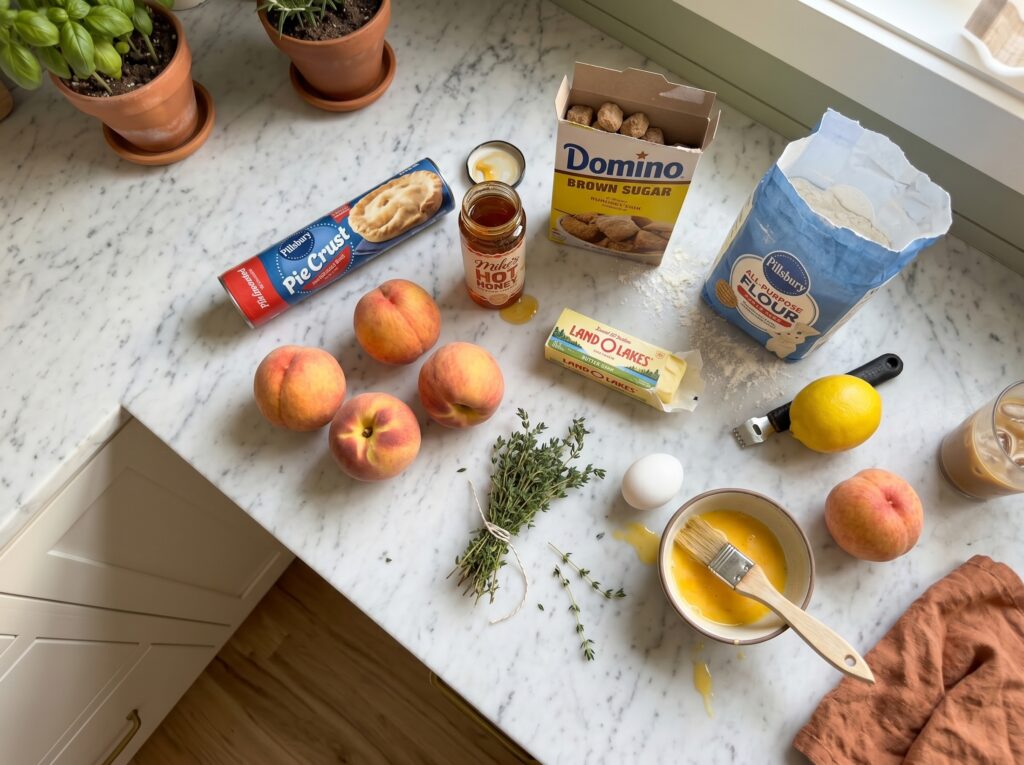
- Make the pastry dough first — it needs at least 30 minutes of refrigerator rest before rolling. In a large bowl or food processor, combine the flour, sugar, and salt and whisk or pulse briefly to combine. Add the very cold butter cubes and work them into the flour using your fingertips or the food processor pulse function — the goal is to break the butter down until the largest pieces are the size of a pea and the smallest are the size of a lentil, with loose flour surrounding all of it. You want visible butter pieces in the dough, not fully incorporated butter. Mix the apple cider vinegar into the ice water, then add the cold water mixture one tablespoon at a time, tossing with a fork after each addition, until the dough just comes together when you squeeze a handful — it should hold its shape without being wet or sticky. Turn it out onto a lightly floured surface, press it into a flat disk, wrap in plastic wrap, and refrigerate for at least 30 minutes and up to 48 hours.
💡 Pro Tip: While the dough rests in the refrigerator, prepare the fruit filling and the almond cream so everything is ready to assemble the moment the pastry comes out. Cold dough warms up quickly on a warm kitchen counter, and you want to work efficiently once you start rolling. Having the filling fully prepared — fruit sliced and tossed with sugar and cornstarch, almond cream mixed — means the assembly takes under five minutes and the dough stays cold throughout.
- Make the almond cream base while the dough chills. In a small bowl, beat together the almond flour, sugar, softened butter, egg yolk, almond extract, and salt with a fork until completely smooth and paste-like — it should look like a thick, pale spreadable paste with no visible lumps. Set aside at room temperature. If the kitchen is very warm, refrigerate it so it stays spreadable rather than becoming too soft and runny to control on the pastry.
- Prepare the stone fruit filling. Halve, pit, and slice the peaches into ½-inch wedges — not too thin, which would produce mush, and not too thick, which would leave the fruit undercooked in the center of the galette. Place the slices in a large bowl and toss with the sugar, cornstarch, vanilla, lemon zest, lemon juice, cinnamon, and salt. Toss gently until every piece is evenly coated and the mixture looks slightly syrupy from the sugar drawing out the peach juices. Let it sit for 10 minutes — the sugar will draw out more juice, the cornstarch will begin absorbing it, and the filling will become slightly thicker and more cohesive. Taste a slice of peach — it should taste like a perfectly seasoned version of the fruit itself, bright and sweet with a hint of warmth from the cinnamon.
💡 Pro Tip: Drain the macerated fruit in a colander set over a bowl for 5 minutes before adding it to the galette — this removes the most excessive liquid that has been drawn out by the sugar and reduces the risk of the filling running out onto the parchment during baking. Save the drained liquid — pour it into a small saucepan with an extra tablespoon of sugar and reduce it over medium heat for 3 to 4 minutes until slightly syrupy, then brush it over the finished galette right after the hot honey for an extra glossy, deeply fruity finish that is genuinely beautiful.
- Preheat the oven to 400°F and line a large baking sheet with parchment paper. A hot oven is essential for galette pastry — the high initial heat causes rapid steam production in the cold butter, which creates the flaky layers, and it caramelizes the sugars in the fruit and the egg-washed pastry edges into that deep golden color. If your oven runs cool, bump it to 425°F. Position the rack in the lower third of the oven — closer to the bottom heat source helps ensure the bottom crust cooks through and doesn’t stay pale and underdone while the top colors.
- Roll the chilled pastry into a rough circle about 12 to 13 inches in diameter on a lightly floured surface. Remove the dough from the refrigerator and let it sit for exactly 5 minutes — cold enough to stay flaky, warm enough to roll without cracking. Flour your rolling surface and rolling pin lightly. Roll from the center outward in short, firm strokes, rotating the dough a quarter turn after every few rolls to keep it roughly circular and prevent sticking. It does not need to be a perfect circle — an irregular edge is beautiful and deliberately rustic. Thickness should be between ⅛ and ¼ inch — thin enough to be delicate, thick enough to hold the fruit without tearing.
- Transfer the rolled pastry to the parchment-lined baking sheet, spread the almond cream, then add the fruit. The easiest way to transfer a rolled pastry without tearing it is to fold it gently in quarters, lift it onto the parchment, and unfold — like unfolding a map. Spread the almond cream over the center of the pastry in a thin, even layer, leaving a 2-inch border around the edge bare. Pile the drained fruit filling over the almond cream in the center, arranging the peach slices in overlapping concentric circles if you want a beautiful presentation, or simply tumbling them in for a more casual look — both are correct, both bake the same way. Leave the 2-inch border bare for folding.
💡 Pro Tip: Fold the pastry border over the fruit with confidence — don’t tentatively tuck small bits at a time, which produces a thin, fragile folded edge that tears during baking. Instead, lift a section of the pastry border about 3 to 4 inches wide, fold it decisively over the edge of the fruit filling, press it lightly to adhere, then move to the next section and overlap slightly. Work around the entire perimeter. The folds will be uneven and the pastry will pleat at irregular intervals — this is correct and beautiful. Thick, confident folds caramelize into golden, slightly crispy edges that are one of the best parts of the galette.
- Brush the pastry border generously with the egg wash and sprinkle turbinado sugar over it. Use a pastry brush or your fingers to apply the egg wash evenly across the entire folded pastry border — get into all the pleats and folds so every surface gets color in the oven. The egg wash is what produces that deep golden-brown, slightly glossy finish on the pastry edges. Immediately after the egg wash, sprinkle the turbinado sugar evenly over the entire brushed surface — the coarse sugar crystals caramelize in the oven into a sparkling, crackly crust on the pastry edge that is simultaneously beautiful and delicious.
- Bake at 400°F for 35 to 40 minutes until the pastry is deeply golden and the fruit is bubbling. Place the pan on the lower third rack and bake without opening the oven for the first 25 minutes. The galette is done when the pastry edges are a deep, rich golden brown — not pale gold, not tan, but the color of a well-baked croissant — and the fruit filling is visibly bubbling at the edges where it meets the pastry. The bubbling indicates the cornstarch has activated and the filling has thickened, which is what you need for clean slices rather than a runny mess. If the edges are browning faster than the bottom is cooking, tent the edges loosely with foil for the last 10 minutes.
- Drizzle the hot honey over the warm galette immediately out of the oven, finish with flaky sea salt, and let rest for 15 minutes before slicing. The moment the galette comes out of the oven, drizzle the hot honey generously over the entire surface — over the fruit, over the pastry edges, into the bubbling juices. The heat of the galette warms the honey on contact and helps it flow into all the crevices between the peach slices. Finish immediately with a pinch of Maldon flaky sea salt over the honey — the salt amplifies every other flavor and makes the sweet-heat combination of the hot honey even more vivid. Rest for 15 minutes before cutting so the filling can set slightly — a galette cut immediately out of the oven will have runny filling; one rested for 15 minutes will hold its shape cleanly when sliced.
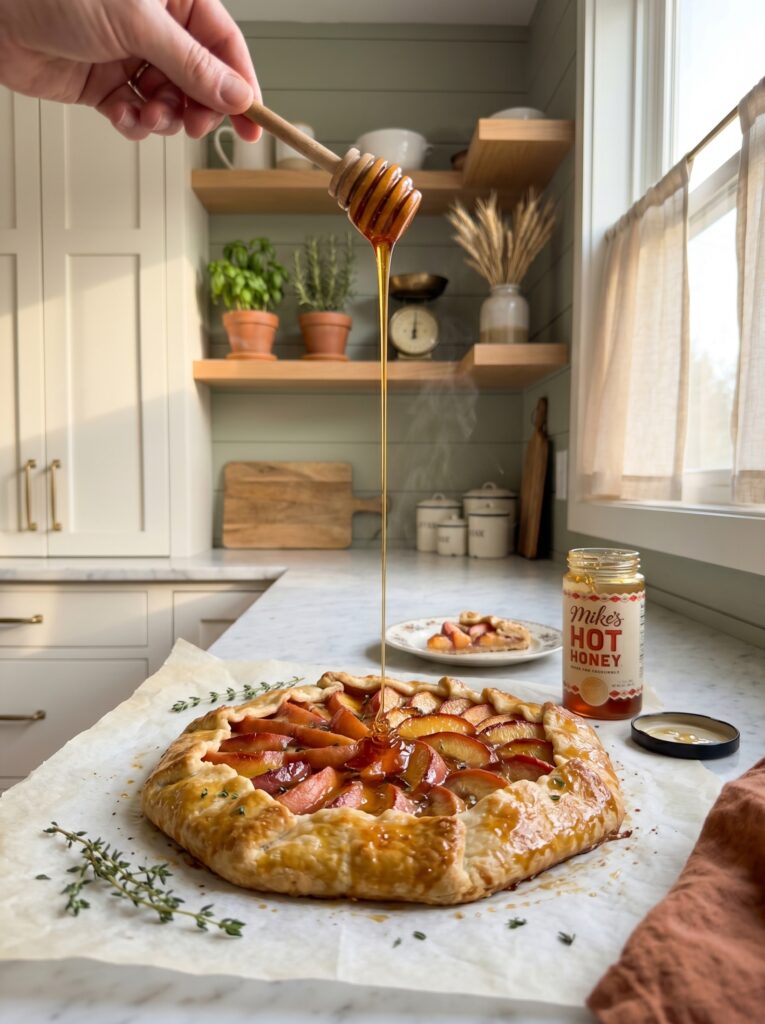
From mixing the pastry to pulling the finished galette from the oven, you’re looking at about an hour and a half total — but only forty-five minutes of that is active work. The dough rest and the bake time are entirely hands-off. What you end up with is a dessert that looks like it came from a French patisserie, tastes like it came from the best peach orchard in Georgia, and required less technical precision than a batch of cookies. That is the galette promise, and it delivers every single time.
How to Serve It
This hot honey peach galette is one of those desserts that works beautifully in almost any setting — elegant enough for a dinner party, casual enough for a Sunday afternoon, simple enough to bring to a cookout where it will immediately become the most interesting thing on the dessert table. Here are five ways to bring it to the table.
- ☕ Classic Warm Dessert with Ice Cream: Slice the galette while still warm — about 15 minutes out of the oven — and serve each wedge on a wide plate with a generous scoop of Häagen-Dazs Vanilla Bean ice cream alongside or directly on top, where it will begin melting into the hot honey glaze and the fruit juices immediately. The warm pastry, jammy peaches, hot honey, and cold melting ice cream is one of the perfect dessert combinations of the entire summer. Set a small pitcher of extra hot honey on the table for anyone who wants more.
- 🥞 French Breakfast Galette: A room-temperature slice of galette the morning after it was baked, with a cup of very good coffee and nothing else, is one of the best breakfasts of summer. The pastry has set overnight into something slightly crisper and more cohesive, the fruit juices have absorbed back into the filling, and the hot honey has mellowed into a glossy glaze that is perfect with coffee. Do not underestimate leftover galette as a breakfast pastry. It is genuinely superior to almost anything else you could be eating at 8 a.m. in July.
- 🌸 Dinner Party Centerpiece Dessert: Present the entire galette on a large wooden board or a round marble slab — dust lightly with powdered sugar over the fruit and pastry, add a small additional drizzle of hot honey across the surface, tuck a few sprigs of fresh thyme or mint at the edge, and carry it to the table whole. Slice it at the table in front of your guests — the first cut revealing the jammy, glistening fruit against the flaky pastry layers produces a moment of genuine visual drama. Serve with a bowl of crème fraîche and a small jar of hot honey alongside for people to add their own.
- 📚 Farmers Market Weekend Bake: Make the galette on Saturday afternoon with whatever stone fruit you bought at the market that morning — peaches, plums, nectarines, cherries, any combination — and serve it that evening warm from the oven with vanilla ice cream. This is the format that makes galette-making a summer ritual rather than an occasion — you buy the best fruit you can find, you make the simplest beautiful thing you can make with it, and you eat it the same day. Repeat every Saturday until the stone fruit season ends.
- 🎃 Gifted Galette for a Special Occasion: Bake the galette in a round parchment-lined cake pan instead of free-form on a sheet pan — it produces a more uniform circular shape that is easier to transport — and carry it still on the parchment in the pan, covered loosely with foil. Present it at room temperature with a small jar of hot honey and a card explaining what it is. A homemade peach galette as a hostess gift, birthday gift, or thank-you is one of the most genuinely thoughtful food gifts you can bring to someone, and the hot honey alongside makes it feel considered and complete. It is better than flowers and it costs about eight dollars to make.
However you serve it, always add the final drizzle of hot honey right before the galette reaches whoever is eating it — either while the galette is still warm from the oven or immediately before serving at room temperature. The honey looks and tastes best when applied fresh rather than sitting on the galette for hours, where it can absorb into the fruit surface and lose its visual impact.
Storage & Make-Ahead Tips
Baked galette — Room Temperature: A fully baked galette keeps beautifully at room temperature, loosely covered with foil or a clean kitchen towel, for up to 2 days. The pastry stays crisp and the filling stays set — in fact, day-two galette at room temperature is arguably better than freshly baked, with the filling fully settled and the hot honey glaze absorbed into a concentrated, intensely flavored surface. Do not refrigerate a baked galette if you can avoid it — refrigeration softens the pastry significantly and produces a crust that is pale and slightly dense rather than flaky and golden. Room temperature storage is always the right choice for baked pastry.
Galette dough — Refrigerator and Freezer: The pastry dough keeps in the refrigerator for up to 3 days and freezes beautifully for up to 3 months. Wrap the disk tightly in plastic wrap and then in foil before freezing. Thaw overnight in the refrigerator before rolling — never at room temperature, which softens the butter unevenly. Having a disk of galette dough in the freezer at all times during stone fruit season is one of the best kitchen preparedness moves of summer; it means a galette is always thirty minutes away from whenever you have good fruit and an oven available.
The assembled unbaked galette — Refrigerator: Assemble the complete galette — pastry rolled, almond cream spread, fruit filling piled on, edges folded — and refrigerate on the parchment-lined pan, covered loosely with plastic wrap, for up to 8 hours before baking. Apply the egg wash and turbinado sugar immediately before it goes into the oven rather than before refrigerating — egg wash applied too far in advance can make the pastry slightly soggy. This make-ahead approach is perfect for dinner parties: complete all the prep in the afternoon, refrigerate, and bake while you eat dinner so the galette comes out of the oven warm when dessert is called for.
📅 Make-Ahead Tip: Make a double batch of galette dough on Sunday and freeze one disk for later in the week or the following weekend. When good stone fruit is in season, having ready dough in the freezer means the decision to make a galette is never derailed by the time it takes to mix pastry. Thaw the frozen dough Thursday evening, refrigerate overnight, roll and fill on Friday — dinner party dessert handled with essentially zero Friday prep. This is the summer baking habit that makes you look like you bake far more than you actually do.
Reheating a stored galette: To restore a room-temperature or slightly stale galette to its original glory, place individual slices or the whole galette on a parchment-lined baking sheet in a 350°F oven for 8 to 10 minutes until the pastry is warm and re-crisped and the filling is gently bubbling at the edges. The oven reheat restores the flakiness of the crust and the jammy warmth of the filling in a way that a microwave absolutely cannot — microwaved galette pastry becomes soft and slightly gummy in under a minute. Always reheat in the oven. Always.
Helpful Tips & Common Mistakes
These are the five mistakes that most consistently stand between a good galette and a great one — and every single fix is simple once you understand what is actually going wrong and why.
✗ Mistake: Overworking the pastry dough when mixing the butter in, ending up with a smooth, uniform dough that bakes into a dense, crumbly, cookielike crust with no visible flaky layers.
✓ Fix: Stop mixing while there are still visible pieces of butter in the dough — pea-sized and smaller, distributed throughout, but not fully incorporated into the flour. Those butter pieces are what produce flaky layers in the oven; fully incorporated butter produces a crumbly, mealy texture. The dough should look rough and slightly shaggy, not smooth and uniform. If it looks smooth, you’ve gone too far. Work faster and colder next time — cold butter and quick hands are the two most important tools in pastry-making.
✗ Mistake: Skipping the cornstarch in the filling and pulling a galette from the oven where the fruit juices have run out under the folded pastry edges, soaked the bottom, and created a wet, soggy crust that falls apart when you try to slice it.
✓ Fix: Always include the cornstarch or tapioca starch in the fruit filling — it absorbs the juices released by the fruit during baking and thickens them into a glossy, jammy sauce that stays where it belongs rather than running out onto the pastry. One tablespoon is enough for this recipe. Also drain the macerated fruit for 5 minutes before adding it to the galette — removing the most excessive liquid before baking gives the cornstarch less work to do and makes a soggy bottom essentially impossible.
✗ Mistake: Rolling the pastry on a cold day or from dough that’s been in the refrigerator for more than an hour without letting it warm slightly, and cracking the edges badly when you try to fold them over the fruit.
✓ Fix: Let the dough sit at room temperature for exactly 5 minutes after coming out of the refrigerator before rolling — no more, no less. Five minutes is enough to make the dough pliable enough to roll without cracking, while keeping it cold enough to stay flaky. If a crack develops at the edge when you fold, simply press it back together gently with wet fingertips — the egg wash will seal it during baking and the finished galette will show no evidence of the repair.
✗ Mistake: Slicing the galette the moment it comes out of the oven because everyone is waiting and the smell is unbearable, and having the filling pour out in a liquid rush that pools on the cutting board and leaves each slice with a bare, wet interior.
✓ Fix: Rest for a minimum of 15 minutes after the hot honey goes on and before the first cut. The filling is still actively thickening during the first 10 to 15 minutes out of the oven as the cornstarch continues setting with the residual heat. A galette cut at the 5-minute mark will pour. A galette cut at the 15-minute mark will hold clean, beautiful slices that show the full layered cross-section of flaky pastry, almond cream, and jewel-colored fruit. The wait is fifteen minutes. It is worth every second of it.
✗ Mistake: Using room-temperature butter in the pastry because it seemed like it would be easier to mix, and producing a dough that feels greasy and smooth and bakes into a dense, flat, completely un-flaky crust.
✓ Fix: The butter must be cold — genuinely, aggressively cold, straight from the refrigerator or the freezer — at every stage of the pastry-making process. Cut the butter into cubes and put it back in the freezer for 10 minutes before you start. Work quickly with your fingertips when incorporating it into the flour so the heat of your hands doesn’t melt it. If the dough starts feeling warm and greasy at any point, stop, put the bowl in the refrigerator for 15 minutes, then continue. The entire flakiness of the finished crust depends on the butter remaining in distinct, cold, intact pieces right up until the moment it hits the oven.
Recipe Variations
The galette formula — flaky free-form pastry, thin flavor base, seasonal fruit, beautiful finish — is one of the most adaptable dessert frameworks in summer baking. Here are four variations that are all genuinely extraordinary in their own right.
🍑 Mixed Stone Fruit and Thyme Galette: Use a combination of peaches, plums, and fresh cherries — about equal portions of each for a total of 1½ lbs of fruit — and add 1 teaspoon of fresh thyme leaves to the fruit filling when you toss it with the sugar and cornstarch. The herbal, slightly floral note of thyme against the combination of sweet peaches, tart plums, and rich cherries is one of the most sophisticated fruit combinations in summer baking. Finish with the hot honey as written and scatter additional fresh thyme leaves over the hot honey for a savory-sweet finish that is genuinely elegant. This is the variation I make when I want to serve something that generates recipe requests from people who consider themselves serious bakers.
🍫 Peach and Dark Chocolate Galette: Scatter 2 oz of finely chopped dark chocolate — 70% cacao — over the almond cream base before the peaches go on. The chocolate melts during baking into a thin, bitter-sweet layer between the almond cream and the fruit that is one of the best flavor combinations in all of summer baking — the dark chocolate bitter against the sweet peach, the almond cream tying both together. Finish with the hot honey and a pinch of flaky sea salt. This variation is the one for confirmed chocolate lovers who have never considered pairing chocolate with stone fruit and will never look back once they do. Serve with a scoop of salted caramel ice cream instead of vanilla.
🧀 Ricotta and Peach Galette with Lavender Honey: Replace the almond cream base with a ricotta layer — beat ½ cup of whole-milk ricotta with 2 tablespoons of powdered sugar, 1 teaspoon of lemon zest, and a pinch of salt until smooth. Spread this over the pastry in place of the almond cream. Arrange the peaches over the ricotta and bake as written. Instead of hot honey, finish with lavender honey — warm ¼ cup of honey with ½ teaspoon of culinary dried lavender for 5 minutes over low heat, then strain — drizzled over the warm galette. The ricotta creates a creamy, tangy layer against the fruit, and the lavender honey finish is floral, complex, and completely beautiful. This is the spring and early summer version — before the heat of July makes lavender seem too delicate — and it is wonderful for bridal showers, Mother’s Day, and any occasion that calls for something specifically beautiful.
🍎 Apple and Salted Caramel Galette for Fall Transition: When the peaches are gone and the apples arrive in September, make the same galette with 3 to 4 thinly sliced apples — Honeycrisp or Pink Lady for flavor and structure — tossed with brown sugar instead of white, a full teaspoon of cinnamon, a pinch of nutmeg, and a tablespoon of unsalted butter cut into small pieces dotted over the filling before folding. Replace the hot honey finish with a drizzle of warm salted caramel sauce — Trader Joe’s fleur de sel caramel sauce is outstanding and requires zero effort — immediately out of the oven. This fall transition galette bridges the end of summer stone fruit season and the beginning of apple season without missing a week of galette-making, which is the correct priority for anyone who has made this recipe once.
Final Thoughts
That Saturday morning farmers market haul — three pounds of peaches, a bag of plums, a flat of blackberries, and the resulting galette that was gone by Sunday evening — is the origin story of a dessert that has become as reliable and as anticipated in my kitchen as the summer itself. The hot honey peach galette works because it asks very little of you technically and gives back everything that makes summer fruit baking extraordinary: the smell of buttery pastry and ripe peaches filling the kitchen, the visual drama of pulling something golden and bubbling from the oven, the way hot honey drizzled over warm stone fruit smells before it even reaches the table, and the particular satisfaction of eating something beautiful that you made with your own hands from ingredients that were alive and growing a few days ago. This is what summer baking is supposed to feel like. Make it this weekend.
Leave a ⭐⭐⭐⭐⭐ rating below when you make this, tag @zippydishes on Pinterest with your beautiful galette — I want to see every imperfect fold and every bubbling peach slice — and share this with anyone in your life who thinks they can’t bake. The galette is the proof that they can, and the hot honey is the proof that they should have started sooner. 🍑🍯✨
Frequently Asked Questions
What does a hot honey peach galette taste like?
It tastes like the concentrated essence of a perfect summer peach wrapped in the most buttery, flaky pastry you’ve ever eaten, finished with a sweet heat that makes the whole thing more interesting than the sum of its parts. The pastry is deeply buttery and slightly salty — it tastes like a croissant and a pie crust had a beautiful child — and the caramelized turbinado sugar on the edges adds a crackly, slightly molasses-sweet crunch at every bite of the border. The peach filling is jammy and intensely fruity, with the lemon and vanilla amplifying the natural peach flavor rather than competing with it. And the hot honey finish sits on top of all of that as a thin, glistening glaze that adds warmth and a subtle floral heat that makes the sweetness of the fruit taste more complex than it would without it. It is the best possible version of a fruit tart, and it is not subtle about any of it.
What is the difference between a galette and a pie?
A galette is a free-form, flat pastry made on a baking sheet rather than in a pie dish — the crust is rolled into a rough circle, the filling is piled in the center, and the edges are folded over the filling in rustic, imperfect pleats. There is no crimping, no fitting to a dish, no blind baking, no lattice, and no precise shaping required. The pastry for a galette is typically the same as pie crust — cold butter worked into flour with a small amount of cold liquid — but it is handled in a more forgiving context where imperfection is the aesthetic rather than a failure. A pie requires precision and technique. A galette requires good fruit and the confidence to fold a circle of dough over a pile of something delicious. Both are wonderful; one is significantly more accessible to home bakers of every skill level.
Can I make the galette dough in a food processor?
A food processor makes galette dough faster and produces very consistent results — it’s the method most professional bakers use for speed and reliability. Add the flour, sugar, and salt to the food processor and pulse twice to combine. Add the cold butter cubes and pulse 8 to 10 times in short, 1-second pulses until the largest butter pieces are the size of a pea — do not process continuously, which would incorporate the butter too fully and produce a mealy rather than flaky crust. Add the ice water mixture one tablespoon at a time through the feed tube, pulsing briefly after each addition, until the dough just holds together when squeezed. The critical caution with the food processor method is over-processing — it works so quickly and efficiently that it’s easy to go from perfectly coarse to over-mixed in two extra pulses. Stop early. The dough should look crumbly and rough in the food processor bowl but hold together when pressed. Turn it out, press into a disk, and refrigerate.
How do I prevent a soggy bottom on my galette?
Three practices in combination essentially eliminate soggy-bottom galette: the almond cream base acts as a moisture barrier between the juicy fruit and the pastry; the cornstarch in the filling absorbs the fruit juices during baking and thickens them into a glossy sauce rather than letting them run free onto the pastry; and draining the macerated fruit for 5 minutes before adding it to the galette removes the most excessive pre-bake liquid. Baking on the lower third rack of a 400°F oven ensures the bottom of the pastry is exposed to direct, high heat from below, which crisps the base efficiently. A preheated baking stone or heavy baking steel under the sheet pan provides even more bottom heat for an exceptionally crisp base. Following all four of these practices produces a galette where the bottom crust is as crispy and golden as the edges — which is the whole point of a well-made galette.
What is the best hot honey to use for this recipe?
Mike’s Hot Honey is the most widely available brand and is genuinely excellent — it has a clean honey flavor with a gradual, building heat from chili peppers that is exactly right for a dessert application where you want warmth without aggression. It’s available at most grocery stores, Whole Foods, and online. Trader Joe’s carries their own hot honey seasonally and it is wonderful at a lower price point. For homemade hot honey, warm ¼ cup of any good-quality floral honey — wildflower, clover, or orange blossom — in a small saucepan with ½ to 1 teaspoon of red pepper flakes over very low heat for 5 minutes, then strain through a fine-mesh sieve. The heat level is completely adjustable — more flakes for more heat, fewer for a milder warmth. Whatever brand or preparation you use, the honey should be good enough to eat off a spoon on its own — the quality of the honey is as present in the finished galette as any other ingredient.
Can I make this galette gluten-free?
Yes — with one important adjustment to expectations. Gluten-free pastry behaves differently from wheat pastry because gluten is what gives pastry its extensibility and structure; without it, the dough is more fragile and prone to cracking when folded. The best approach for a gluten-free galette is to use a 1:1 gluten-free flour blend — King Arthur Measure for Measure is the most reliable for pastry applications — at the same quantity as the all-purpose flour in the recipe. Add an extra tablespoon of cold water to the dough since gluten-free flours absorb liquid differently. Roll the dough slightly thicker than you would for a regular galette — about ¼ inch — to give it more structural integrity. Be gentler when folding the edges, working in smaller sections and pressing firmly to adhere any cracks. The finished gluten-free galette won’t have the same shattering flakiness as the wheat version, but it is genuinely very good and completely worth making for gluten-sensitive guests.
How do I know when the galette is done baking?
Three visual cues tell you the galette is fully baked. First, the pastry edges should be a deep, rich golden brown — the color of a well-baked croissant, not the pale gold of underdone pastry. Second, the bottom of the pastry, visible at the edges, should show the same deep color — lift one edge gently with a spatula to check; a pale or white bottom needs more time regardless of what the top looks like. Third, the fruit filling should be actively bubbling at the point where it meets the folded pastry edges — not just warm, but genuinely bubbling with small, bursting bubbles that indicate the filling has reached a high enough temperature to activate the cornstarch and thicken. All three cues together — deep golden pastry, colored bottom, bubbling filling — mean the galette is done and ready for the hot honey finish.
What other stone fruits work well in this galette besides peaches?
Almost every stone fruit that is ripe and fragrant in summer works beautifully in this galette with the same technique and the same hot honey finish. Nectarines are the most seamless substitute — slightly firmer than peaches, no need to adjust the sugar, and they develop a beautiful deep orange-red color in the oven. Plums produce a more tart, jammy filling with a deep jewel-purple color that is one of the most visually striking galette presentations of the summer — increase the sugar by a tablespoon to compensate for the tartness. Fresh cherries, halved and pitted, create a deeply flavored, intensely dark filling that is extraordinary and worth the effort of pitting. Apricots, halved and arranged cut-side up, make a gorgeous smaller galette that bakes faster — about 25 minutes — and has an intensely concentrated apricot flavor that is almost addictively good. Any combination of two or three stone fruits together produces a more complex, layered flavor than any single fruit alone — and the hot honey finish is flattering to every one of them.