
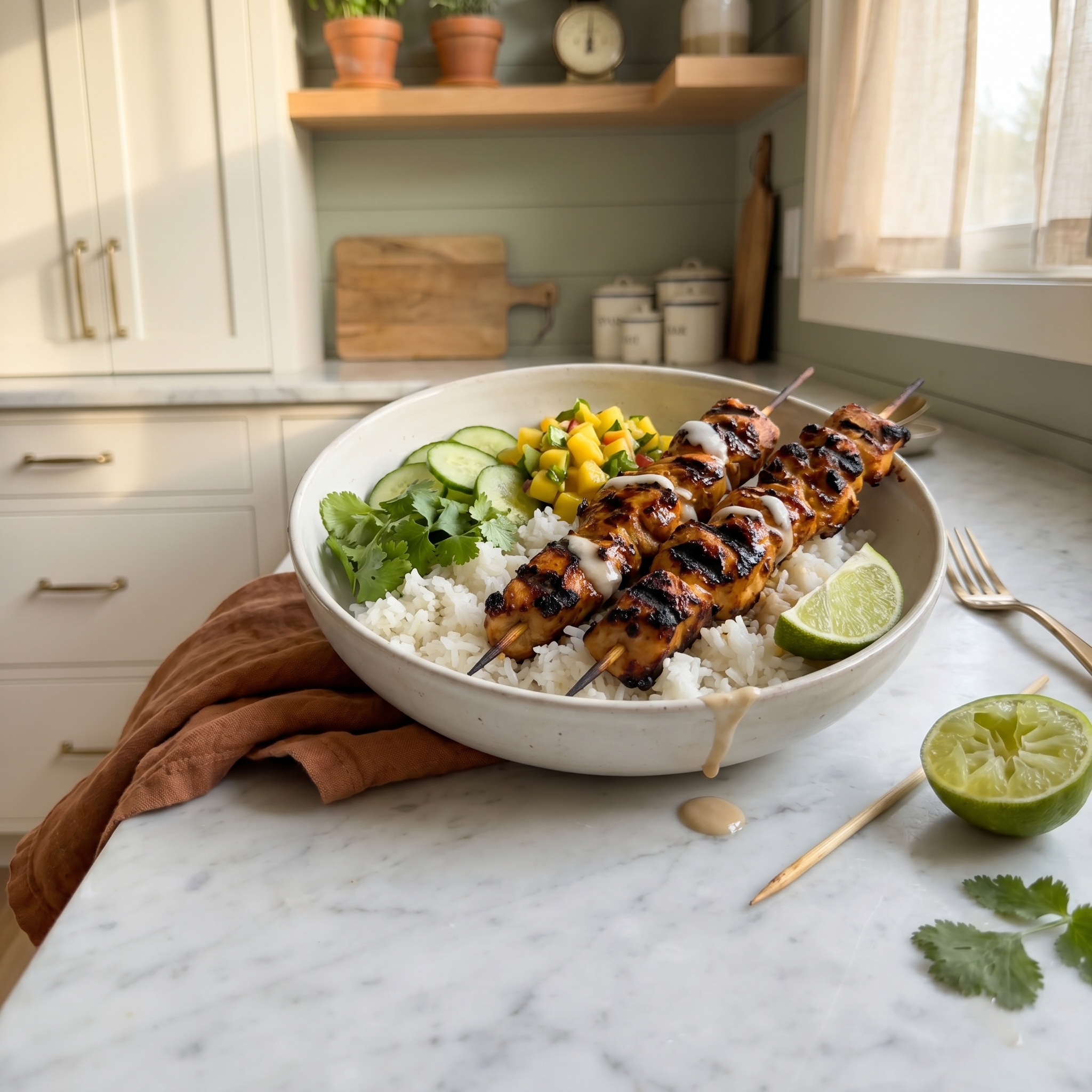
Irresistible Coconut Lime Grilled Chicken Skewer Rice Bowl: 9 Reasons This Dreamy 30-Minute Dinner Will Be Your Most-Made Recipe All Summer
It started with a trip to Hawaii I took three summers ago that I have never fully recovered from — not the flight or the sunburn or the price of everything, but the food. Specifically a plate of grilled chicken skewers from a roadside lunch spot on the North Shore of Oahu that cost eight dollars and changed my entire relationship with what a weeknight dinner could taste like. The chicken had been marinated in something coconut-based — I could smell it before I tasted it — and the lime came through so clearly it almost tasted like citrus in solid form, bright and sharp against the sweetness of the coconut and the char of the grill. It was served over rice with a quick cucumber salad and some kind of creamy sauce and I ate the whole thing in approximately four minutes and immediately wanted another one. I spent the rest of the trip thinking about how to recreate it at home. I spent most of the following October testing it. By November I had a version I was genuinely proud of, and I have made it at least twice a month since then without any sign of getting tired of it.
Have you ever eaten something at a restaurant or a food truck or on a vacation that lived in your memory for months afterward — not because it was complicated or expensive, but because the flavors were so clean and bright and perfectly balanced that you kept finding yourself thinking about it at random moments? These coconut lime grilled chicken skewer rice bowls are that recipe for me, translated into a format that comes together in thirty minutes on a weeknight with ingredients from any grocery store. The chicken marinates in a coconut milk and lime base that does extraordinary things to the texture and the flavor, the skewers come off the grill with a caramelized, golden-edged char that fills the whole backyard with an aroma that makes neighbors ask what you’re making, and the whole thing comes together in a rice bowl with cucumber, fresh herbs, and a drizzle of coconut lime sauce that ties every element together into something that tastes like you planned it for much longer than you did.
Whether you’re a weeknight home cook who needs a dinner that genuinely excites you rather than just sustaining you, someone who has been making the same three chicken recipes on rotation since February and is quietly desperate for something new, or a backyard griller who wants to expand beyond burgers and steaks into something more interesting without sacrificing simplicity — keep reading. This is the recipe that earns a permanent spot in your summer rotation, and it is considerably easier to make than it looks or tastes.
Table of Contents
Why This Recipe Works
Coconut lime grilled chicken works because the marinade is doing two completely different jobs simultaneously — the coconut milk tenderizes the chicken from the outside in while the fat in the coconut cream carries the lime, garlic, and ginger flavors deep into the meat, and the natural sugars in the coconut milk caramelize on the grill into that golden, slightly lacquered exterior that makes every skewer look restaurant-worthy. The rice bowl format takes what would already be a great protein and surrounds it with elements that make every bite more complete.
- ✔ On the table in 30 minutes with a 2-hour marinade window — The active work is minimal. Mix the marinade, submerge the chicken, walk away for two hours or overnight, thread the skewers, grill for twelve minutes. The marinade does the heavy lifting while you live your life.
- ✔ The most tender grilled chicken you’ve ever made — Coconut milk is naturally acidic and rich in fat, which together create a marinade that tenderizes muscle fibers and adds moisture to the meat simultaneously. Chicken thighs marinated in coconut milk overnight are so tender and juicy they practically fall apart on the grill in the best possible way.
- ✔ That caramelized coconut char on the grill — The natural sugars in coconut milk caramelize against hot grill grates in a way that plain olive oil marinades never achieve, creating a slightly lacquered, golden-edged exterior with real depth of flavor at every contact point.
- ✔ Bright, clean tropical flavor in every bite — The combination of fresh lime juice, lime zest, ginger, and garlic in the marinade produces a flavor profile that is simultaneously familiar and surprising — recognizable as grilled chicken, but brighter and more complex than any grilled chicken you’ve had from a standard marinade.
- ✔ The rice bowl format makes it a complete meal — Coconut jasmine rice as the base, cucumber and fresh herbs on top, a creamy coconut lime drizzle tying everything together — the bowl format turns four simple components into a complete, deeply satisfying dinner that requires no side dishes and no additional cooking.
- ✔ Impressive enough for company, fast enough for Tuesday — Grilled skewers over a rice bowl with colorful toppings and a sauce drizzle looks like a restaurant meal. The actual effort is a weeknight dinner. That gap between appearance and effort is the whole point.
- ✔ Meal-prep gold for the whole week — The marinated chicken keeps for three days raw or four days cooked, the coconut rice reheats beautifully, and the assembled bowls travel perfectly for work lunches. Make everything Sunday and eat well all week.
Let’s get into what you need to build this bowl from the marinade outward.
What You’ll Need
This recipe serves 4 generous bowls. Everything here is available at any grocery store, Trader Joe’s, or Walmart — the coconut milk and fish sauce may require a quick trip to the Asian foods aisle if you don’t already keep them on hand, but both are worth having in your pantry year-round for recipes like this one.
For the Coconut Lime Marinade
- 1½ lbs boneless, skinless chicken thighs — cut into 1½-inch pieces; thighs are strongly preferred over breast for this recipe for reasons detailed below
- 1 can (13.5 oz) full-fat coconut milk — not light coconut milk; the fat content is essential for both the tenderizing function and the caramelization on the grill
- Zest of 2 limes
- Juice of 2 limes — about 3 tablespoons
- 3 garlic cloves, grated on a microplane or very finely minced
- 1 tablespoon fresh ginger, grated — about a 1-inch piece; do not substitute powdered
- 2 tablespoons fish sauce — this is the secret ingredient that adds savory depth without tasting fishy in the finished dish; soy sauce works as a substitute
- 1 tablespoon honey or brown sugar
- 1 teaspoon turmeric — gives the chicken a beautiful golden color and a subtle earthy warmth
- ½ teaspoon cumin
- ½ teaspoon coriander
- ¼ teaspoon cayenne pepper
- ½ teaspoon kosher salt
For the Coconut Jasmine Rice
- 1½ cups jasmine rice, rinsed until the water runs clear
- 1 can (13.5 oz) full-fat coconut milk
- ¾ cup water
- ½ teaspoon kosher salt
- 1 teaspoon sugar
- Zest of 1 lime stirred in after cooking
For the Coconut Lime Drizzle Sauce
- 3 tablespoons full-fat coconut milk — skimmed from the top of a can
- 2 tablespoons mayonnaise — Hellmann’s
- 1 tablespoon fresh lime juice
- 1 teaspoon honey
- ½ teaspoon sriracha — more to taste
- Pinch of salt
- 1 to 2 tablespoons water to thin to a drizzleable consistency
For the Bowl Components
- 1 English cucumber, thinly sliced into rounds or half-moons
- 1 cup shredded red cabbage — for crunch and color
- 1 large ripe avocado, sliced
- ½ cup fresh cilantro leaves, roughly torn
- 3 scallions, thinly sliced on the diagonal
- 1 tablespoon toasted sesame seeds
- Lime wedges for serving
- Optional: thinly sliced fresh red chili or jalapeño for heat
For the Skewers
- 8 to 10 wooden or metal skewers — if using wooden, soak in cold water for at least 30 minutes before threading to prevent scorching
Optional Add-Ins and Upgrades
- Grilled pineapple chunks threaded between the chicken pieces on the skewer — caramelizes beautifully and adds a sweet, tropical note that is outstanding
- A quick mango salsa — diced mango, red onion, cilantro, lime juice, jalapeño — spooned over the finished bowl
- Pickled red onions made the night before — thin slices of red onion submerged in equal parts rice vinegar and water with a pinch of sugar and salt for an hour; they turn brilliant pink and add a sharp, bright counterpoint to the richness of the coconut
- A spoonful of sambal oelek or chili crisp drizzled over the top for serious heat lovers
- Edamame, shelled and warm, scattered over the bowl for extra protein and a pop of green
- Crispy fried shallots from a jar — available at Trader Joe’s and Asian grocery stores — scattered over the top for extraordinary crunch
Substitutions
Why thighs and not chicken breast for this recipe? Chicken thighs are the correct choice for grilled skewers in almost every situation, and especially in this recipe. Thighs have a higher fat content that keeps them juicy and forgiving on a grill — they can go a minute or two past done without drying out, which breast cannot. The coconut milk marinade works into thigh meat beautifully and the slightly denser, richer flesh holds up to the heat and the threading onto skewers without falling apart. Chicken breast cut into pieces for skewers dries out quickly on a grill and can become chalky before it’s properly charred on the outside. If you strongly prefer breast, cut the pieces slightly larger — 2-inch chunks — and pull them at exactly 165°F to prevent drying.
What if I don’t eat fish sauce? Soy sauce or tamari is a one-for-one substitute that delivers a similar savory depth. Worcestershire sauce at half the quantity adds a different but equally interesting complexity. For a fully fish-free, soy-free version, a teaspoon of miso paste dissolved in a tablespoon of warm water provides a fermented, savory depth that functions similarly to fish sauce in a marinade context. The fish sauce in this recipe does not make the finished chicken taste fishy at all — it simply amplifies the savory, umami depth of every other flavor in the marinade.
Can I make this without a grill? A grill pan on the stovetop over high heat produces excellent results — good char marks, similar caramelization, and the same moisture-preserving qualities of the coconut marinade. Preheat the grill pan for 3 full minutes over high heat before the skewers go on, and work in batches to avoid crowding. An oven broiler set to high with the rack in the top position is the other option — broil for 5 to 6 minutes per side on a foil-lined baking sheet, watching closely for caramelization. Both methods produce genuinely good results; the grill produces the best flavor from the slight smokiness that carries through the coconut-caramelized crust.
🧑🍳 Chef’s Note — Marinade Time: The minimum effective marinating time for coconut lime chicken is 2 hours — long enough for the coconut milk acids and fat to begin penetrating the outer layer of the meat and for the aromatics to start infusing. Four hours is noticeably better. Overnight — 8 to 12 hours — is where this marinade reaches its full potential, producing chicken that is deeply flavored all the way through with a texture so tender it practically melts on the grill. Do not marinate longer than 24 hours; the acids in the lime juice will eventually start breaking down the proteins in a way that produces a slightly mushy exterior rather than the firm, juicy texture you’re going for. Overnight is the sweet spot and it requires zero day-of prep beyond threading the skewers.
🧑🍳 Chef’s Note — Coconut Rice: Cooking the jasmine rice in coconut milk instead of water is not a subtle upgrade — it is a transformative one. The rice absorbs the coconut fat and the natural sweetness of the coconut milk during cooking, producing grains that are subtly rich, slightly fragrant, and have a delicate sweetness that pairs with the lime and the charred chicken in a way that plain rice simply does not. Rinse the rice until the water runs clear before cooking to remove excess starch, which would otherwise make the coconut milk rice gummy. The teaspoon of sugar and the lime zest stirred in after cooking are small additions that make a real difference — the sugar amplifies the coconut sweetness and the lime zest connects the rice to the citrus flavors running through the entire bowl.
How to Make Coconut Lime Grilled Chicken Skewer Rice Bowls — Step by Step
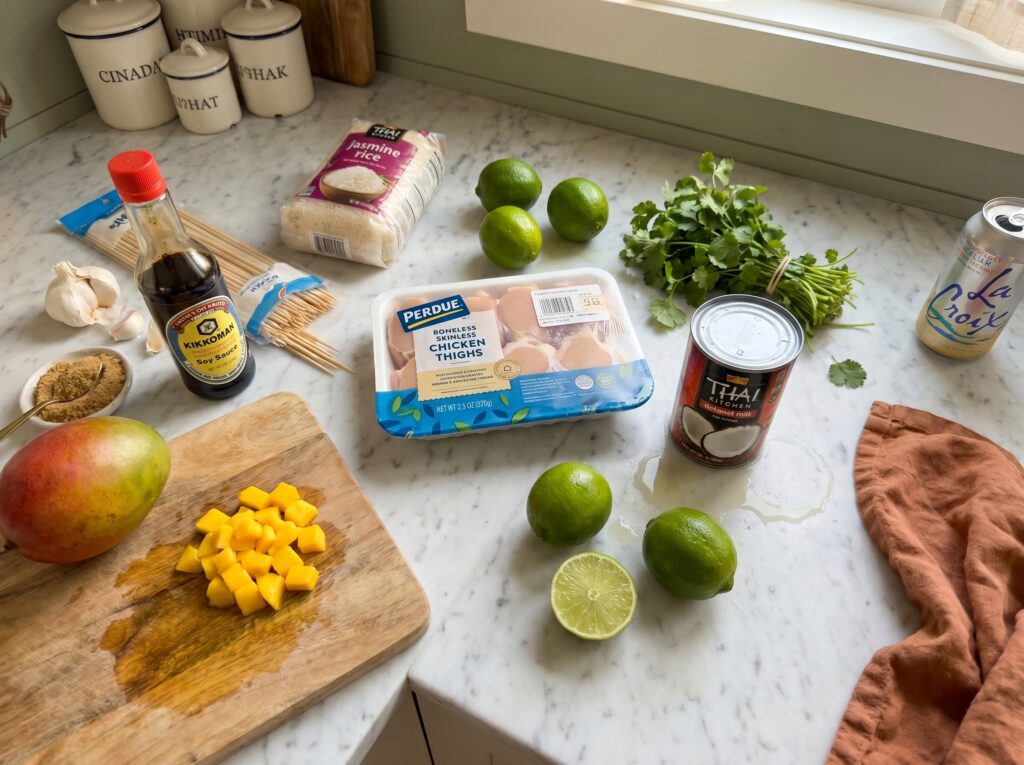
- Make the marinade and get the chicken into it as early as possible — ideally the night before. In a medium bowl or large zip-top bag, whisk together the full can of coconut milk, lime zest, lime juice, grated garlic, grated ginger, fish sauce, honey, turmeric, cumin, coriander, cayenne, and salt until smooth and completely combined. Taste it — the raw marinade should taste boldly seasoned, bright from the lime, fragrant from the ginger and aromatics, with a detectable heat from the cayenne. It will taste slightly more intense than you want the finished chicken to taste, which is correct — the intensity mellows as it marinates and cooks. Add the chicken pieces, submerge completely, seal or cover, and refrigerate for a minimum of 2 hours and a maximum of 24 hours.
💡 Pro Tip: Start the coconut jasmine rice before you do anything else on grill day — it takes 20 minutes and is completely hands-off, and having it ready and resting before the chicken comes off the grill means the bowl goes together in under two minutes per serving. Rice that’s been resting for 10 minutes with the lid on is more evenly cooked, more fluffy, and more flavorful than rice served immediately out of the pot. Get it going first, walk away, and let it do its thing while you prep and grill everything else.
- Cook the coconut jasmine rice while you prep the skewers. Combine the rinsed jasmine rice, full can of coconut milk, ¾ cup of water, salt, and sugar in a medium saucepan and bring to a boil over medium-high heat, stirring once. The moment it reaches a full boil, drop the heat to the lowest setting, cover tightly with a lid, and cook for 18 minutes without lifting the lid. Remove from heat and let it steam, covered, for an additional 5 minutes. Fluff with a fork and stir in the lime zest immediately. The rice should be tender, slightly glossy with coconut fat, and fragrant — taste it and adjust the salt if needed.
- Make the coconut lime drizzle sauce and refrigerate until serving. In a small bowl, whisk together the coconut milk, mayonnaise, lime juice, honey, sriracha, and salt until smooth. Thin with water one teaspoon at a time until the sauce falls in a thin, steady stream from a spoon — it should drizzle cleanly rather than dropping in heavy globs. Taste and adjust the sriracha for heat and the lime for brightness. Refrigerate. Like most drizzle sauces, this one improves significantly with even 15 minutes of rest as the flavors integrate.
💡 Pro Tip: Pull the marinated chicken from the refrigerator 30 minutes before grilling and let it come toward room temperature. Cold chicken straight from the fridge hits a hot grill and creates a temperature differential that causes the exterior to cook much faster than the interior — you end up with a beautifully charred outside and an undercooked center, or an overcooked exterior by the time the center is done. Room temperature chicken cooks more evenly from edge to center and develops better caramelization because the surface moisture has time to evaporate slightly rather than steaming off the grill.
- Thread the marinated chicken onto soaked wooden or metal skewers, shaking off excess marinade as you go. Skewer the chicken pieces with a slight gap between each one — pieces that are jammed tightly together steam rather than grill at the contact points. Allow roughly 4 to 5 pieces per skewer. As you thread, shake off any large pools of excess coconut marinade — a thin coating is what you want. Too much marinade on the surface creates flare-ups from the dripping coconut fat and can cause the sugars to burn before the chicken is cooked through. A light, even coating caramelizes beautifully. A thick, dripping coating burns.
- Preheat your grill to medium-high heat — around 400 to 425°F — and oil the grates. Clean the grates with a brush while they heat, then oil them thoroughly with a paper towel dipped in neutral oil held with tongs — do this right before the skewers go on, not ten minutes before. The natural sugars in the coconut marinade will stick aggressively to un-oiled grates, tearing the caramelized crust when you try to flip the skewers. Well-oiled grates release the skewers cleanly when the caramelization is fully developed. Set up two zones if possible — direct heat for charring, indirect heat for finishing if the exterior is coloring faster than the interior is cooking through.
- Grill the skewers over direct medium-high heat, turning every 3 to 4 minutes to develop char on all sides. Lay the skewers across the grill grates and close the lid. Cook for 3 to 4 minutes undisturbed until the chicken releases naturally from the grates and shows deep golden caramelization on the contact side. Turn and repeat on the remaining sides — the goal is charred color on all four exposed surfaces of the chicken, with the coconut sugars visibly caramelized and darkened at the edges. Total grill time is 12 to 15 minutes. Pull the skewers when an instant-read thermometer reads 165°F in the thickest piece.
💡 Pro Tip: In the last 2 minutes of grilling, brush the skewers with a thin coat of the leftover marinade that has been brought to a boil in a small saucepan — boiling the reserved marinade for 2 minutes makes it safe to use as a basting sauce and concentrates it into a slightly thicker glaze. This final glaze coat caramelizes against the already-charred chicken in the last minutes of heat and creates a deep, lacquered exterior that looks extraordinary on the plate. Never use raw marinade as a basting sauce without boiling it first.
- Rest the skewers for 5 minutes off the grill before building the bowls. Set them on a cutting board or plate, tent loosely with foil, and let them rest. The resting period allows the juices to redistribute throughout the meat — chicken skewers slid immediately off the grill and into a bowl will release their juices into the rice rather than staying in the meat where they belong. Five minutes is enough. Use the time to slice the cucumber, halve the avocado, and set out the topping components.
- Build the bowls starting with a generous scoop of coconut jasmine rice. Spoon a generous portion of the coconut rice into each bowl as the base — about ¾ cup per serving. Fluff it one more time as you scoop so it’s light and separate rather than packed and dense. Slide the grilled chicken off the skewers directly onto the rice — use a fork to push the pieces off cleanly — and arrange them in a loose pile or a neat row depending on how much presentation effort you feel like making. Both look good. One takes thirty additional seconds.
- Add the toppings, drizzle the sauce, and finish with lime and fresh herbs right before serving. Arrange the sliced cucumber, shredded red cabbage, and sliced avocado around and over the chicken. Scatter the cilantro, sliced scallions, and sesame seeds generously over the entire bowl. Drizzle the coconut lime sauce across everything in a generous zigzag — don’t be conservative with it, the sauce is one of the best elements of the bowl. Squeeze a lime wedge directly over the top. Add sliced chili if using. Serve immediately — the warm rice, warm chicken, cold cucumber, and creamy avocado are best experienced together while the temperature contrast between them is at its most dramatic.
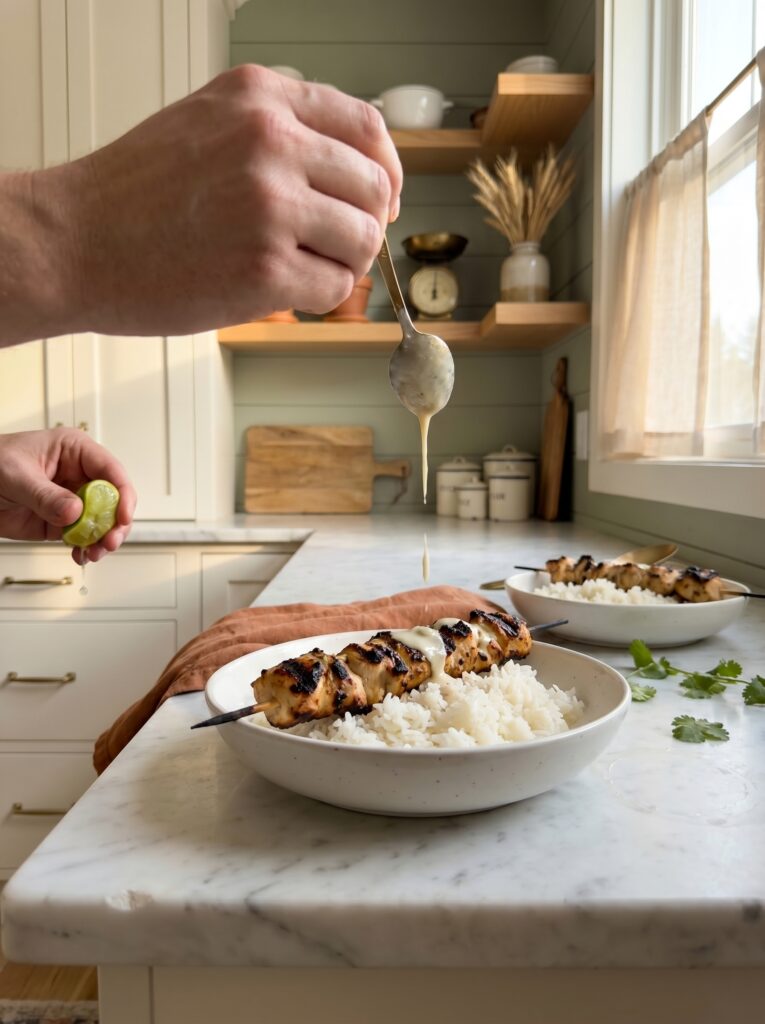
From the moment you pull the chicken from the marinade to the moment you sit down with a finished bowl, you’re looking at about 30 minutes of cooking time — and two hours to overnight of hands-off marinating that you’re not present for. This is the rare recipe where the best version requires the most advance planning and the least day-of work. Put the chicken in the marinade before you go to bed. Wake up, cook rice, grill skewers, build bowls. That is the whole program and it consistently produces one of the best dinners of the summer.
How to Serve It
These coconut lime grilled chicken skewer rice bowls are built for flexibility — beautiful enough for a dinner party, practical enough for weekday meal prep, festive enough for a summer backyard gathering where you want to serve something more interesting than burgers. Here are five ways to bring them to the table.
- ☕ Classic Weeknight Dinner Bowl: Build individual bowls in wide, deep soup bowls — coconut rice base, chicken slid off the skewers, cucumber, cabbage, avocado, cilantro, scallions, sesame seeds, and a generous drizzle of the coconut lime sauce finishing everything. Set a lime wedge on the rim of each bowl. Carry them to the table and eat them while everything is at optimal temperature — warm chicken, warm rice, cool cucumber and avocado. This is the format that makes a Tuesday feel like a destination.
- 🥞 Dinner Party Family-Style Platter: Arrange the finished skewers on a long serving platter over a bed of coconut rice, with the toppings — cucumber, cabbage, avocado, herbs — arranged around and over the skewers in colorful sections. Drizzle the coconut lime sauce over the entire platter and set lime wedges at the ends. Bring it to the table whole and let people serve themselves. This presentation is visually stunning — the golden charred chicken against the white rice and the vivid green herbs and bright orange chili — and requires almost no additional plating effort beyond the cooking itself.
- 🌸 Meal-Prep Lunch Containers: Pack the components separately in meal-prep containers — rice and chicken together, cucumber and cabbage in a small side container, avocado added fresh at eating time with a squeeze of lime to prevent browning. Store the coconut lime sauce in a small sealed container. Each morning, grab a container and a lime from the fridge. At lunch, add fresh avocado from a whole avocado kept at room temperature, drizzle the sauce, and eat something that feels like a restaurant bowl for about three dollars. This setup handles four to five lunches from one Sunday cooking session.
- 📚 Build-Your-Own Skewer Bowl Bar: Set up a full spread for a backyard dinner party — skewers on a platter, coconut rice in a large bowl, and all the toppings in individual small bowls: cucumber, cabbage, avocado slices, mango salsa, pickled red onions, cilantro, scallions, sesame seeds, chili, the coconut lime sauce in a small pitcher. Let guests build their own bowls. The interactive format makes the dinner feel festive and communal, accommodates different preferences naturally, and requires zero individual plating on your part. This is the easiest impressive dinner party format in summer grilling.
- 🎃 Coconut Lime Chicken Skewer Tacos: Take the same grilled chicken and slide it off the skewers into warm corn tortillas instead of a rice bowl — add a spoonful of mango salsa, a drizzle of the coconut lime sauce, and a scatter of fresh cilantro and thinly sliced red cabbage. The coconut lime chicken in a corn tortilla with mango and cilantro is a tropical taco variation that is extraordinary and uses every element of this recipe in a different format. Make both the bowls and the tacos at the same cookout and give people the option — this format generates more genuine excitement around a dinner table than almost any other single recipe I know.
However you serve it, always add the avocado, fresh cilantro, and lime squeeze at the very last moment — avocado browns quickly, fresh herbs wilt against warm food within minutes, and fresh lime juice over the finished bowl right before eating is one of the most important flavor contributions in the entire recipe. Build the bowl, add the fresh elements, eat immediately.
Storage & Make-Ahead Tips
Cooked chicken — Refrigerator: Store cooked grilled chicken skewers — slid off the skewers and stored flat — in an airtight container in the refrigerator for up to 4 days. Reheat in a skillet over medium heat with a splash of water or coconut milk for 2 to 3 minutes, covered, until warmed through without drying out. Alternatively, microwave covered with a damp paper towel for 60 to 75 seconds. The reheated chicken is excellent — the coconut marinade seems to preserve moisture through refrigeration and reheating better than most marinades, and day-two chicken has an even more deeply integrated coconut lime flavor than the freshly grilled version.
Raw marinated chicken — Refrigerator: The chicken can stay in the marinade in the refrigerator for up to 24 hours before cooking — this is the intended make-ahead approach and the one that produces the best finished flavor. Beyond 24 hours, the lime juice acids begin to affect the protein structure of the outer meat in a way that produces a slightly mushy texture rather than the firm, juicy result you’re going for. Marinate overnight, cook the next day.
Coconut jasmine rice — Refrigerator: Store leftover coconut rice in an airtight container in the refrigerator for up to 5 days. Reheat with a splash of water or coconut milk stirred in before microwaving — the added liquid steams the rice back to its original fluffy texture. Without added liquid, refrigerated rice reheats dry and slightly gummy. A tablespoon of coconut milk stirred into a portion of leftover rice before microwaving is one of the simplest improvements to leftover rice reheating you can make.
📅 Make-Ahead Tip: The ideal prep schedule for this recipe is to marinate the chicken Thursday or Friday evening for a weekend dinner, or Sunday evening for weeknight meal prep. Saturday or weeknight, the only cooking involved is the 20-minute rice and the 15-minute grill. Make the coconut lime sauce at the same time as the marinade — it keeps for a week in the fridge and improves with time. This two-step advance prep turns a 30-minute dinner into a 20-minute dinner with better results, which is the only reason to make a plan at all.
Coconut lime sauce — Refrigerator: The drizzle sauce keeps in a sealed jar in the refrigerator for up to 7 days. It thickens slightly when cold — stir in a teaspoon of water and whisk to restore the drizzleable consistency before serving. The sauce improves noticeably over the first 24 hours as the lime juice, honey, and sriracha integrate into the coconut and mayo base. Make a double batch and use it on grilled shrimp, roasted vegetables, grain bowls, and fish tacos throughout the week.
Helpful Tips & Common Mistakes
These five mistakes are the ones that most consistently prevent coconut lime grilled chicken from being as extraordinary as it should be — and every fix is simple once you understand what’s actually happening.
✗ Mistake: Using light coconut milk instead of full-fat because it seemed like a reasonable substitution, and ending up with chicken that doesn’t caramelize properly on the grill and tastes thin and flat compared to what this marinade is supposed to produce.
✓ Fix: Always use full-fat coconut milk — the fat content is doing two essential jobs in this recipe that light coconut milk cannot replicate. The fat carries fat-soluble flavor compounds from the garlic, ginger, and spices deep into the meat during marinating, and the natural coconut sugars in full-fat coconut milk are what caramelize against the hot grill grates into that gorgeous golden lacquered exterior. Light coconut milk has had most of the fat removed and doesn’t perform either function adequately.
✗ Mistake: Threading the chicken pieces too tightly on the skewer so they’re pressed together, then pulling off skewers where the contact points between pieces are gray and steamed rather than charred and caramelized.
✓ Fix: Leave a small gap — just a few millimeters — between each chicken piece on the skewer. Air needs to circulate around each piece for the heat to reach all surfaces and for moisture to escape rather than steaming between the pieces. Tightly packed skewers cook unevenly and produce undercooked, steamed contact points between pieces that are unpleasant in texture and appearance. Slightly spaced pieces grill evenly on all sides.
✗ Mistake: Not rinsing the jasmine rice before cooking it in coconut milk and ending up with gummy, clumped coconut rice where the grains have stuck together into a dense mass instead of staying separate and fluffy.
✓ Fix: Rinse the rice under cold water in a fine-mesh strainer, stirring with your hand, until the water running through it is nearly clear — this takes about 60 seconds and removes the surface starch on the grains that causes clumping during cooking. Unrinsed jasmine rice cooked in the high-fat environment of coconut milk clumps dramatically more than rinsed rice cooked in water. The rinse takes 60 seconds and produces a completely different, dramatically better result.
✗ Mistake: Leaving too much excess marinade on the skewers when they go on the grill, causing constant flare-ups from the dripping coconut fat and ending up with burned, bitter exterior spots before the chicken is cooked through.
✓ Fix: Shake each threaded skewer vigorously over the marinade bag or bowl to remove excess before it goes on the grill. You want a thin, even coating of marinade — enough to provide flavor and caramelization — not dripping puddles of coconut milk that create fat fires on the grill grates. If you’re getting flare-ups anyway, move the skewers to the indirect heat zone temporarily until the flames die down, then return to direct heat to finish the caramelization.
✗ Mistake: Building the entire bowl including the avocado and fresh herbs 10 minutes before people are ready to eat because you wanted to be ahead of things, and carrying beautifully arranged bowls to the table where the avocado has browned, the cilantro has wilted against the warm rice, and the cucumber has released liquid into the sauce.
✓ Fix: Build everything except the avocado, fresh herbs, and lime squeeze right up to 15 minutes in advance if needed. Add the avocado, cilantro, scallions, and lime squeeze in the 60 seconds before the bowl goes in front of a person. Fresh avocado browns within minutes once sliced, fresh herbs wilt against warm food quickly, and lime juice is best when its volatile aromatics are fully intact — which means adding it immediately before eating. The finished bowl takes 90 seconds to top and finish. That 90 seconds is worth every second.
Recipe Variations
The coconut lime marinade and rice bowl format in this recipe are a framework that adapts beautifully to different proteins, flavor profiles, and seasonal produce. Here are four variations that are all genuinely worth making.
🍤 Coconut Lime Grilled Shrimp Skewer Bowl: Replace the chicken thighs with 1½ lbs of large shrimp — 16 to 20 count — peeled and deveined. The marinade time drops to 30 minutes maximum since the lime acids will cook the shrimp if left too long. Thread 4 to 5 shrimp per skewer, grill over high heat for 2 to 3 minutes per side until pink and just cooked through with char marks at the tail ends. Shrimp cook faster and with more dramatic visual caramelization than chicken in a coconut lime marinade — the char develops in under 3 minutes per side. Serve over the same coconut rice with the same toppings plus a quick mango salsa spooned over the top. This is the faster, lighter, summer-party-showstopper version of the original.
🌿 Coconut Lime Tofu Skewer Bowl: Press an extra-firm tofu block under a heavy pan for 30 minutes to remove as much moisture as possible, then cut into 1½-inch cubes and marinate in the full coconut lime marinade for 4 hours or overnight. Tofu is surprisingly excellent in this marinade — it absorbs the coconut lime flavors deeply and caramelizes beautifully on the grill if the grates are well-oiled and the heat is high enough. Grill for 3 to 4 minutes per side until golden and slightly charred at the edges. Serve over the coconut rice with all the same toppings plus a drizzle of chili crisp for heat. This is a fully plant-based bowl that does not feel like a compromise — it feels like a genuinely great dinner.
🥥 Thai-Inspired Coconut Peanut Chicken Bowl: Keep the coconut lime marinade exactly as written but add 2 tablespoons of peanut butter and 1 tablespoon of soy sauce to it — whisk until smooth before adding the chicken. Make a quick peanut sauce for the bowl instead of the coconut lime drizzle: 3 tablespoons of peanut butter, 2 tablespoons of soy sauce, 1 tablespoon of lime juice, 1 tablespoon of honey, 1 teaspoon of sriracha, and enough warm water to thin to a drizzleable consistency. Top the bowl with the peanut sauce, crushed roasted peanuts, fresh cilantro, sliced scallions, and shredded carrots alongside the cucumber. The Thai peanut direction is a natural extension of the coconut lime base and produces a bowl that is deeply familiar and deeply satisfying in a slightly different way than the original.
🍍 Coconut Lime Chicken and Pineapple Skewer Bowl: Cut fresh pineapple into 1½-inch chunks and alternate them with the chicken pieces on each skewer — roughly 3 chicken pieces and 2 pineapple chunks per skewer. The pineapple caramelizes against the grill in the same coconut marinade that coats the chicken, developing a deep, jammy, slightly smoky sweetness that is one of the great grilling transformations of summer. The natural acidity of the pineapple also bastes the chicken as the juice runs down the skewer during grilling, keeping the chicken pieces adjacent to the fruit particularly moist and flavorful. Serve with a quick pineapple-lime relish on top — finely diced fresh pineapple, lime juice, cilantro, and a pinch of red pepper flakes — instead of mango salsa for a pure tropical flavor experience that is genuinely transportive.
Final Thoughts
That eight-dollar plate of grilled chicken from the North Shore roadside stand is still the flavor memory I cook toward every time I make this recipe — that specific brightness of coconut and lime against charred chicken over fragrant rice, eaten in the open air with nothing more complicated than good hunger and a good appetite. Three years of testing and refining later, this coconut lime grilled chicken skewer rice bowl is as close as I have gotten to that memory, and some days I think it might actually be better — because I can make it on a Wednesday in Tennessee with ingredients from Trader Joe’s and a backyard grill and a bowl I already own. That kind of accessibility to something genuinely extraordinary is what cooking at home is supposed to be about, and this recipe delivers it every single time.
Make it this week — tonight if the grill is calling and you have chicken in the fridge — and tell me what you think. Leave a ⭐⭐⭐⭐⭐ rating below, tag @zippydishes on Pinterest with your beautiful bowl, and share this with everyone you know who needs a new summer chicken recipe that actually gets them excited about dinner again. This is the one. 🥥🍋🔥
Frequently Asked Questions
What does coconut lime grilled chicken taste like?
It tastes like a grilled chicken that has been genuinely transformed by its marinade rather than just coated by it. The coconut milk penetrates the meat during marinating and emerges during cooking as a caramelized, slightly sweet exterior with a subtle tropical richness that is unlike anything you get from an oil-based marinade. The lime comes through clearly and brightly — not as sourness but as a vivid citrus note that makes the chicken taste fresh and alive rather than heavy. The ginger and garlic sit underneath both flavors as a savory, aromatic foundation, and the turmeric gives the exterior a beautiful golden color with a subtle warmth. Against the coconut jasmine rice and the cool cucumber and the creamy avocado, the complete bowl tastes like a carefully composed restaurant dish that happens to have been made in thirty minutes in a home kitchen.
How long should I marinate the chicken?
The minimum effective marinating time is 2 hours — long enough for the coconut milk fat to begin carrying the aromatics into the outer layer of the meat. Four hours produces noticeably better results with more deeply integrated flavor throughout the chicken rather than just on the surface. Overnight — 8 to 12 hours — is the gold standard and the approach I’d always recommend if you can plan ahead: the chicken is more tender, more flavorful, and more evenly seasoned all the way through. Do not exceed 24 hours; the lime juice acids will begin breaking down the protein structure of the outer meat past the point of tenderness into mushiness. Overnight marinating requires one minute of work the evening before and produces the best possible result — it is the most efficient use of your hands-off time in this entire recipe.
Can I use chicken breast instead of chicken thighs?
You can, but the results are meaningfully different and the margin for error is much smaller. Chicken thighs have a higher fat content that keeps them juicy and forgiving through the high heat of grilling — they can tolerate a minute or two past done without drying out, which makes them ideal for skewers where heat distribution is uneven. Chicken breast is leaner, dries out faster, and can become chalky on a grill before the exterior has had time to develop real caramelization. If you prefer breast, cut the pieces slightly larger than the recipe calls for — 2-inch chunks rather than 1½-inch — to give the interior more thermal mass and more time before the exterior overcooks. Pull at exactly 165°F and don’t leave them on the grill a moment longer. The coconut milk marinade helps breast stay juicier than it would with a standard marinade, but it cannot fully compensate for the structural difference between the two cuts.
What can I substitute for fish sauce?
Fish sauce in this marinade is doing one specific job — adding deep, fermented umami depth that makes the coconut and lime flavors taste more complex and rounded than they would without it. The finished chicken does not taste fishy at all; the fish sauce disappears completely during marinating and cooking and leaves only its savory, depth-adding effect behind. The most seamless substitute is soy sauce at the same quantity — it provides similar umami depth with a slightly different character. Tamari works identically for a gluten-free version. A teaspoon of miso paste dissolved in a tablespoon of warm water is a particularly good substitute for its fermented depth. Worcestershire sauce at half the quantity adds complexity in a different direction. The recipe is still excellent without any of these substitutes, but the fish sauce version has a depth that is difficult to achieve otherwise.
Can I make this recipe without a grill?
A cast-iron grill pan on the stovetop is the best no-grill alternative — it produces genuine char marks and good caramelization from the coconut sugars with the right technique. Preheat the grill pan over high heat for 3 full minutes before any skewers touch it, then cook the skewers exactly as you would on an outdoor grill, turning every 3 to 4 minutes. The main limitation is ventilation — a coconut milk marinade caramelizing in a hot indoor pan produces significant smoke, so have the range hood running at full capacity and a window open. An oven broiler set to high is the other option — place skewers on a foil-lined baking sheet on the top rack and broil for 5 to 6 minutes per side, watching carefully. Both methods produce genuinely good results; the outdoor grill produces the best flavor from the smokiness that the coconut caramelization absorbs.
Is coconut jasmine rice difficult to make?
It is exactly as easy as regular steamed rice — you just replace the cooking water with a combination of coconut milk and a smaller amount of water. The ratio in this recipe — one can of full-fat coconut milk plus ¾ cup of water for 1½ cups of dry jasmine rice — has been tested many times and produces fluffy, separate grains rather than gummy clumped rice, provided you rinse the rice thoroughly first. The most common mistake is skipping the rice rinse, which removes the surface starch that causes clumping in the high-fat coconut milk cooking environment. Rinse until the water runs clear — about 60 seconds — and the rice cooks perfectly every time. The rest is identical to regular rice: bring to boil, drop to lowest heat, cover, 18 minutes, steam 5 minutes covered, fluff with fork. Add the lime zest after the fluff. Done.
How do I keep the avocado from browning in meal-prep bowls?
The simplest and most effective approach is to not slice the avocado until right before eating. For meal-prep containers, keep one whole avocado at room temperature and slice it fresh each morning or at lunchtime — a whole uncut avocado keeps perfectly at room temperature for two to three days and in the refrigerator for up to a week. If you must prep sliced avocado in advance, toss the slices thoroughly in lime juice, press plastic wrap directly against the surface of the avocado to block air contact, and refrigerate — the lime juice slows oxidation and the air barrier prevents browning for up to 24 hours. For packed bowls, store the sliced avocado in a separate small container with a squeeze of lime juice and add it to the bowl at eating time. Brown avocado is safe to eat but visually unappetizing and slightly bitter in flavor — fresh avocado is always worth the thirty-second extra step.
What sides pair well with this rice bowl besides what’s already in it?
The bowl is designed to be a complete meal on its own, but if you’re serving it at a dinner party or cookout and want to add dishes alongside, the best companions are light, bright, and acidic enough to contrast with the richness of the coconut. A simple Thai-inspired cucumber salad — thinly sliced cucumber, rice vinegar, a pinch of sugar and salt, sesame oil, and crushed red pepper — is the most natural pairing. Grilled bok choy halves charred cut-side down for 3 minutes provide a slightly bitter, smoky green vegetable that plays beautifully against the sweet coconut. A mango avocado salad with lime dressing and chili flakes adds color and tropical brightness. For a heartier spread, a platter of fresh summer rolls with peanut dipping sauce alongside the bowls creates a full Southeast Asian-inspired summer dinner that is both visually stunning and genuinely extraordinary to eat.