
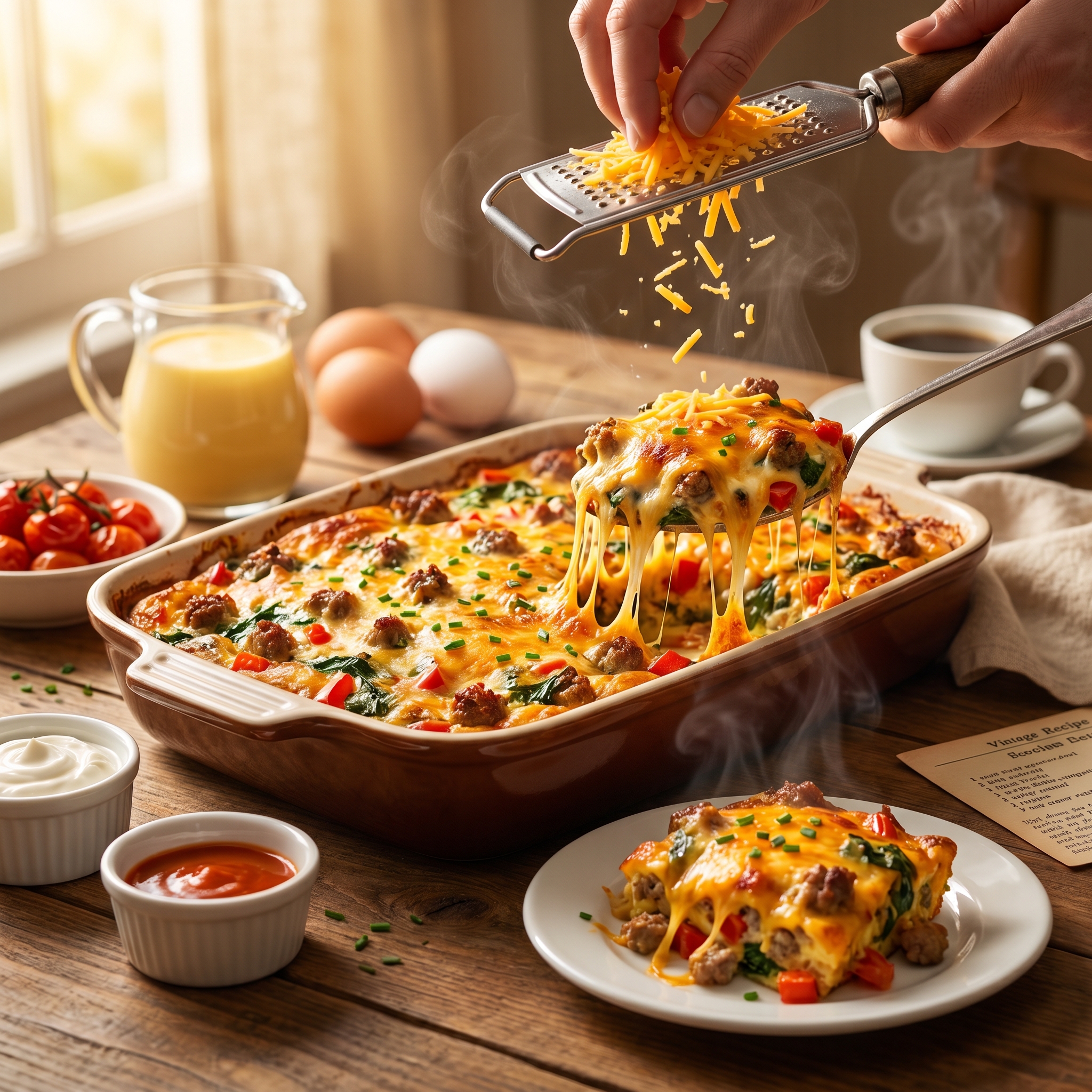
The Best Make-Ahead Breakfast Casserole for a Brunch Crowd — Cheesy, Hearty, and Ready Before Your First Cup of Coffee
We have all been there — it is 7 a.m. on Christmas morning, the house is full of family, everyone is hungry and buzzing with excitement, and you are somehow supposed to produce a hot, hearty, impressive brunch for twelve people while simultaneously opening gifts, refilling coffee, and keeping the dog out of the living room. If that scenario makes your stomach tighten just a little, this recipe is about to change your entire holiday morning. This make-ahead breakfast casserole gets assembled the night before, slides into the fridge while you sleep, and bakes itself into golden, cheesy, bubbling perfection while your guests are still in their pajamas. You get to actually enjoy the morning instead of spending it glued to the stove.
Be honest — when was the last time you hosted a brunch and actually sat down and relaxed with your guests instead of running back to the kitchen every five minutes? A great make-ahead breakfast casserole is the answer to that problem, and this one specifically is the recipe people beg for the address of after they eat it. Layers of buttery bread cubes, savory breakfast sausage, sautéed peppers and onions, and sharp cheddar cheese all soaked overnight in a rich, seasoned egg custard — it bakes up into something that is simultaneously fluffy and hearty, creamy and crispy on top, and deeply satisfying in every single bite.
Whether you are hosting Easter brunch, Thanksgiving morning, a holiday open house, a baby shower, or just a big Sunday family breakfast that you want to actually enjoy, keep reading. I am sharing every tip and trick I have learned for making this recipe foolproof, including the overnight rest technique that makes this casserole so much better than anything you could throw together the same morning.
Table of Contents
Why This Recipe Works
This is not just a good breakfast casserole — it is the smartest breakfast casserole, and here is exactly why it belongs in your entertaining rotation permanently:
- ✔ Completely assembled the night before — the entire dish is ready to go in the fridge before you go to bed so morning is completely stress-free
- ✔ Feeds 10 to 12 people from one dish — no flipping pancakes one at a time, no scrambling eggs in batches, just one glorious dish that feeds the whole crowd at once
- ✔ The overnight soak is the secret weapon — the bread absorbs the egg custard completely overnight and bakes up into something far more custardy, cohesive, and deeply flavored than any same-day version
- ✔ Uses simple, budget-friendly ingredients that you can find at any grocery store for under $20 total
- ✔ Customizable for any crowd — swap the sausage for bacon or ham, change up the vegetables, swap the cheese — the base recipe is endlessly adaptable
- ✔ Kid-approved and adult-obsessed — there is genuinely not a person at any table who has turned down a second helping of this
- ✔ Leftovers reheat beautifully for easy weekday breakfasts all week long — meal prep gold hiding in plain sight
The overnight rest transforms this from a simple egg bake into something that tastes like it took genuine skill and effort — and your guests will absolutely believe that. Let’s get into the ingredients.
What You’ll Need
Straightforward, crowd-pleasing ingredients — nothing fancy, everything delicious.
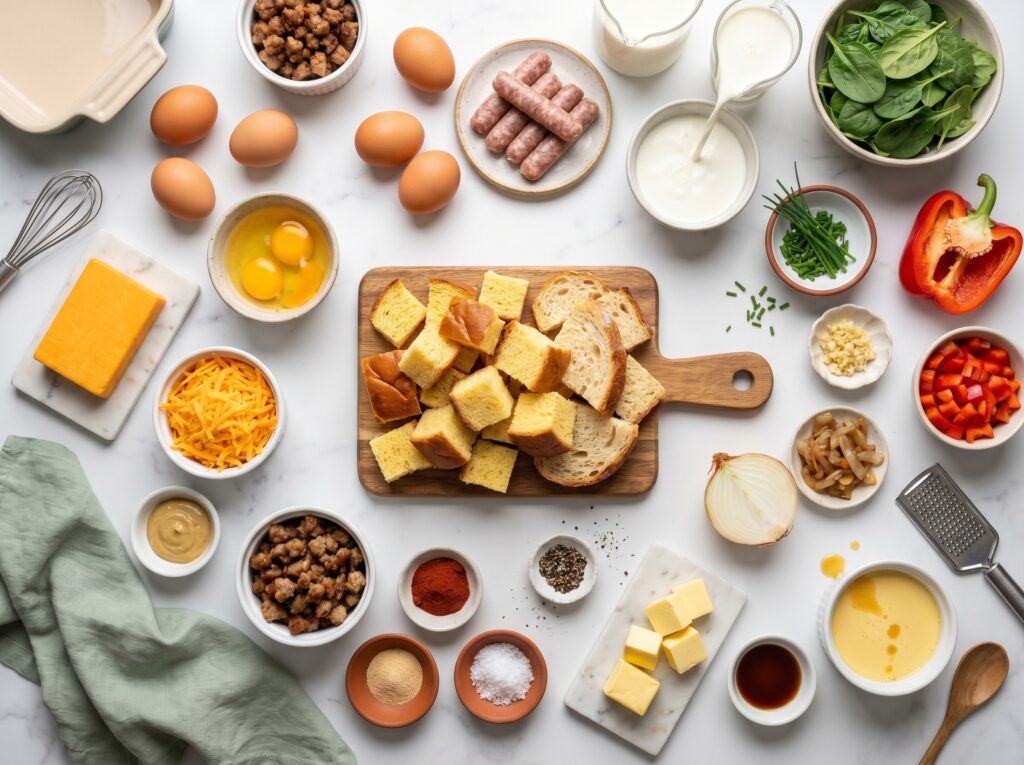
For the Casserole Base
- 1 lb ground breakfast sausage (mild or hot — your call)
- 1 loaf (about 12 oz) day-old French bread or sourdough, cut into 1-inch cubes — roughly 8 to 10 cups
- 1 medium yellow onion, diced
- 1 red bell pepper, diced
- 1 green bell pepper, diced
- 3 cloves garlic, minced
- 2 cups sharp cheddar cheese, freshly shredded and divided — never pre-shredded from a bag
- ½ cup Gruyère or Monterey Jack, shredded (optional but spectacular)
- 2 tablespoons unsalted butter for sautéing
For the Egg Custard
- 10 large eggs
- 2½ cups whole milk
- ½ cup heavy cream
- 1 tablespoon Dijon mustard
- 1 teaspoon garlic powder
- 1 teaspoon onion powder
- 1 teaspoon kosher salt
- ½ teaspoon black pepper, freshly ground
- ½ teaspoon smoked paprika
- ¼ teaspoon cayenne pepper (optional — adds a gentle background warmth)
- 2 tablespoons fresh chives or flat-leaf parsley, finely chopped
For Topping
- ½ cup sharp cheddar cheese, reserved for topping
- ½ teaspoon smoked paprika for color
- Fresh chives or parsley for garnish after baking
Substitutions
No breakfast sausage? Diced ham, crumbled cooked bacon, or Italian sausage all work beautifully. For a vegetarian version, skip the meat entirely and double the vegetables — add sautéed mushrooms, baby spinach, and sun-dried tomatoes for a meatless version that is every bit as hearty and satisfying as the original.
No French bread or sourdough? Any sturdy, crusty bread works well here — ciabatta, Italian loaf, brioche for a richer sweeter result, or even thick-cut Texas toast. Avoid soft sandwich bread — it turns to mush overnight instead of absorbing the custard properly and holding its structure through the bake.
No heavy cream? All whole milk works fine — the casserole will be slightly less rich but still deeply satisfying. For extra richness, swap the heavy cream for sour cream or full-fat Greek yogurt whisked smooth before adding to the egg mixture. Either option adds a subtle tang that is genuinely wonderful.
🧑🍳 Chef’s Note — Day-Old Bread: This is the one ingredient detail that makes the biggest structural difference in the finished casserole. Fresh bread is too moist — it gets waterlogged overnight in the custard and bakes up soggy and dense rather than fluffy and custardy. Day-old bread has dried out slightly, which means it absorbs the egg custard like a sponge without dissolving into it. If your bread is fresh, spread the cubes on a baking sheet and dry them in a 300°F oven for 15 to 20 minutes before using. Problem completely solved.
🧑🍳 Chef’s Note — Freshly Shredded Cheese: Pre-shredded cheese from a bag is coated in a fine layer of anti-caking starch that prevents it from melting smoothly and cohesively into the casserole. Freshly shredded cheese from a block melts into glossy, stretchy, perfectly integrated layers that look and taste dramatically better. It takes an extra two minutes and the difference is visible in every single slice.
How to Make a Make-Ahead Breakfast Casserole — Step by Step
- Cook the sausage. In a large skillet over medium-high heat, cook the breakfast sausage, breaking it up into small crumbles with a wooden spoon, until it is deeply browned and cooked through — about 7 to 8 minutes. Do not rush this step. The deep browning on the sausage develops savory, complex flavor through the Maillard reaction that adds enormous depth to the finished casserole. Transfer the cooked sausage to a paper towel-lined plate to drain and set aside, leaving about 1 tablespoon of the rendered fat in the skillet.
- Sauté the vegetables. Add the butter to the same skillet with the reserved sausage fat over medium heat. Add the diced onion and bell peppers and cook, stirring occasionally, for 5 to 6 minutes until softened and just beginning to take on some color at the edges. Add the minced garlic and cook for another 60 seconds until fragrant. Season with a pinch of salt and pepper. Remove from heat and let the vegetables cool for 5 minutes before adding them to the casserole dish — hot vegetables going into the egg custard can begin cooking the eggs prematurely.
- Prep the baking dish and layer the ingredients. Generously butter a 9×13-inch baking dish — get into the corners and up the sides so nothing sticks. Spread half the bread cubes in an even layer across the bottom of the dish. Scatter the cooked sausage evenly over the bread, followed by the sautéed vegetables. Sprinkle 1½ cups of the shredded cheddar and all of the Gruyère evenly over the sausage and vegetables. Top with the remaining bread cubes, pressing them gently into the layers below so everything begins to nestle together.
- Make the egg custard. In a large bowl, whisk together the eggs, whole milk, heavy cream, Dijon mustard, garlic powder, onion powder, salt, black pepper, smoked paprika, cayenne, and fresh herbs until completely smooth and evenly combined — about 60 seconds of vigorous whisking. The Dijon mustard is doing something important here beyond just adding flavor: its emulsifying properties help bind the egg and dairy mixture together and contribute to a custard that sets up evenly and smoothly throughout the entire casserole.
- Pour and press. Pour the egg custard slowly and evenly over the entire surface of the layered casserole, making sure it reaches every corner and edge of the dish. Use a spatula or the back of a large spoon to gently press the bread cubes down into the custard so every piece is moistened and submerged. The bread should be thoroughly saturated — if the custard seems shallow, use your hands to press the bread down firmly so it all makes contact with the egg mixture.
- Cover and refrigerate overnight. Sprinkle the reserved ½ cup of cheddar and a dusting of smoked paprika over the top of the casserole. Cover the dish tightly with plastic wrap and refrigerate for a minimum of 8 hours — overnight is ideal and strongly preferred. During this time, the bread absorbs the egg custard completely, the flavors from the sausage and vegetables permeate every layer, and the whole casserole becomes a single cohesive, deeply flavored unit rather than a collection of separate components. This overnight rest is not optional — it is the entire secret to why this casserole is so good.
- Bring to room temperature before baking. In the morning, pull the casserole out of the refrigerator 30 to 45 minutes before you plan to bake it. A cold casserole going into a hot oven bakes unevenly — the outside sets and browns before the center has had a chance to cook through properly. Bringing it partway to room temperature first ensures even cooking from edge to center and a consistently custardy, perfectly set texture all the way through.
- Bake to golden perfection. Preheat your oven to 350°F. Remove the plastic wrap from the casserole dish and replace it with a sheet of aluminum foil tented loosely over the top — the foil traps steam in the first half of baking and ensures the egg custard in the center cooks through gently without the top burning. Bake covered for 35 minutes, then remove the foil and bake uncovered for another 20 to 25 minutes until the top is deeply golden brown, the cheese is bubbling and lightly caramelized at the edges, and a knife inserted in the very center comes out clean with no wet egg custard clinging to it.
- Rest, garnish, and serve. Remove the casserole from the oven and let it rest for 10 full minutes before cutting into it. Just like a roast or a steak, resting allows the egg custard to finish setting up completely so your slices hold their shape cleanly on the spatula instead of sliding apart. Scatter fresh chives or parsley generously over the top, cut into generous squares, and serve directly from the baking dish. Brunch is served — and you did not even break a sweat this morning.
You have just produced a hot, impressive, crowd-feeding brunch dish that was almost entirely done last night — and now let’s talk about all the spectacular ways to build a full spread around it.
How to Serve It
This make-ahead breakfast casserole is the anchor of any great brunch spread. Here are my favorite ways to build the table around it:
- 🎄 Christmas or Thanksgiving morning: Set the casserole in the center of the table alongside a fresh fruit salad, a bowl of Greek yogurt with granola and honey, and a platter of pastries from your local bakery. Coffee and orange juice handle the rest. You spent zero time in the kitchen this morning and everything looks and tastes like you spent all week preparing it. This is the hosting move that changes everything.
- 🌸 Easter brunch centerpiece: Pair with a simple green salad dressed lightly with lemon vinaigrette, deviled eggs, and a honey-glazed ham for an Easter spread that feels genuinely special and effortless at the same time. The casserole does the heavy lifting so everything else can be simple.
- 👶 Baby shower or bridal shower brunch: Cut into smaller squares and serve on individual plates with a side of sliced seasonal fruit and a mimosa or sparkling water with citrus. The individual plating feels elegant and intentional and makes serving a large group of guests fast and organized rather than chaotic.
- 🏈 Game day morning tailgate: This travels perfectly in the dish it bakes in — cover with foil to transport and serve at room temperature or keep warm in an insulated bag. Pair with a big thermos of coffee, orange juice, and a bowl of mixed fruit for the easiest, most satisfying game day morning setup imaginable.
- ☀️ Lazy Sunday family brunch: Serve with warm buttered biscuits, a simple green salad, and a bowl of fresh berries. Let everyone sleep in while the oven does all the work, then call the family to the table for the kind of slow, relaxed Sunday morning that everyone remembers fondly for years. This is Sunday done right.
Whatever the occasion, always have the baking dish on the table with a trivet — people will go back for seconds before you have even finished your first plate, and you want it within easy reach.
Storage & Leftovers
Refrigerator: Store leftover baked casserole covered tightly with plastic wrap or aluminum foil in the fridge for up to 4 days. The flavor honestly improves slightly over the first day as everything settles and melds together — leftover squares are one of the best grab-and-go weekday breakfasts imaginable, especially when you are short on time in the morning.
Freezer: This casserole freezes beautifully, either baked or unbaked. For baked casserole, let it cool completely, cut into individual squares, wrap each piece tightly in plastic wrap and then foil, and freeze for up to 3 months. For unbaked casserole, assemble through step six, cover tightly in two layers of plastic wrap and a layer of foil, and freeze for up to 2 months — thaw overnight in the refrigerator before baking as directed.
Storing before baking: The assembled, unbaked casserole keeps in the refrigerator for up to 24 hours before baking — any longer and the bread can become over-saturated and the vegetables can make the custard watery. Assemble the night before and bake the next morning for the absolute best result.
📅 Make-Ahead Tip: For the ultimate stress-free entertaining strategy, cook and crumble the sausage and sauté the vegetables up to 2 days in advance and store them in separate airtight containers in the fridge. On the evening before your brunch, assembly takes less than 15 minutes — layer everything, make the custard, pour, cover, and refrigerate. You have done almost all of the work spread across two low-pressure evenings and your brunch morning is completely, entirely free. This is the approach I use for every holiday gathering and it has never once let me down.
Reheating individual slices (Microwave): Place a square on a microwave-safe plate, cover with a damp paper towel to retain moisture, and heat on MEDIUM power for 90 seconds to 2 minutes until heated through. Quick, easy, and the texture holds up remarkably well for a weekday morning breakfast.
Reheating a large portion (Oven — Best Method): Cover the casserole dish with foil and reheat in a 325°F oven for 20 to 25 minutes until heated all the way through. Remove the foil for the last 5 minutes to re-crisp the top. This method is nearly indistinguishable from fresh out of the oven and is the way to go when you are reheating for a second gathering or a large group of leftovers.
Helpful Tips & Common Mistakes
This recipe is genuinely forgiving, but a handful of small habits make the difference between a good breakfast casserole and a legendary one. Here is what to watch for:
✗ Mistake: Using fresh bread straight from the bag without drying it first.
✓ Fix: Fresh bread is too moist and does not absorb the egg custard cleanly — it gets waterlogged overnight and bakes up dense, soggy, and structurally weak. Use bread that is at least one day old, or dry fresh bread cubes in a 300°F oven for 15 minutes before using. Properly dried bread absorbs the custard like a sponge and bakes up fluffy, custardy, and perfectly structured.
✗ Mistake: Skipping the overnight rest and baking it the same day it is assembled.
✓ Fix: The overnight soak is not a suggestion — it is the foundational technique that makes this recipe work. Same-day assembly gives you a casserole where the bread is partially soaked and the flavors have not had time to integrate. Overnight assembly gives you a casserole where the bread is completely saturated with custard and every ingredient has melded into a single cohesive, deeply flavored whole. The difference between the two is not subtle.
✗ Mistake: Putting the casserole straight from the fridge into a hot oven without letting it rest at room temperature first.
✓ Fix: A cold 9×13 dish going into a 350°F oven bakes unevenly — the edges and top cook and set while the cold center is still catching up, which can give you overcooked edges and an underdone, slightly custardy-but-not-in-a-good-way center. Always pull it out 30 to 45 minutes before baking. It is the single easiest way to guarantee an even, perfectly cooked result from corner to corner.
✗ Mistake: Not covering the casserole with foil for the first half of baking.
✓ Fix: The foil cover during the first 35 minutes traps steam that gently cooks the egg custard through from the inside without letting the top brown too fast. Without the foil, the top layer gets dark and crusty before the center is fully set. Covered first, then uncovered to brown — this two-stage baking approach is what gives you that perfect contrast of a custardy interior and a golden, lightly crispy top.
✗ Mistake: Cutting into the casserole the moment it comes out of the oven.
✓ Fix: Ten minutes of resting after baking is mandatory. The egg custard continues to set during those ten minutes and the interior firms up from a slightly wobbly, just-cooked texture into a clean, sliceable, cohesive structure. Cut too early and the pieces slide apart on the spatula and the interior looks wet and underdone even though it is perfectly cooked. Rest it, then cut it — every single time.
Recipe Variations
The classic sausage and cheddar version is absolutely spectacular as written — and these four variations are worth having in your back pocket for different crowds and occasions:
🥓 Bacon, Gruyère, and Caramelized Onion: Swap the breakfast sausage for 1 lb of thick-cut bacon cooked and roughly crumbled, replace the sharp cheddar with all Gruyère, and instead of sautéing the onion quickly, caramelize it slowly over low heat for 35 to 40 minutes until deep golden brown and jammy sweet. This version is extraordinarily sophisticated, rich, and complex — the kind of brunch casserole that makes guests ask if you went to culinary school. Perfect for a dinner party brunch or an upscale holiday gathering where you want to genuinely impress.
🌿 Vegetarian Spinach, Mushroom, and Feta: Skip all the meat entirely. Sauté 8 oz of sliced cremini mushrooms until deeply browned and caramelized, add 3 cups of fresh baby spinach and cook just until wilted, and stir in 3 oz of crumbled feta cheese along with the cheddar in the layers. Add 1 teaspoon of dried Italian herbs and a pinch of red pepper flakes to the custard. This version is deeply satisfying, completely meatless, and genuinely so flavorful that nobody at the table misses the sausage for a single second. A must-make for any gathering with vegetarian guests.
🌶️ Southwest Chorizo and Pepper Jack: Swap the breakfast sausage for 1 lb of Mexican chorizo (removed from casings and crumbled), replace the sharp cheddar with pepper jack cheese, add one diced jalapeño to the vegetables, and stir ½ teaspoon of cumin and ½ teaspoon of chili powder into the egg custard. Serve topped with fresh pico de gallo, sliced avocado, a drizzle of hot sauce, and a scattering of fresh cilantro. This is the version that gets the loudest reaction at any casual gathering and makes everyone immediately ask for the recipe before they are even halfway through their first square.
🫐 Sweet French Toast Casserole Version: For a crowd that leans sweet, transform this into a make-ahead French toast bake. Use a brioche loaf instead of French bread, omit all the savory ingredients entirely, and make the custard with 2½ cups whole milk, ½ cup heavy cream, 8 eggs, ½ cup maple syrup, 1 tablespoon vanilla extract, 1 teaspoon cinnamon, and ¼ teaspoon nutmeg. Layer with fresh blueberries, sliced strawberries, or sautéed cinnamon apples between the bread layers. Top with a brown sugar and butter streusel before refrigerating overnight. Bake at 350°F for 45 to 55 minutes until puffed and golden and serve with warm maple syrup and whipped cream. This is the sweet counterpart to the savory casserole and the two together on a brunch table cover absolutely every preference in the room.
Final Thoughts
This make-ahead breakfast casserole is the recipe that genuinely transforms how you feel about hosting brunch — it turns what is usually a stressful, rushed, standing-over-the-stove morning into a relaxed, unhurried, actually enjoyable experience where you get to sit down with your people and be present for the whole thing. It is hearty, deeply flavorful, endlessly customizable, and the kind of recipe that works equally well for two people on a slow Sunday morning as it does for twenty people on Christmas morning, all from the exact same dish.
If you make this recipe — and I genuinely cannot recommend it strongly enough for your next gathering — please come back and leave a comment below, drop a star rating, and tag me on Pinterest with your beautiful golden casserole. Seeing your brunch tables makes my whole week. 🍳✨
Frequently Asked Questions
How far in advance can I make a breakfast casserole?
The sweet spot is assembling it the evening before you plan to bake it — an 8 to 12 hour overnight rest in the refrigerator is ideal. You can push it to a full 24 hours before baking and it will still be excellent, though beyond that the vegetables can release excess moisture into the custard and the bread can become slightly over-saturated. For even further advance prep, cook and store the sausage and vegetables separately up to 2 days ahead, then assemble the full casserole the evening before baking.
Can I freeze a breakfast casserole?
Yes — both baked and unbaked. For baked casserole, cool completely, cut into portions, wrap individually, and freeze for up to 3 months. For unbaked, assemble through the overnight rest step, wrap the entire dish in two layers of plastic wrap and a layer of aluminum foil, and freeze for up to 2 months. Thaw the unbaked casserole in the refrigerator overnight before baking. Thaw baked individual portions in the fridge overnight and reheat in the microwave or oven as directed.
Can I make breakfast casserole without bread?
Absolutely — a crustless breakfast casserole is a great lower-carb option and bakes up more like a thick, hearty frittata. Simply skip the bread entirely and reduce the milk and cream slightly (use 1½ cups milk and ¼ cup cream instead of the full amounts) since there is no bread to absorb the extra liquid. Layer the sausage, vegetables, and cheese directly in a buttered baking dish, pour the custard over the top, and bake at 350°F for 35 to 40 minutes until set in the center. Still deeply delicious, completely gluten-free, and naturally lower in carbohydrates.
How do I know when a breakfast casserole is done baking?
Three reliable signals tell you it is done: first, the top should be a deep golden brown with the cheese bubbling and lightly caramelized at the edges. Second, the casserole should not jiggle significantly when you gently shake the dish — a slight wobble at the very center is fine and will finish setting during the resting period, but the majority of the casserole should look and feel firmly set. Third, a thin knife or skewer inserted into the very center of the casserole should come out clean with no wet, uncooked egg custard clinging to it.
Can I make breakfast casserole without meat?
Yes, and the vegetarian version is genuinely outstanding. Skip the sausage entirely and replace it with a combination of deeply sautéed mushrooms, fresh spinach wilted down in butter with garlic, roasted red peppers, and sun-dried tomatoes. Double the cheese for extra richness and add a teaspoon of dried Italian seasoning and some red pepper flakes to the custard for depth of flavor. The finished casserole is hearty, deeply savory, and filling enough that absolutely nobody misses the meat.
What size baking dish is best for breakfast casserole?
A 9×13-inch baking dish is the standard and ideal size for this recipe as written — it produces a casserole that is about 2 to 2½ inches deep, which is the perfect thickness for even cooking all the way through. A deeper dish (like a Dutch oven or deep-sided roasting pan) will produce a thicker casserole that requires additional baking time. A shallower or smaller dish will overflow. If you are scaling the recipe up for a very large crowd, use two 9×13 dishes side by side rather than one larger vessel for the most consistent results.
Can I make this casserole dairy-free?
Yes — swap the whole milk and heavy cream for full-fat oat milk or full-fat canned coconut milk (the kind without sweetener), replace the butter with a good dairy-free butter substitute like Miyoko’s, and use a dairy-free shredded cheese. The texture will be slightly different — a touch less rich and custardy — but the flavors from the sausage, vegetables, and seasonings still come through beautifully. Make sure your sausage is also dairy-free, as some brands contain milk solids.
Why is my breakfast casserole soggy in the middle?
Soggy middle is almost always caused by one of three things: the bread was too fresh and moist before assembly, the casserole went from the refrigerator into the oven without resting at room temperature first, or it was not baked long enough. Fresh bread needs to be dried in the oven before using. The room temperature rest before baking ensures even heat penetration. And if the center is still wet after the suggested baking time, cover it back up with foil and continue baking in 10-minute increments until a knife comes out clean. Every oven runs slightly differently, so use the knife test as your true done signal rather than the clock.