
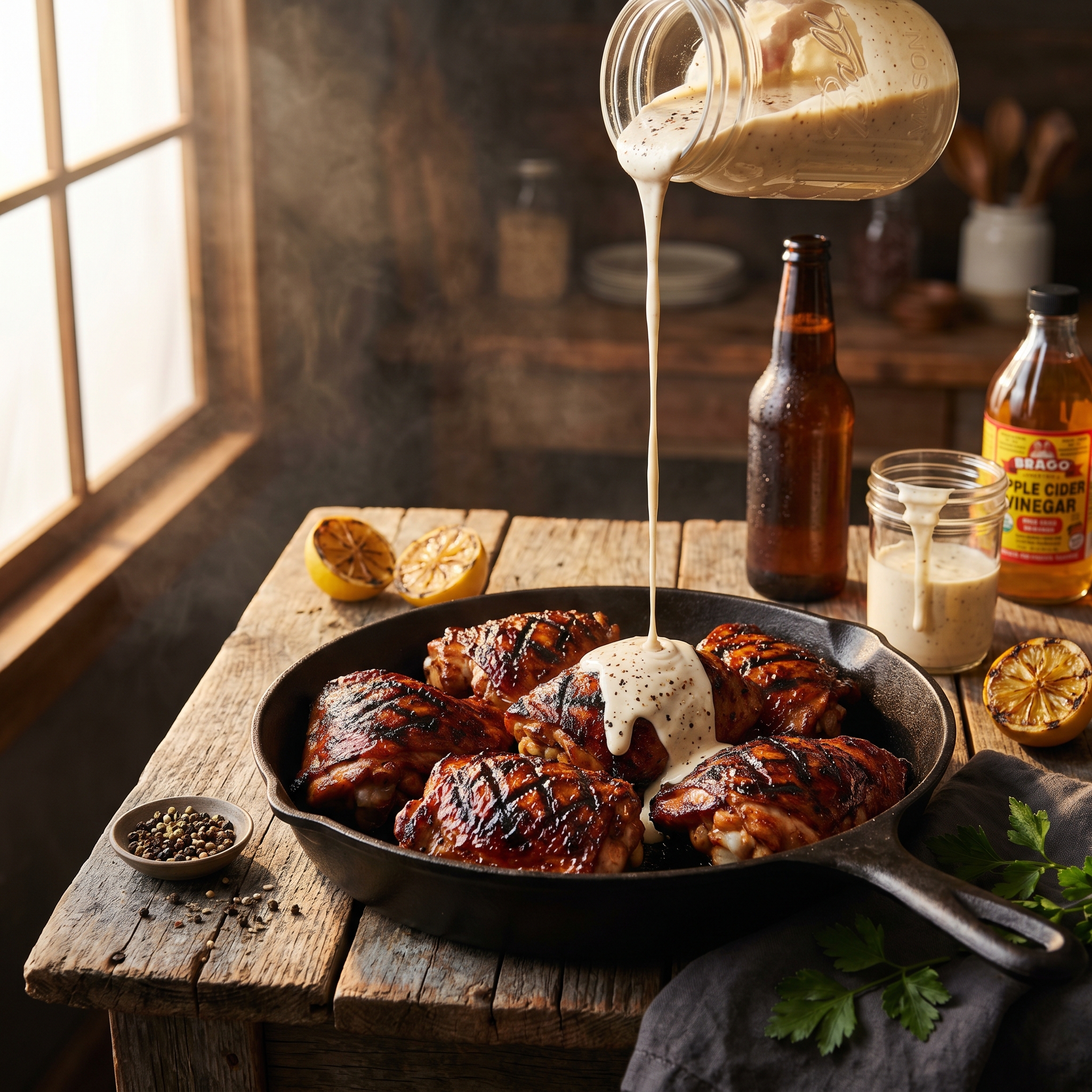
The Best BBQ Chicken Thighs with Alabama White Sauce That Will Make You Forget Every Other Barbecue Sauce You’ve Ever Used
Picture a warm Sunday afternoon in the deep South — the kind where the air smells like hickory smoke and the neighbors start drifting toward your fence the moment the grill fires up. The chicken thighs have been sitting in a bold dry rub since morning, and now they are sizzling over indirect heat, turning the most gorgeous shade of deep mahogany while the fat renders slowly and the skin crisps into something that crackles like a dream. And then comes the sauce — not the thick, sugary red barbecue sauce you have used a hundred times before, but something completely different, something that stops every single guest mid-conversation the first time they taste it. Creamy, tangy, peppery, with a brightness from the apple cider vinegar and a gentle heat that builds beautifully with every bite. That is Alabama white sauce, and paired with perfectly grilled chicken thighs, it is one of the greatest barbecue combinations this country has ever produced. This is the BBQ chicken thighs with Alabama white sauce recipe that is going to completely change your backyard game this summer — and probably every summer after that.
Tell me something — have you ever ordered barbecue chicken at a restaurant and thought “this is good, but it’s missing something”? That something, nine times out of ten, is Alabama white sauce. Most people outside of the South have spent their entire lives eating only red barbecue sauce and have never been introduced to this creamy, vinegar-forward, black-pepper-heavy white sauce that has been the secret weapon of North Alabama pitmasters since Big Bob Gibson invented it in Decatur back in 1925. It is the sauce that makes smoked chicken taste more intensely of smoke. It is the sauce that cuts through the richness of chicken skin in the most satisfying way. It is the sauce that makes people who have never heard of it take one bite and immediately ask what is in it with an expression of genuine, slightly bewildered delight.
This recipe gives you both — a deeply flavorful, perfectly grilled chicken thigh with crispy, crackling skin and a juicy interior, and a from-scratch Alabama white sauce that takes four minutes to make and tastes like it has been the house sauce at a legendary barbecue joint for a hundred years. Whether you are cooking for a Fourth of July crowd, a Father’s Day backyard dinner, a Sunday family cookout, or just a Wednesday evening when you decided the week deserved something extraordinary — this is the recipe. Keep reading. Every single technique, every tip, and every secret is right here.
Table of Contents
Why This Recipe Works
There are a thousand grilled chicken recipes in the world. Here is exactly why this BBQ chicken thighs with Alabama white sauce belongs at the very top of that list:
- ✔ Alabama white sauce is unlike anything you have tasted before — if you have spent your whole life with red barbecue sauce, the tangy, creamy, peppery revelation of white sauce on perfectly grilled chicken is genuinely one of the great barbecue moments available to any backyard cook in America
- ✔ Chicken thighs are the right choice every single time — naturally higher in fat and flavor than breasts, thighs stay incredibly juicy and forgiving on the grill even if the timing is not absolutely perfect, making this the ideal recipe for feeding a crowd without the anxiety
- ✔ The dry rub builds extraordinary flavor before the grill even fires up — a perfectly balanced spice blend applied hours in advance creates a flavor-packed bark that makes the chicken deeply delicious even before the sauce arrives
- ✔ Two-zone grilling produces the best of both worlds — low-and-slow indirect heat renders the fat and cooks the chicken through beautifully, followed by a quick high-heat finish that crisps the skin into something genuinely spectacular
- ✔ The white sauce takes four minutes to make — whisk together eight pantry ingredients and you have a sauce so good you will put it on everything from now until the end of summer and then some
- ✔ Perfect for every summer occasion — Fourth of July, Father’s Day, Labor Day, neighborhood cookouts, Sunday family dinners, tailgates — this recipe fits every single one with equal distinction
- ✔ Crowd-feeding and budget-friendly — bone-in chicken thighs are one of the most affordable cuts at any grocery store and taste like a million dollars prepared this way, feeding six to eight people generously without breaking the grocery budget
Ready to make the barbecue dish that introduces everyone at your table to the greatest regional sauce they have never heard of? Good. Let’s get into the ingredients — and please read both Chef’s Notes before you start, because they contain the two most important flavor secrets in the entire recipe.
What You’ll Need
Serves 6 to 8 people
For the Chicken
- 4 lbs bone-in, skin-on chicken thighs (about 8 to 10 pieces)
- 2 tablespoons olive oil
- 1 teaspoon kosher salt (for initial seasoning before the rub)
For the Dry Rub
- 2 tablespoons smoked paprika
- 1 tablespoon dark brown sugar, packed
- 1 tablespoon garlic powder
- 1 tablespoon onion powder
- 1½ teaspoons freshly cracked black pepper
- 1 teaspoon kosher salt
- 1 teaspoon dry mustard powder
- 1 teaspoon chili powder
- ½ teaspoon cayenne pepper
- ½ teaspoon dried thyme
- ½ teaspoon celery salt
For the Alabama White Sauce
- 1 cup good-quality mayonnaise (Duke’s is the Southern gold standard — use it if you can find it)
- ¼ cup apple cider vinegar
- 2 tablespoons prepared horseradish
- 1 tablespoon fresh lemon juice
- 1 teaspoon lemon zest
- 1 teaspoon Dijon mustard
- 1 teaspoon coarsely ground black pepper (this is not a typo — the pepper is essential)
- ½ teaspoon kosher salt
- ½ teaspoon garlic powder
- ½ teaspoon onion powder
- ¼ teaspoon cayenne pepper
- 1 teaspoon sugar (balances the vinegar)
- 1 tablespoon Worcestershire sauce
For Serving
- Extra Alabama white sauce, for dipping at the table
- Fresh flat-leaf parsley or chives, chopped
- Lemon wedges
- Sliced white bread or buttery rolls (classic Alabama style)
- Classic coleslaw
- Pickles and sliced raw white onion
Substitutions
No Duke’s mayonnaise? Any full-fat, good-quality regular mayonnaise works perfectly — Hellmann’s and Blue Plate are both excellent. Avoid light or reduced-fat mayonnaise, which contains more water and less fat than full-fat versions and produces a thinner, less rich sauce that does not coat the chicken the way it should. If you want to make the sauce slightly lighter, Greek yogurt can replace up to one-third of the mayonnaise while still maintaining the body and richness the sauce needs.
No prepared horseradish? Horseradish is one of the defining flavor notes of authentic Alabama white sauce — it provides the sharp, sinus-clearing bite that makes the sauce so distinctive and memorable. If you truly cannot find it, one teaspoon of wasabi paste stirred in provides a similar heat profile, though the flavor is slightly different. Omitting it entirely produces a sauce that is still very good but noticeably less complex and less authentically Alabama white sauce in character.
No apple cider vinegar? White wine vinegar is the best substitute and produces a sauce that is nearly indistinguishable from the original. Plain white distilled vinegar works in a pinch but is slightly harsher and less nuanced. Rice wine vinegar is too mild and does not provide the acidity punch that makes this sauce so effective at cutting through the richness of grilled chicken skin.
No bone-in chicken thighs? Boneless, skinless thighs work well and cook faster — about 5 to 6 minutes per side over medium-high heat rather than the lower-and-slower bone-in method. They will not get quite as crispy since there is no skin to render, but they are equally juicy and delicious with the white sauce. Bone-in thighs are strongly recommended for the full experience — the bone conducts heat evenly and the skin crisps into something extraordinary that makes this recipe what it is.
🧑🍳 Chef’s Note — The Pepper in Alabama White Sauce Is Not Negotiable: If you read the sauce ingredient list and thought “that seems like a lot of black pepper” — you are right, and it is completely intentional. Coarsely ground black pepper is one of the three defining characteristics of authentic Alabama white sauce alongside the mayonnaise base and the apple cider vinegar. The pepper provides a slow, building heat that is completely different in character from the immediate, sharp heat of cayenne — it blooms gradually across the palate and gives the sauce its distinctive, slightly rustic quality that is immediately recognizable as something genuinely Southern and genuinely special. Do not reduce the pepper. Do not substitute fine-ground pepper for coarsely ground. The texture and the heat profile of coarsely cracked pepper is part of what makes this sauce taste like Alabama white sauce rather than a generic creamy dressing. Grind it fresh if you can — a few turns of a pepper mill produces the best possible result.
🧑🍳 Chef’s Note — Apply the White Sauce in Two Stages: Unlike thick red barbecue sauces that are typically applied at the very end of cooking, Alabama white sauce is traditionally applied in two stages with chicken — a generous baste during the last 5 minutes of grilling, and then a second, heavier application right after the chicken comes off the heat while it rests. The first application cooks into the surface of the skin, creating a slightly set, lightly caramelized coating that adds flavor and a beautiful sheen. The second application coats the finished, rested chicken in a fresh, cool layer of sauce that provides the creamy, tangy, peppery hit of flavor in every single bite. Always sauce twice. It is the difference between chicken that has white sauce on it and chicken that tastes like it was born wearing white sauce.
All the ingredients assembled and both Chef’s Notes locked firmly into your memory? Perfect. Let’s cook the most celebrated regional barbecue chicken recipe in American history — and there is a skin-drying technique in the instructions that is the single biggest reason the skin comes out crackling-crispy instead of soft and rubbery.
How to Make BBQ Chicken Thighs with Alabama White Sauce — Step by Step
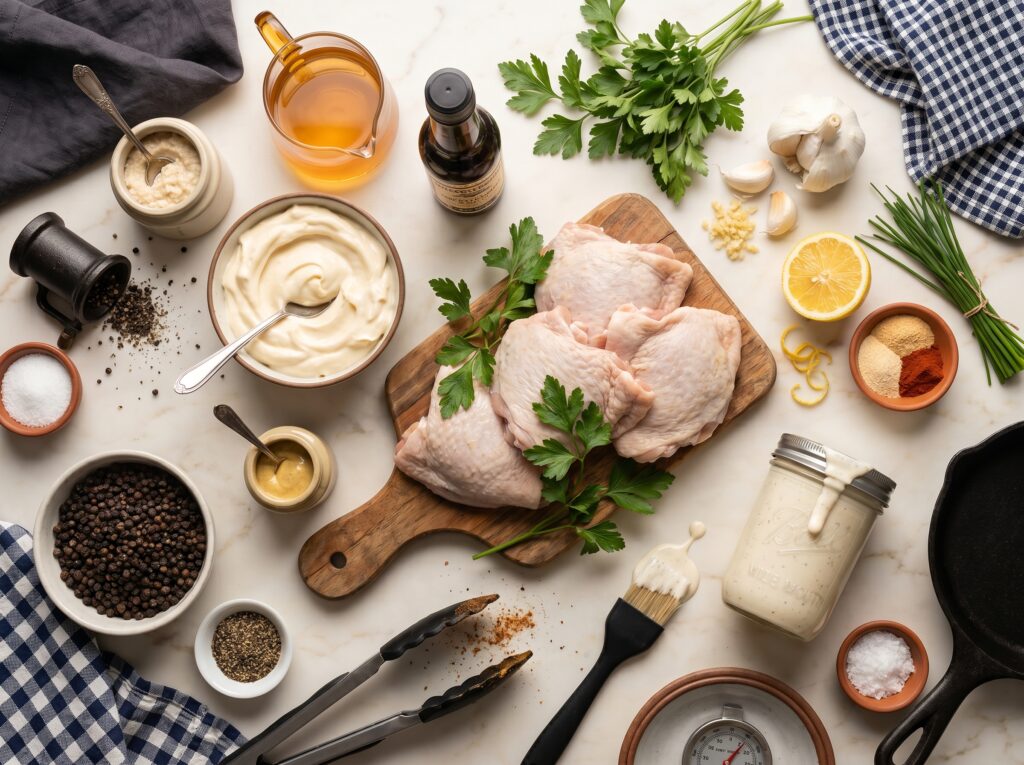
Part One: Make the Alabama White Sauce First
- Whisk all the sauce ingredients together until smooth. Combine the mayonnaise, apple cider vinegar, prepared horseradish, lemon juice, lemon zest, Dijon mustard, coarsely ground black pepper, salt, garlic powder, onion powder, cayenne, sugar, and Worcestershire sauce in a medium bowl. Whisk vigorously until completely smooth, creamy, and fully combined — the vinegar and lemon juice will thin the mayonnaise slightly and the whole sauce should be pourable but still have good body. Taste it immediately — it should be tangy, creamy, peppery, and bright with a building heat at the back of the palate. Adjust the vinegar for more tang, the pepper for more heat, the sugar for more balance, or the salt for more depth.
- Refrigerate for at least 30 minutes before using. Cover the bowl and refrigerate the sauce for a minimum of 30 minutes before grilling. This resting time is important — the flavors meld significantly as the sauce sits, the garlic and onion powders hydrate and bloom into the mayonnaise base, and the horseradish mellows slightly from sharp and aggressive to deep and complex. A sauce made and used immediately is noticeably less harmonious than one that has had time to come together. Make it first, every time.
Part Two: Prepare the Chicken
- Dry the chicken skin thoroughly — this is the crispy skin secret. Pat every chicken thigh completely, obsessively dry with paper towels — the tops, the undersides, the sides, every surface. Then set the thighs on a wire rack over a sheet pan and let them air-dry uncovered in the refrigerator for at least 1 hour and up to overnight. Surface moisture is the enemy of crispy chicken skin — it creates steam under the skin during cooking, which prevents the skin from ever achieving the crackling, rendered, golden-brown crispiness that makes grilled bone-in chicken thighs so extraordinary. Dry skin equals crispy skin. Wet skin equals soft, flabby, disappointing skin. Dry obsessively. Every time. Without exception.
- Mix the dry rub. Combine the smoked paprika, dark brown sugar, garlic powder, onion powder, black pepper, salt, dry mustard, chili powder, cayenne, dried thyme, and celery salt in a small bowl and mix thoroughly until the brown sugar is fully broken up and evenly distributed through the spice blend. The finished rub should be a deep, rust-colored powder that smells simultaneously smoky, warm, and slightly sweet. Taste a tiny pinch — it should be bold, complex, and tingly on the tip of your tongue.
- Apply the rub and let it penetrate. Drizzle the dried chicken thighs with olive oil and rub it all over every surface. Sprinkle the dry rub generously over every piece — tops, undersides, and all edges — pressing it firmly into the skin and meat with your hands rather than just dusting it lightly. For the best possible flavor penetration and bark development, cover the rubbed chicken loosely and refrigerate for a minimum of 2 hours and up to 24 hours. The salt in the rub draws moisture to the surface, dissolves, and gets reabsorbed back into the meat — a dry-brining process that seasons the chicken from the inside out and builds extraordinary depth of flavor that surface-only seasoning simply cannot achieve.
- Bring the chicken to near room temperature. Remove the rubbed chicken from the refrigerator 30 minutes before grilling. Cold chicken placed directly on the grill takes longer to cook through evenly and can result in skin that is fully rendered and sometimes scorched before the meat near the bone has reached a safe internal temperature. Thirty minutes on the counter is enough to take the chill off without any food safety concerns and produces significantly more even cooking throughout the piece.
Part Three: Set Up the Grill and Cook
- Set up a two-zone grill. This is the single most important grill setup technique for bone-in chicken thighs, and it works identically on both gas and charcoal. For a gas grill: turn one or two burners on one side to medium heat and leave the remaining burners completely off. For a charcoal grill: pile all the lit coals to one side of the grill and leave the other side completely clear of coals. You are creating two cooking zones — a direct heat zone for searing and a cool indirect zone where the chicken cooks through gently and evenly without burning. Preheat the grill to around 375°F to 400°F with the lid closed.
- Start the chicken on the indirect heat side, skin-side up. Place all the chicken thighs on the cool, indirect side of the grill, skin-side up — bone-side down. Close the lid and cook at 375°F to 400°F for 25 to 30 minutes without opening the lid. The indirect heat gently renders the fat under the skin and cooks the meat through from the outside in without any risk of flare-up charring or burning the spice rub before the interior is cooked. This is the patience phase. Trust the process and keep the lid closed.
- Move to direct heat to crisp the skin. After the indirect cooking phase, check the internal temperature of the thickest thigh — it should be reading between 155°F and 160°F at this point. Move all the thighs to the direct heat side of the grill, skin-side down this time, and cook over medium-high direct heat for 4 to 6 minutes until the skin is deeply golden, visibly crisped, and beautifully caramelized. Watch them carefully during this phase — the brown sugar in the rub means the exterior can go from perfectly caramelized to scorched in a matter of minutes over direct heat. Do not walk away.
- Flip and apply the first round of white sauce. Flip the chicken skin-side up and immediately brush a generous layer of Alabama white sauce over the skin while the chicken is still on the direct heat. Let it cook for another 2 minutes — the sauce will set slightly against the hot skin, caramelize very lightly at the edges, and create a gorgeous, lightly glazed coating over the crisped exterior. The internal temperature should reach 165°F at this point — verify with an instant-read thermometer inserted into the thickest part of the meat away from the bone.
- Rest and apply the second round of white sauce. Transfer all the finished chicken thighs to a clean platter or cutting board and immediately — while they are still steaming and hot — brush on a second, generous layer of Alabama white sauce over every piece. The heat from the freshly grilled chicken partially warms the sauce and helps it adhere to the surface without simply running off. Let the chicken rest for 5 full minutes with this second coat of sauce on it before serving. This resting time allows the juices to redistribute back into the meat and gives the second sauce application a chance to settle into the chicken beautifully.
- Garnish and serve with extra sauce alongside. Scatter chopped fresh parsley or chives over the platter. Arrange lemon wedges around the chicken for squeezing. Set a bowl of additional white sauce at the table — there will never be enough, so make extra — alongside pickles, sliced raw white onion, and sliced white bread for soaking up every drop of sauce. Bring it to the table still steaming and sizzling and watch what happens.
You have just made the greatest regional barbecue chicken combination in American cooking. Now let’s talk about how to build the full Southern spread around it.
How to Serve It
These BBQ chicken thighs with Alabama white sauce deserve a spread worthy of their extraordinary flavor. Here are five ways to serve them that do the recipe complete justice:
- 🤠 Classic Southern barbecue spread — set the chicken platter in the center of the table surrounded by the full complement of traditional Southern sides: creamy coleslaw dressed with a little of the Alabama white sauce in place of regular mayo dressing, baked beans slow-cooked with brown sugar and bacon, cornbread fresh from the cast iron skillet, and a big bowl of potato salad. Add sliced white bread, pickles, and raw white onion on the side exactly the way they do at Big Bob Gibson’s in Decatur, Alabama — the birthplace of this legendary sauce. This is the complete Alabama barbecue experience, and it is one of the great American meals.
- 🎆 Fourth of July and Labor Day cookout star — these chicken thighs are the centerpiece that makes your cookout the one everyone compares all future cookouts to. Set them out on a big wooden cutting board with the white sauce in a bowl alongside, add corn on the cob charred on the grill with herb butter, a big summer tomato salad with basil, and cold watermelon slices, and you have a Fourth of July menu that is simultaneously deeply traditional and completely unexpected in the best possible way. The white sauce will be what everyone asks about for the rest of the summer.
- 👨 Father’s Day barbecue dinner — Father’s Day and grilled chicken thighs were practically made for each other, and this version with Alabama white sauce is the upgrade that takes a reliable classic into legendary territory. Pair it with smoked macaroni and cheese, a crispy iceberg wedge salad with blue cheese dressing, grilled asparagus with lemon, and cold beer — a proper Southern Father’s Day dinner that celebrates the occasion exactly the way it deserves to be celebrated.
- 🏈 Game day and tailgate crowd-pleaser — pre-grill a big batch of chicken thighs, let them cool slightly, and transport them to the tailgate in a covered foil pan. Pack the Alabama white sauce separately in a jar. Set up a simple spread with bread, pickles, and napkins — lots of napkins — and watch Alabama white sauce convert an entire parking lot of red-sauce loyalists in a single afternoon. This sauce travels better than any red barbecue sauce because it does not separate or congeal the way thick tomato-based sauces do at room temperature.
- 🌿 Weeknight dinner made extraordinary — on a Thursday evening when you need something genuinely special but do not have hours to dedicate to the grill, boneless skinless thighs with the same dry rub seared in a cast iron skillet and finished in a 400°F oven take about twenty-five minutes and pair with the Alabama white sauce just as beautifully as the full outdoor grill version. Serve over a simple arugula salad dressed with lemon and olive oil, with crusty bread alongside for soaking up the sauce. Dinner in under thirty minutes that tastes like a Sunday afternoon spent tending the grill all day.
Let me walk you through the make-ahead strategy and storage details that make this recipe even more practical and useful throughout the entire grilling season.
Storage & Make-Ahead Tips
Alabama white sauce — fridge: This is one of the great make-ahead condiments of summer. The sauce keeps beautifully in a sealed jar or airtight container in the refrigerator for up to 10 days, improving significantly in flavor over the first two to three days as all the components meld and deepen. Give it a good stir or shake before each use — it may separate slightly in the fridge, which is completely normal and corrects instantly with agitation. Make it at the beginning of the week and use it on everything.
Dry rub — pantry: Store any unused dry rub in an airtight jar in a cool, dark pantry for up to 6 months. Label it and keep it near the grill all summer — it is outstanding on pork ribs, whole chicken, chicken wings, shrimp, and roasted vegetables far beyond just chicken thighs. A batch of this rub made once stores indefinitely and saves you significant prep time every time you grill.
Rubbed raw chicken — fridge: Once the dry rub has been applied and the chicken has been coated in olive oil, the pieces can be covered and refrigerated for up to 24 hours before grilling. In fact, as noted above, a longer rub time — up to 24 hours — produces noticeably more deeply flavored, more beautifully seasoned chicken through the dry-brining process. Apply the rub the night before a cookout and your day-of grill preparation is reduced to simply firing up the grill.
Cooked chicken — fridge: Leftover cooked chicken thighs keep in an airtight container in the refrigerator for up to 4 days. The flavors continue developing in the refrigerator and cold leftover chicken thighs eaten the next day with an extra drizzle of Alabama white sauce are genuinely one of the great next-day lunch experiences available to any home cook. Pull the meat from the bones, pile it on bread with extra white sauce, pickles, and coleslaw, and you have one of the best sandwiches of the entire summer.
Cooked chicken — freezer: Fully cooked chicken thighs freeze well for up to 3 months. Let them cool completely, wrap each piece individually in plastic wrap, and store in a zip-top freezer bag with the air pressed out. Thaw overnight in the refrigerator and reheat as below.
Reheating — oven method (best): Place the chicken thighs skin-side up on a wire rack over a baking sheet and reheat in a 375°F oven for 15 to 20 minutes until heated through and the skin has re-crisped beautifully. Do not cover with foil during reheating — foil traps steam and turns crispy skin soft and rubbery. Apply a fresh brush of Alabama white sauce for the last 5 minutes of reheating for a just-grilled flavor that is genuinely close to the original.
Reheating — air fryer method (even better): Place thighs in the air fryer basket at 375°F for 8 to 10 minutes. The circulating heat re-crisps the skin magnificently and heats the interior evenly — this is arguably the best reheating method for any skin-on poultry. Apply a brush of white sauce right before serving.
🗓️ Cookout Make-Ahead Game Plan: Here is the exact timeline that makes serving this recipe to a large crowd feel completely effortless. Two days before: make a big batch of Alabama white sauce and refrigerate. One day before: dry the chicken thoroughly, apply the rub, cover, and refrigerate overnight. Day of: remove chicken from the refrigerator 30 minutes before grilling, fire up the grill to 375°F to 400°F, cook the indirect phase, finish over direct heat, double-sauce, rest, and serve. Total active morning-of effort: virtually nothing. Total guest experience: something that feels like it took all day and tastes like it was made by someone who has been grilling chicken thighs in North Alabama for forty years.
Let me make sure you have the five most critical technique details locked in so your first batch of these chicken thighs comes out absolutely perfectly.
Helpful Tips & Common Mistakes
Bone-in chicken thighs on the grill are forgiving by nature — but a handful of avoidable mistakes stand between good and genuinely extraordinary. Here is how to nail every single detail:
✗ Mistake: Not drying the chicken skin before applying the rub
✓ Fix: Moisture on the surface of chicken skin prevents it from ever crisping properly on the grill — it creates steam rather than sear, producing soft, pale, flabby skin that is one of the most disappointing outcomes in all of backyard cooking. Pat every piece completely dry with paper towels before adding any oil or rub, and if time allows, let the pieces air-dry uncovered on a rack in the refrigerator for at least an hour before cooking. Dry skin is the single most important prerequisite for crispy skin, and it costs nothing but paper towels and a little bit of patience.
✗ Mistake: Skipping the indirect heat phase and cooking entirely over direct heat
✓ Fix: Bone-in chicken thighs are thick and meaty — cooking them entirely over direct high heat virtually guarantees a result where the exterior is charred and the skin is burnt while the meat near the bone is still pink and raw. The indirect phase cooks the meat through gently and completely before the direct heat finish crisps the skin, producing a chicken thigh that is perfectly cooked from the skin all the way to the bone with no raw spots and no burnt exterior. Two-zone grilling is not optional for bone-in chicken — it is the method that makes the result consistently excellent every single time.
✗ Mistake: Applying the Alabama white sauce too early in the cooking process
✓ Fix: Alabama white sauce contains mayonnaise, which is essentially an emulsified oil — put it over high heat for extended cooking and it breaks down, the fat separates, and the result is greasy and visually unappealing rather than the gorgeous, creamy, glossy coating you want. Apply the first round of sauce only in the final 2 minutes of direct heat cooking, after the skin is already fully crisped. Apply the second round immediately off the grill. This sequence keeps the sauce intact, fresh-tasting, and beautifully applied rather than broken and oily.
✗ Mistake: Making the white sauce and using it immediately without resting
✓ Fix: A white sauce used immediately after mixing tastes sharp, slightly harsh, and slightly disjointed — the individual flavors have not had time to integrate. Even thirty minutes of refrigerator rest makes a noticeable difference. An overnight rest produces a sauce that is harmonious, complex, and deeply flavored throughout rather than a collection of individual strong flavors competing for attention. Make the sauce first, always, and give it as much time as possible before using it.
✗ Mistake: Cutting into the chicken immediately off the grill to check doneness
✓ Fix: Cutting into chicken the moment it comes off the grill sends all the accumulated juices running out onto the cutting board rather than staying in the meat where they belong — leaving you with a drier, less flavorful result than the chicken deserves after all your effort. Use an instant-read thermometer to verify doneness at 165°F without cutting, then let the chicken rest for a full 5 minutes before serving. Those five minutes make the chicken noticeably juicier and the meat more flavorful in every bite. Set a timer, apply the second coat of white sauce, and step away from the cutting board.
With all five mistakes fully addressed and permanently behind you, here are four spectacular variations that take this already-extraordinary recipe in four completely different and equally delicious directions.
Recipe Variations
🌶️ Spicy Alabama White Sauce Version: Double the cayenne in the white sauce to ½ teaspoon and add 1 tablespoon of your favorite hot sauce — Crystal, Tabasco, or Louisiana-style all work beautifully. Add an extra teaspoon of freshly cracked black pepper for an even more aggressively peppery sauce. Increase the horseradish to 3 tablespoons for a sinus-clearing, deeply warming heat that builds with every bite. This spicier version is an absolute revelation for heat lovers and pairs especially well with ice-cold sweet tea or a cold beer to manage the building warmth. Apply it to the chicken exactly as directed in the main recipe — the extra heat does not change the application method, only the reaction from your guests.
🍋 Lemon Herb White Sauce Version: Add the zest of a full lemon and an extra tablespoon of fresh lemon juice to the white sauce. Stir in 2 tablespoons of very finely chopped fresh tarragon, 1 tablespoon of fresh chives, and 1 tablespoon of fresh dill after blending. This herbaceous variation is lighter and more spring-forward than the classic version, and it is absolutely spectacular on the chicken thighs for a more elegant presentation — a dinner party version rather than a cookout version, though it would be completely at home at either. The tarragon and lemon together with the vinegar base of the white sauce create a flavor profile that feels simultaneously classic Southern and quietly French in the best possible way.
🍯 Honey Alabama White Sauce Version: Whisk 2 tablespoons of good local honey into the finished white sauce for a sweet-tangy-peppery combination that is deeply addictive and slightly more approachable for guests who are new to white sauce and initially uncertain about a vinegar-forward mayonnaise-based barbecue condiment. The honey softens the vinegar edge without eliminating the characteristic tang that defines the sauce, and the sweetness caramelizes beautifully when the sauce is applied to the hot chicken for the first basting round. This honey version is particularly popular with children and with guests who describe themselves as preferring sweet barbecue sauce — it brings them over to the white sauce side without them ever feeling like they compromised.
🥬 Smoked Chicken Thigh Version with White Sauce: If you own or have access to a smoker or a kettle grill set up for low-and-slow smoking, smoke the dry-rubbed chicken thighs at 225°F to 250°F over hickory or apple wood for 2 to 2½ hours until they reach 165°F internal temperature. The extended smoke time produces a deep smoke ring in the meat, an extraordinary mahogany-colored bark, and a flavor depth that is simply unachievable at standard grilling temperatures. Apply the Alabama white sauce in the same two-stage sequence — a baste during the final 15 minutes of smoking and a generous application immediately off the smoker. Smoked chicken thighs dressed in Alabama white sauce is as close as you can get in a backyard setting to the transcendent experience of eating at Big Bob Gibson’s Bar-B-Q in Decatur, Alabama — and that is the highest possible compliment this recipe can receive.
Fire Up the Grill and Make Some History
These BBQ chicken thighs with Alabama white sauce are more than just a great grilled chicken recipe — they are an introduction to one of the most historically significant, most regionally distinct, and most genuinely delicious barbecue traditions in the entire American South. Once you taste what perfectly grilled, crispy-skinned chicken thighs taste like draped in that tangy, creamy, black-pepper-forward white sauce, you will understand immediately why Big Bob Gibson’s original creation has been legendary in North Alabama for a hundred years — and why it deserves to be on backyard grills all across this country every single summer from now on. Now make the sauce, dry that chicken skin, and fire up the grill. Something extraordinary is about forty-five minutes away.
Tried this recipe for the first time? I cannot wait to hear your reaction — especially if it is your first encounter with Alabama white sauce. Drop a comment and a star rating below, or tag me on Pinterest with your gorgeous platter! Watching people discover white sauce for the first time through this recipe is genuinely one of the great joys of sharing food online. Happy grilling! 🔥🍗
Frequently Asked Questions
What exactly is Alabama white sauce and where does it come from?
Alabama white sauce is a mayonnaise-based barbecue sauce invented by Robert “Big Bob” Gibson at his Bar-B-Q restaurant in Decatur, Alabama in 1925. Unlike the tomato-based, sweet red barbecue sauces most Americans are familiar with, Alabama white sauce is built on a mayonnaise base thinned with apple cider vinegar and seasoned aggressively with coarsely ground black pepper, horseradish, lemon juice, and spices. It was originally developed specifically for smoked chicken — the tangy, creamy, peppery sauce cuts through the richness of the chicken skin and amplifies the smoke flavor in a way that red sauce simply does not. Big Bob Gibson’s has been serving it continuously since 1925 and it remains one of the most celebrated regional barbecue sauces in the entire country, though it is still relatively unknown outside the South.
Does Alabama white sauce taste like mayonnaise?
Not in the way you might expect — and this is the question most people ask before they try it and the concern that disappears entirely with the first bite. The large amount of apple cider vinegar in the sauce thins the mayonnaise significantly and shifts the flavor profile dramatically away from the rich, fatty quality of plain mayo and toward something tangy, bright, and peppery. The result tastes nothing like eating mayonnaise — it tastes like a complex, creamy, vinegar-forward, black-pepper-driven condiment that is simultaneously cooling and warming and entirely unlike any other barbecue sauce in existence. The easiest way to understand it is simply to make it and taste it, because describing it accurately to someone who has never had it is genuinely difficult. Trust the recipe and trust the process.
Can I make Alabama white sauce ahead of time?
Not only can you make it ahead — you absolutely should. The sauce improves significantly with time as all the flavors meld and the raw edges of the individual components — particularly the vinegar, the garlic powder, and the horseradish — soften and integrate into a harmonious whole. A sauce made 24 hours in advance is noticeably better than one made 30 minutes before serving, and a sauce made 48 hours ahead is arguably at its peak. It keeps in a sealed jar in the refrigerator for up to 10 days, which means you can make it on a Monday and have it perfectly ready for a Saturday cookout with zero day-of work required.
What internal temperature should chicken thighs reach?
The USDA minimum safe internal temperature for chicken is 165°F, and bone-in chicken thighs should be measured at the thickest part of the meat away from the bone — the bone conducts heat faster than the meat and will always read higher than the surrounding flesh. For bone-in thighs specifically, many experienced grillers and barbecue cooks prefer to cook to 175°F to 180°F — higher than the safe minimum — because at these temperatures the collagen and connective tissue in the thigh meat fully breaks down into gelatin, producing a noticeably more tender, juicier, more deeply flavored piece of chicken than one pulled at exactly 165°F. Thighs are far more forgiving of higher temperatures than breasts — they benefit from the extra few degrees rather than drying out from them.
Can I use this recipe with chicken wings or drumsticks instead of thighs?
Yes — and both are exceptional with Alabama white sauce. Chicken wings cook faster than thighs — grill them over indirect heat at 375°F for about 20 to 25 minutes, then finish over direct heat for 5 to 8 minutes to crisp the skin. Apply the white sauce in the same two-stage method. Drumsticks fall between wings and thighs in cook time — about 30 to 35 minutes total using the same two-zone method. White sauce on chicken wings in particular is genuinely extraordinary — the tangy, creamy sauce clings beautifully to the small pieces and makes them disappear from the platter faster than any other wing preparation you have ever served.
Can I make this recipe indoors without a grill?
Absolutely. For the best indoor result, sear the dry-rubbed chicken thighs skin-side down in a very hot cast iron skillet with a tablespoon of oil for 4 to 5 minutes until the skin is deeply golden and crisped. Flip once and transfer the entire skillet to a 400°F oven for 20 to 25 minutes until the internal temperature reaches 165°F to 175°F. Remove from the oven, apply the first coat of Alabama white sauce, return to the oven for 3 minutes, then remove and apply the second coat immediately. Rest for 5 minutes. The cast iron skillet method produces excellent skin crispness — not quite as dramatic as the grill but genuinely impressive for an indoor preparation — and the white sauce works just as beautifully indoors as it does outside.
Is Alabama white sauce only for chicken?
Alabama white sauce was invented specifically for smoked chicken, but once you have a jar of it in your refrigerator, you will quickly discover that it improves virtually everything it touches. It is exceptional on smoked pork ribs and pulled pork, extraordinary on grilled turkey, surprisingly wonderful as a dressing for coleslaw in place of traditional mayo-based dressing, outstanding as a dip for French fries and sweet potato fries, delicious spread on sandwiches and burgers, and genuinely wonderful drizzled over grilled corn on the cob. Some North Alabama restaurants serve it alongside everything on the menu — and once you have lived with a jar of it in your refrigerator for a week, you will completely understand why.
How do I get truly crispy skin on grilled chicken thighs?
Truly crispy chicken skin on the grill requires four things working together: the skin must be completely dry before cooking (pat dry obsessively and air-dry in the refrigerator if possible), the oil applied before the rub must be thin and even rather than heavy and pooling, the indirect heat phase must render the fat under the skin slowly and completely before any direct heat is applied, and the direct heat finish must be over genuinely hot grates — not medium-low — for a short, intense period that crisps rather than steams. Applying the Alabama white sauce only in the final 2 minutes of direct heat rather than earlier also preserves the crispness achieved during the skin-rendering process, since sauce applied too early creates moisture that softens the skin rather than finishing it.