
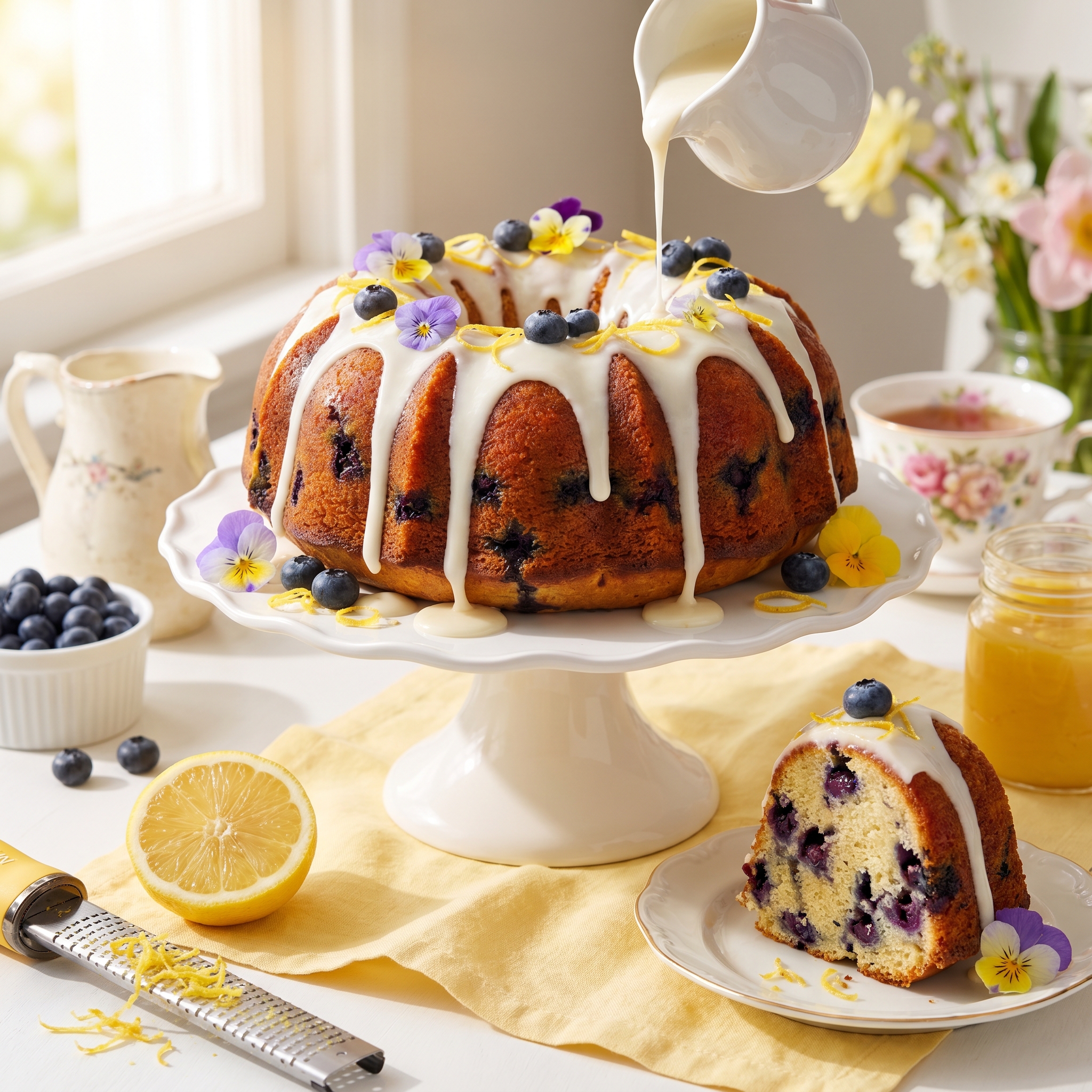
The Best Lemon Blueberry Bundt Cake — An Easy Recipe That Looks Like a Million Bucks
Imagine sliding a golden, perfectly domed Bundt cake onto your prettiest cake stand, drizzling a bright lemon glaze down every ridge and curve while it pools at the base in the most gorgeous way, and watching every single person in the room stop mid-conversation to stare at it. That’s exactly what this lemon blueberry Bundt cake does every time it hits the table — and the best part is that it’s one of the easiest cakes you will ever bake from scratch. Moist, tender crumb. Bright lemon flavor that wakes up your whole mouth. Juicy blueberries in every single bite. A glaze so good you’ll be sneaking spoonfuls straight from the bowl.
Here’s something I think about every time I bake this cake — have you ever wanted to bring something truly showstopping to a brunch or a holiday gathering but felt like you just didn’t have the baking skills to pull it off? That used to be me. And then I discovered that a Bundt pan does all the dramatic visual work for you. The pan makes it look fancy. You just make it delicious. Does it get any better than that?
Whether you need a stunning centerpiece for your Mother’s Day brunch, a crowd-pleasing Easter dessert, a summer potluck showstopper, a beautiful teacher appreciation gift, or simply a weekend baking project that makes your whole house smell like a bakery — this lemon blueberry Bundt cake recipe is going to become your most treasured go-to. Keep reading — I’m sharing every single tip and trick I’ve learned to make this recipe completely foolproof and absolutely unforgettable.
Table of Contents
Why This Recipe Works
This isn’t just another cake — this is the cake that people photograph before they cut into it and text you about the next morning asking for the recipe. Here’s why this lemon blueberry Bundt cake belongs in your permanent baking rotation:
- ✔ Stunning presentation with zero decorating skills required — the Bundt pan does all the beautiful work for you
- ✔ Incredibly moist and tender crumb thanks to sour cream and real butter in the batter
- ✔ Bright, real lemon flavor from both fresh zest AND fresh juice — no artificial lemon extract in sight
- ✔ Juicy blueberries in every single slice that burst with flavor and never all sink to the bottom
- ✔ Perfect for Mother’s Day, Easter, spring brunches, and summer potlucks
- ✔ Make-ahead friendly — actually tastes better the next day as the lemon flavor deepens overnight
- ✔ Feeds 12–14 people from one beautiful, budget-friendly cake
Bright citrus, jammy berries, and a glaze that runs down that gorgeous Bundt shape like it was made for a magazine cover — because it was. Let’s make sure you have everything you need to pull this off perfectly.
What You’ll Need
For the Lemon Blueberry Bundt Cake
- 3 cups all-purpose flour, plus 1 tablespoon for tossing the blueberries
- 1 teaspoon baking powder
- ½ teaspoon baking soda
- ½ teaspoon salt
- 1 cup (2 sticks) unsalted butter, softened to room temperature
- 2 cups granulated sugar
- 4 large eggs, room temperature
- 1 cup full-fat sour cream, room temperature
- Zest of 3 large lemons (about 3 tablespoons — don’t hold back)
- 3 tablespoons fresh lemon juice
- 2 teaspoons pure vanilla extract
- 2 cups fresh or frozen blueberries
For the Lemon Glaze
- 2 cups powdered sugar, sifted
- 3–4 tablespoons fresh lemon juice (start with 3, add more for desired consistency)
- Zest of 1 lemon
- Pinch of salt
For Greasing the Bundt Pan
- 2 tablespoons softened butter or solid shortening
- 2 tablespoons all-purpose flour (or baking spray with flour like Baker’s Joy)
Optional Finishing Touches
- Fresh blueberries, for scattering over the top
- Thin lemon slices, for garnish
- Fresh mint sprigs
- Powdered sugar dusting instead of glaze for a simpler finish
Substitutions
No sour cream? Plain full-fat Greek yogurt is a perfect 1:1 swap and gives you the same moist, tender crumb with a very slightly tangier flavor that actually works beautifully with the lemon. No fresh lemons? You can use bottled lemon juice in a pinch for the juice component, but please — use fresh lemon zest if at all possible. The zest is where almost all of the real lemon flavor lives and it makes an enormous difference that no bottled product can replicate. No fresh blueberries? Frozen blueberries work great — do not thaw them first, and toss them in flour straight from the freezer before folding into the batter.
Chef’s Note — Lemon Zest Is Everything: Three lemons’ worth of zest might seem like a lot — it’s not. The zest contains the essential oils from the lemon skin and carries about 80% of the real lemon flavor in this entire cake. The juice adds brightness and acidity, but the zest is what gives you that unmistakable, deep, perfumy lemon flavor that makes people close their eyes when they take the first bite. Zest every lemon before you juice it — it’s dramatically easier that way.
Chef’s Note — The Blueberry Flour Trick: Tossing your blueberries in a tablespoon of flour before folding them into the batter is the single most important trick for keeping them evenly distributed throughout the cake instead of sinking in a sad purple heap at the bottom. The flour coating gives each berry a little grip on the surrounding batter so they stay suspended right where you put them. It takes ten seconds and it works every single time — don’t skip it.
Ingredients on the counter and butter softening? Let’s build something beautiful.
How to Make Lemon Blueberry Bundt Cake — Step by Step
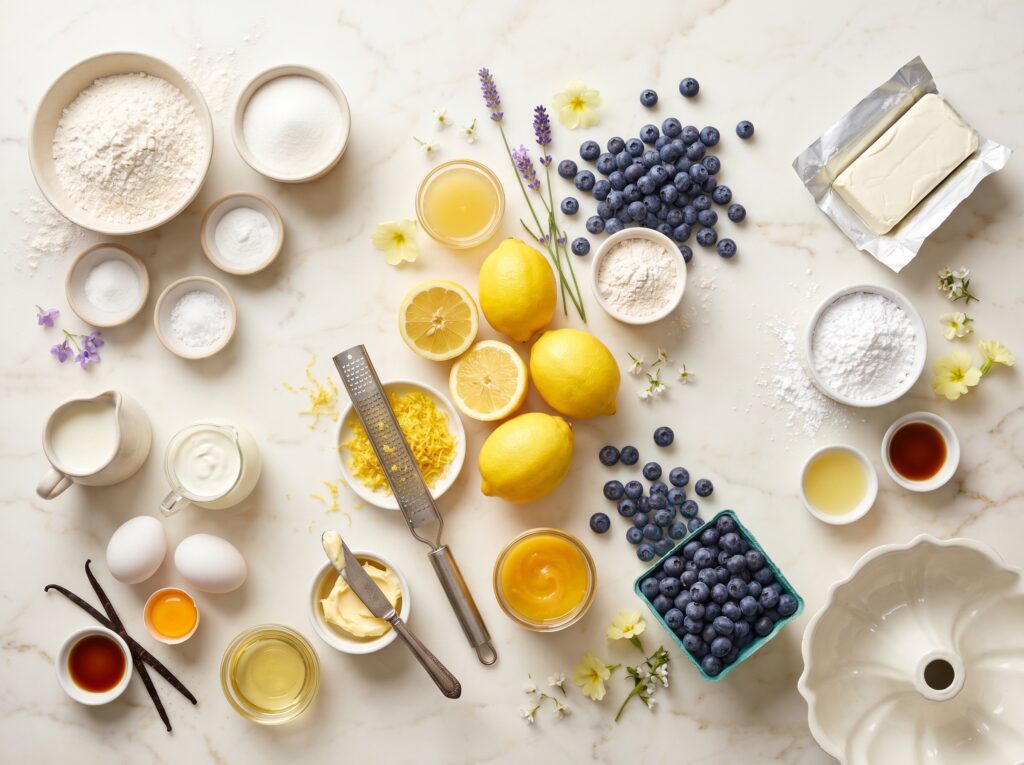
- Preheat and prep your Bundt pan obsessively. Set your oven to 350°F. Now give your Bundt pan more attention than it’s ever received — grease every single ridge, curve, and crevice with softened butter or shortening using a pastry brush or your fingers, then dust with flour, tapping out any excess. Every inch must be coated or your beautiful cake will stick and tear when you try to unmold it. Alternatively, use a baking spray that contains flour like Baker’s Joy — it’s the fastest and most reliable method for a flawless release.
- Whisk the dry ingredients. In a large bowl, whisk together the 3 cups of flour, baking powder, baking soda, and salt until evenly combined. Set aside. Having this ready before you start the wet ingredients keeps everything moving smoothly and prevents overmixing later.
- Cream the butter, sugar, and lemon zest. In a stand mixer or with a hand mixer, beat the softened butter and granulated sugar on medium-high speed for a full 4–5 minutes until the mixture is very pale, light, and fluffy. It should look almost white and feel airy when you rub it between your fingers. Add the lemon zest to the butter and sugar at this stage — beating it into the fat releases those essential oils and infuses deep lemon flavor into every molecule of this batter.
💡 Pro Tip: The creaming step is where most home bakers rush — and it’s the single biggest factor in the texture of your finished cake. Under-creamed butter and sugar gives you a dense, heavy cake. A full 4–5 minutes of beating incorporates tiny air bubbles into the fat that expand in the oven and give you that impossibly light, tender crumb. Set a timer. Do the full five minutes. It is absolutely worth every second.
- Add the eggs one at a time. With the mixer on medium speed, add the eggs one at a time, beating for 30 seconds after each addition before adding the next. Scrape down the sides and bottom of the bowl between additions. Adding them one at a time gives the batter time to properly emulsify — this is what keeps your cake batter smooth and cohesive instead of broken and curdled-looking.
- Mix in the sour cream, lemon juice, and vanilla. Add the sour cream, fresh lemon juice, and vanilla extract to the batter and mix on low speed until just combined. The batter may look slightly curdled at this point — that is completely normal and will smooth out the moment the flour is added. Don’t panic and don’t overmix trying to fix it.
- Fold in the dry ingredients gently. Add the flour mixture to the wet ingredients in three additions, folding gently with a rubber spatula between each addition until just barely combined. Stop mixing the moment you can no longer see dry streaks of flour. A few small lumps are perfectly fine. Overmixing at this stage develops gluten and turns your tender cake into a dense, rubbery disappointment — less is genuinely more here.
💡 Pro Tip: Before folding in the blueberries, set aside about ¼ cup of your batter and spread it in a thin layer on the bottom of the prepared Bundt pan first. This thin layer of plain batter acts as a buffer that helps the blueberries near the bottom of the cake (which becomes the top once inverted) stay in place and not bleed color into the surface of your beautiful glaze presentation.
- Fold in the flour-tossed blueberries. Toss your blueberries in 1 tablespoon of flour until lightly coated, shaking off any excess. Gently fold them into the batter using a rubber spatula with just 3–4 strokes — you want them distributed but you don’t want to crush them or turn the entire batter purple. A few streaks of blue in the batter is totally fine and actually beautiful in the finished slice.
- Fill the pan and bake. Pour and spoon the batter into your prepared Bundt pan, spreading it into an even layer. Give the pan a few gentle taps on the counter to settle the batter and release any large air pockets. Bake at 350°F for 55–65 minutes until the top is deeply golden brown, the cake has pulled slightly away from the edges of the pan, and a long toothpick or skewer inserted into the thickest part comes out with just a few moist crumbs — not wet batter.
- Cool in the pan — then the most important flip of your life. Let the cake cool in the pan on a wire rack for exactly 10–15 minutes. Not 5 minutes — it’ll be too fragile. Not 30 minutes — it’ll steam itself stuck. Ten to fifteen minutes is the sweet spot. Then place your wire rack or serving plate over the top of the pan, take a deep breath, and flip it in one confident, decisive motion. Let it sit inverted for 30 seconds, then gently lift the pan straight up. The cake should release cleanly and beautifully.
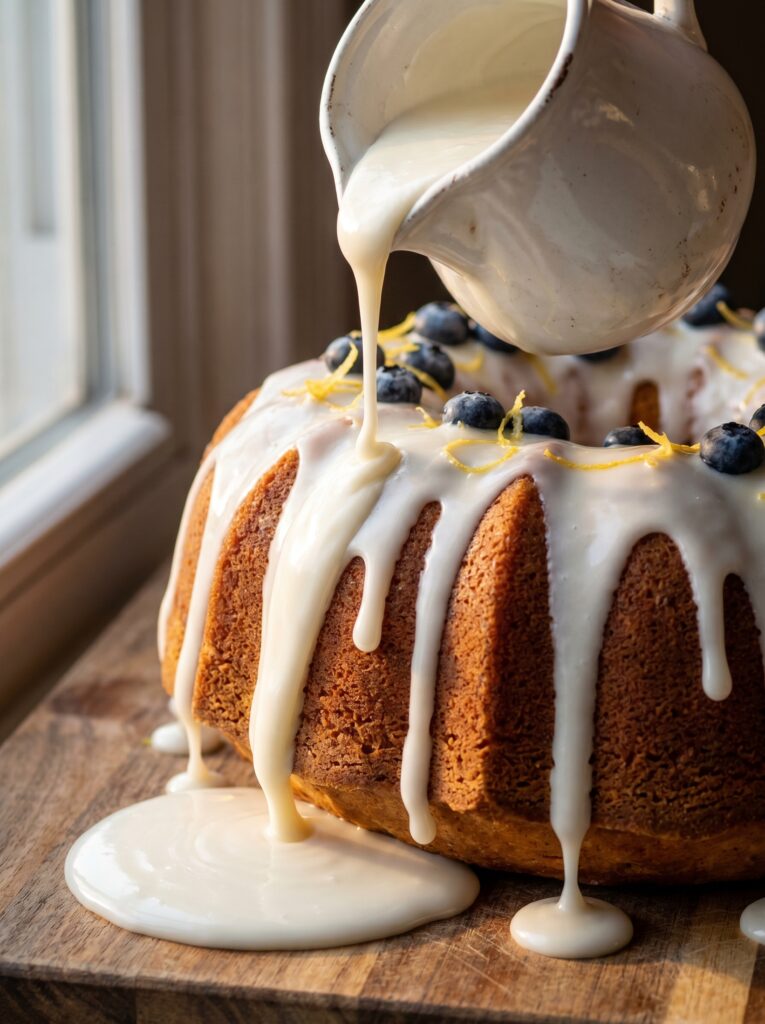
- Make the lemon glaze and finish the cake. Once the cake is completely cool (at least 1 hour after unmolding — warm cake melts the glaze right off), whisk together the sifted powdered sugar, fresh lemon juice, lemon zest, and pinch of salt until smooth and pourable. It should be thick enough to coat a spoon but thin enough to drip slowly down the sides of the cake. Drizzle it slowly and generously over the top of the Bundt, letting it run naturally down all those gorgeous ridges. Scatter fresh blueberries and a few lemon slices on top and step back to admire what you just made.
Now let’s talk about all the wonderful occasions this showstopper cake was absolutely born for.
How to Serve It
This lemon blueberry Bundt cake was made for beautiful moments and big crowds. Here are our favorite ways to serve it:
- 🌸 Mother’s Day brunch centerpiece — set it on a pretty cake stand surrounded by fresh flowers and let it be the star of the entire table without a single additional decoration needed
- 🐣 Easter dessert table — the bright lemon yellow glaze and pop of blueberry purple make this one of the most visually stunning Easter desserts you can possibly bring
- ☀️ Summer potluck showstopper — transport it glazed and ready to slice, set it out, and watch it disappear faster than anything else on the dessert table
- 🍵 Sunday afternoon coffee cake — serve thick slices alongside good coffee or tea for the coziest weekend afternoon ritual your household has ever experienced
- 🎁 Neighbor or teacher appreciation gift — wrap individual slices in parchment and a ribbon, or deliver the whole cake on a pretty board — it’s one of the most thoughtful homemade gifts imaginable
On a cake stand at a fancy brunch or wrapped in parchment for a neighbor — there is truly no wrong way to share this cake. Now let’s make sure every last slice gets treated right.
Storage & Leftovers
Room Temperature: Store the glazed lemon blueberry Bundt cake covered loosely with a cake dome or plastic wrap at room temperature for up to 2 days. The lemon flavor actually intensifies and deepens beautifully overnight — day two slices are genuinely better than day one.
Refrigerator: For longer storage, cover tightly and refrigerate for up to 5 days. Let slices come to room temperature for 20–30 minutes before serving — cold cake is denser and the lemon flavor is more muted. Room temperature is always the way to go for the best eating experience.
Freezer: This cake freezes exceptionally well for up to 3 months. For best results, freeze the cake unglazed — wrap it tightly in two layers of plastic wrap followed by a layer of aluminum foil. Thaw overnight at room temperature, then make and add the fresh lemon glaze right before serving. Individual slices can also be wrapped and frozen separately for grab-and-go portions.
Make-Ahead Tip: This is one of the absolute best make-ahead cakes in existence — and that’s not an accident. Bake the entire cake one or even two days before your Mother’s Day brunch, Easter gathering, or party. Wrap it well and store at room temperature unglazed. The morning of your event, make the fresh lemon glaze and drizzle it over the cake — it looks and tastes as though you just pulled it from the oven an hour ago. Nobody will ever know, and frankly, the overnight rest makes the crumb even more moist and the lemon flavor even more pronounced. It is a genuine win-win.
Storing Sliced Cake:
— Press a piece of plastic wrap directly against any cut surfaces to prevent the crumb from drying out — this keeps leftover slices moist and fresh for days longer than leaving the cut side exposed to air.
— Individual slices stored in airtight zip-lock bags at room temperature stay perfectly moist and tender for up to 2 days — ideal for lunchboxes and afternoon snacking all week long.
Up next — the five most common Bundt cake mistakes that cause cakes to stick, sink, or come out dense, and exactly how to avoid every single one of them.
Helpful Tips & Common Mistakes
Want a perfectly baked, perfectly released, perfectly glazed lemon blueberry Bundt cake every single time? Avoid these very common mistakes:
✗ Mistake: Not properly greasing and flouring the Bundt pan.
✓ Fix: This is the number one Bundt cake disaster and it is entirely preventable. Use softened butter — not melted, not cooking spray alone — applied with a pastry brush or your fingers to coat every single ridge, curve, and crevice. Then flour it thoroughly and tap out the excess. Alternatively, use a flour-based baking spray like Baker’s Joy which gets into all those intricate Bundt shapes far more reliably than regular cooking spray. A properly prepared pan releases a perfect cake every time.
✗ Mistake: Using cold butter, eggs, or sour cream straight from the fridge.
✓ Fix: Cold dairy and eggs do not incorporate properly into batter — they cause the mixture to look broken and curdled, and they result in a denser, less evenly textured cake. Pull your butter, eggs, and sour cream out of the refrigerator at least 1 hour before you start baking. Room temperature ingredients emulsify smoothly and create a batter that bakes up light, even, and perfectly tender throughout.
✗ Mistake: Overmixing the batter after adding the flour.
✓ Fix: Once the flour hits the wet ingredients, gluten development begins — and the more you mix, the tougher and denser your cake becomes. Fold the flour in with a spatula using the absolute minimum number of strokes needed. The moment you see no more dry flour streaks, stop. Put the spatula down. Walk away. Your restraint will be rewarded with an impossibly tender, bakery-quality crumb.
✗ Mistake: Flipping the cake out of the pan too soon or waiting too long.
✓ Fix: The 10–15 minute cooling window in the pan is non-negotiable. Too soon and the cake is too fragile and hot to hold its shape — it collapses or tears. Too late and the steam from cooling causes it to stick to the pan and rip apart when you try to unmold it. Set a timer for 12 minutes and flip with confidence. That sweet spot is where clean, perfect releases happen every time.
✗ Mistake: Glazing the cake while it’s still warm.
✓ Fix: A warm cake will melt and absorb the glaze completely instead of letting it drip beautifully down the sides in that gorgeous, glossy way we’re going for. The cake must be completely and fully cooled to room temperature — at least 1 hour after unmolding — before a single drop of glaze goes near it. Patience here is what gives you that stunning, professional-looking finish that makes everyone’s jaw drop.
Master these five things and you will bake a Bundt cake so beautiful and so delicious it will become the recipe your family requests for every single celebration from here on out.
Recipe Variations
Once you’ve absolutely nailed the classic lemon blueberry version, here are some stunning directions to take this Bundt cake next:
🍊 Orange Cranberry Bundt Cake (Holiday Version): Swap all the lemon zest and juice for fresh orange zest and juice throughout the batter and glaze. Replace the blueberries with 2 cups of fresh or frozen cranberries tossed in flour. The tart cranberries against the sweet orange glaze is a flavor combination that screams Thanksgiving and Christmas — and it’s one of the most stunning holiday desserts you can put on a table.
🫐 Triple Berry Bundt Cake: Replace the 2 cups of blueberries with a mix of 1 cup blueberries, ½ cup raspberries, and ½ cup blackberries — all tossed in flour before folding in. Keep all the lemon elements exactly as written. The mixed berries create the most breathtaking purple and red marbling throughout each slice and the flavor is complex, jammy, and completely spectacular.
🍋 Lemon Poppy Seed Bundt Cake: Skip the blueberries entirely and fold in 3 tablespoons of poppy seeds with the dry ingredients. Increase the lemon zest to 4 lemons’ worth for maximum lemon intensity. Finish with the lemon glaze and a dusting of powdered sugar. This version is pure, unapologetic lemon celebration — clean, bright, and absolutely perfect for a spring brunch or tea party spread.
🧁 Lemon Blueberry Cream Cheese Bundt: Replace half of the sour cream (½ cup) with softened full-fat cream cheese beaten in with the butter and sugar during the creaming stage. The cream cheese adds an incredible richness and tang to the crumb that makes this version taste almost like a cross between a Bundt cake and a cheesecake — dense in the most luxurious way, deeply creamy, and utterly irresistible. Finish with a cream cheese glaze instead of the standard lemon glaze for the full effect.
The base recipe is your canvas — make the classic once, then explore every gorgeous variation your heart desires.
Ready to Bake the Most Beautiful Cake of Your Life?
This lemon blueberry Bundt cake is living proof that stunning, bakery-quality results are absolutely within reach for any home baker — you just need the right recipe, a well-greased pan, and the patience to let that glaze set before you start slicing. Bright lemon, bursting blueberries, and a glaze that runs down every gorgeous ridge — this is the cake that turns an ordinary afternoon into a genuine occasion.
If you bake this beauty up, I would love nothing more than to see it! Drop a comment below with how it turned out, leave a star rating so other bakers can find this recipe, or tag me on Pinterest with your gorgeous glazed Bundt — seeing your cakes on my feed is genuinely one of the highlights of my entire week. Now go zest those lemons and preheat that oven. Something truly spectacular is about 90 minutes away. 🍋💙
Frequently Asked Questions
Why did my Bundt cake stick to the pan?
The culprit is almost always insufficient greasing — Bundt pans with intricate designs need far more attention than a regular cake pan. Every ridge and crevice must be coated in butter or shortening, then thoroughly floured. Cooking spray alone without flour is not reliable for Bundt pans. A flour-based baking spray like Baker’s Joy or Pam Baking is the most foolproof option. Also make sure you’re waiting the full 10–15 minutes before attempting to flip — too early or too late both cause sticking.
Can I use frozen blueberries in this recipe?
Yes — and they work beautifully! The key is to keep them frozen until the very last second before folding them into the batter. Do not thaw them first or they’ll bleed purple juice throughout the entire batter and turn it grey-lavender. Toss the frozen berries in flour directly from the freezer, fold them in quickly, and get the batter into the pan and the pan into the oven as fast as possible. The results are virtually identical to fresh.
Can I make this lemon blueberry Bundt cake ahead of time?
Absolutely — and it’s one of the best make-ahead cakes around. Bake the cake up to 2 days ahead and store it tightly wrapped at room temperature unglazed. Make the fresh lemon glaze and drizzle it on the morning you plan to serve it. The overnight rest actually makes the cake more moist and the lemon flavor more pronounced — it’s genuinely better on day two than day one, which makes it perfect for holiday entertaining and party planning.
How do I prevent the blueberries from sinking to the bottom?
Two tricks working together give you the best results. First, always toss the blueberries in a tablespoon of flour before folding them into the batter — the coating gives them grip so they stay suspended. Second, avoid overmixing after adding the blueberries since stirring too much causes them to break down and sink. For extra insurance, spoon a thin layer of plain batter into the bottom of the Bundt pan first before adding the blueberry-studded batter on top.
My glaze is too thick or too thin — how do I fix it?
Too thick — add fresh lemon juice half a teaspoon at a time, stirring between each addition, until it reaches a slow, pourable consistency that drips lazily off a spoon. Too thin — sift in more powdered sugar a tablespoon at a time until it thickens up. The ideal glaze coats the back of a spoon, drips slowly when you tilt the bowl, and holds its shape on the cake surface for a few seconds before spreading. If your kitchen is very warm, err on the slightly thicker side since it will thin as it hits the cake.
Can I make this recipe gluten-free?
Yes — substitute the all-purpose flour with a good quality 1:1 gluten-free baking flour blend such as Bob’s Red Mill 1:1 or King Arthur Measure for Measure. Use the same amount called for in the recipe and make no other changes. The texture will be very slightly denser than the original but still moist, flavorful, and genuinely delicious. All other ingredients in this recipe — butter, sugar, eggs, sour cream, blueberries, lemon, and vanilla — are naturally gluten-free.
What size Bundt pan does this recipe use?
This recipe is written for a standard 10–12 cup Bundt pan, which is the most common size sold in stores. If you use a smaller 6-cup Bundt pan, you’ll need to divide the batter between two pans and reduce the baking time to approximately 35–45 minutes — check early and often with a toothpick. Do not overfill any Bundt pan beyond ⅔ of its capacity or the batter will overflow in the oven and create a very frustrating mess.
Can I turn this into cupcakes or a layer cake instead?
Yes to both! For cupcakes, divide the batter into lined muffin tins filling each about ⅔ full and bake at 350°F for 18–22 minutes — this recipe makes approximately 24 cupcakes. For a two-layer 9-inch round cake, divide between two greased and parchment-lined pans and bake for 30–35 minutes. The lemon glaze works beautifully drizzled over cupcakes, or make a lemon cream cheese frosting for a truly showstopping layer cake version.