
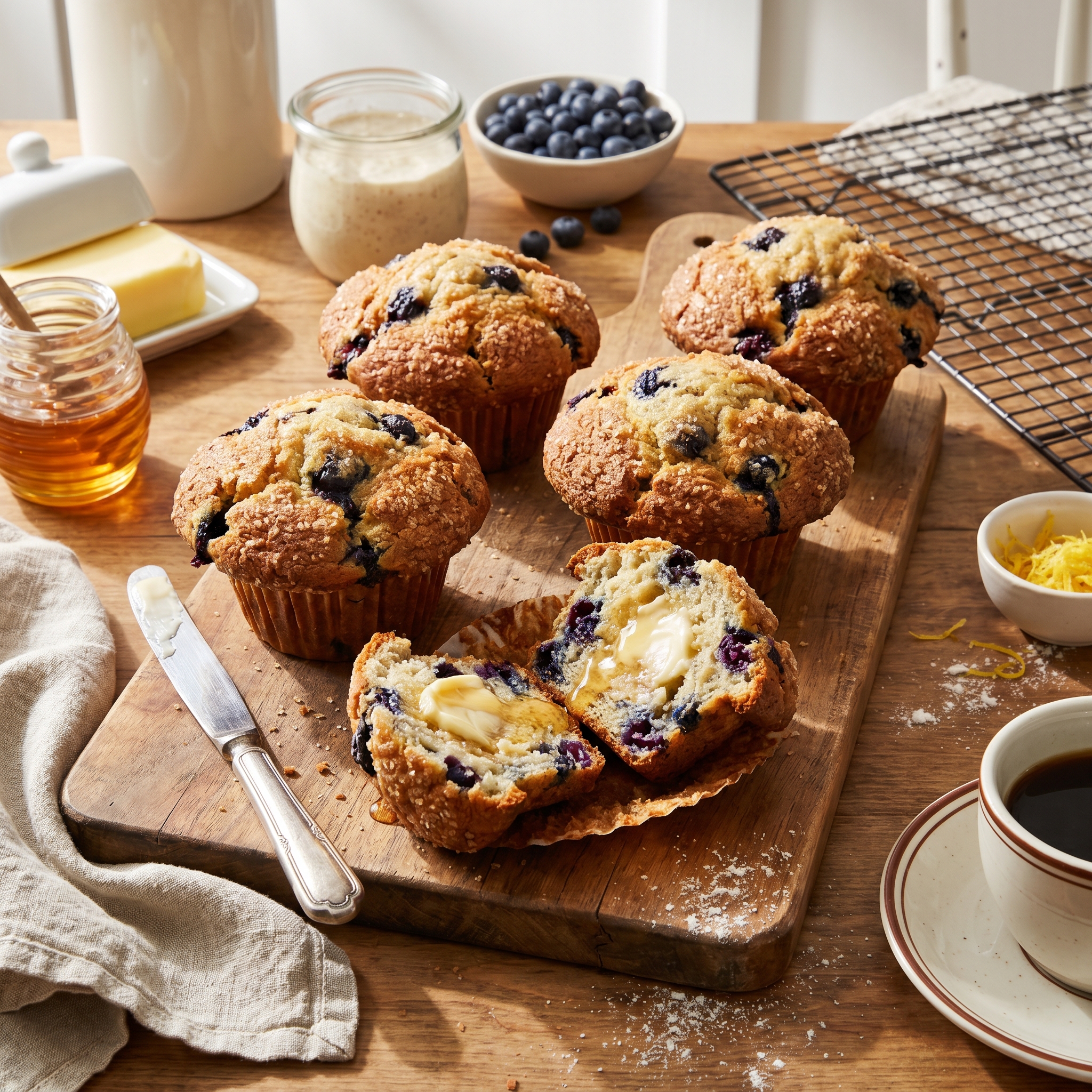
Insanely Good Sourdough Discard Blueberry Muffins: 7 Reasons These Bakery-Style Beauties Will Become Your Favorite Weekend Bake
It started the way most good kitchen discoveries do — out of stubbornness and a refusal to waste something. I’d been keeping a sourdough starter for about three months, feeding it faithfully every morning like a very demanding pet, and dumping that discard down the drain every single time. My husband finally looked at the jar one Saturday morning and said, “You’re just throwing that away?” And honestly? I didn’t have a good answer. So I started experimenting. I made pancakes. I made crackers. I made a flatbread that was fine but not worth writing home about. And then one rainy Sunday in April, with a pint of blueberries on the counter and half a cup of discard sitting in the fridge, I made these muffins — and that was the end of my discard-dumping days for good.
Are you sitting on a jar of sourdough discard right now, not entirely sure what to do with it besides feel vaguely guilty every time you open the fridge? Your sourdough discard blueberry muffins are about to become the most requested thing you bake all year. The discard doesn’t just add a subtle, complex tang that makes these muffins taste like they came from a serious bakery — it also changes the texture in the most wonderful way, giving you a tender, moist crumb that holds together beautifully and stays soft for days. These are not your average blueberry muffins. They are better. Noticeably, unmistakably better.
Whether you’re a sourdough baker who’s been tossing your discard for months and finally wants to put it to work, a blueberry muffin enthusiast chasing that perfect bakery-style dome and crinkly sugar top, or someone who just wants a genuinely impressive bake that comes together in one bowl in under an hour — keep reading. This recipe was made for all three of you, and I promise it delivers every single time.
Table of Contents
Why This Recipe Works
After testing this recipe more times than I care to admit — adjusting the discard ratio, playing with the fat content, trying bread flour versus all-purpose, fresh blueberries versus frozen — I landed on a formula that does everything a great muffin should do. The sourdough discard is not a gimmick here. It is genuinely doing important work, and once you understand why, you’ll never want to make blueberry muffins without it again.
- ✔ That bakery-style tang and depth — Sourdough discard adds a gentle, complex sourness that makes these muffins taste like they came from a serious artisan bakery, not your Tuesday morning kitchen. It’s subtle but unmistakable.
- ✔ Incredibly moist and tender crumb — The acids in the discard tenderize the gluten strands, giving you a softer, more delicate crumb than a standard blueberry muffin. They stay moist for days — not just hours.
- ✔ One bowl, no mixer needed — Everything comes together with a whisk and a spatula. No stand mixer, no hand mixer, no fuss. Less cleanup means more time to eat warm muffins.
- ✔ Works with any discard — fresh or weeks old — Whether your discard is from this morning’s feeding or has been sitting in the back of your fridge for two weeks, it works here. More aged discard just means more tang, which most people love.
- ✔ Fresh or frozen blueberries both work — Don’t run to the store if you don’t have fresh. Frozen blueberries go straight in from the freezer — no thawing — and give you beautiful purple-streaked muffins with concentrated berry flavor.
- ✔ That gorgeous domed top with a crackly sugar crust — A simple technique involving a rest period and a hot oven start gives you that tall, bakery-style dome with a sparkling turbinado sugar top that crackles when you bite in.
- ✔ Zero waste, maximum reward — Every cup of discard you’d have poured down the drain becomes twelve beautiful muffins. That’s the kind of kitchen math that makes a person feel genuinely good about their choices.
Let’s get into what you need to make them happen.
What You’ll Need
This recipe makes 12 standard muffins or 6 jumbo bakery-style ones. Everything here is pantry-friendly — if you bake even occasionally, you probably have most of it already. King Arthur all-purpose flour is my go-to for this recipe; the consistency is excellent and the protein content gives you just enough structure without toughness.
For the Muffin Batter
- ½ cup sourdough discard (unfed, straight from the fridge is fine)
- 2 cups all-purpose flour (King Arthur recommended)
- ¾ cup granulated sugar
- 2 teaspoons baking powder
- ½ teaspoon baking soda
- ½ teaspoon kosher salt
- 1 teaspoon vanilla extract
- 1 teaspoon lemon zest (do not skip this — it makes everything brighter)
- 2 large eggs, room temperature
- ½ cup whole milk or buttermilk (buttermilk gives extra tenderness)
- ½ cup sour cream (this is the secret weapon for moisture)
- ⅓ cup neutral oil (vegetable or avocado oil) or melted butter
For the Blueberries
- 1½ cups fresh blueberries — or frozen, straight from the freezer, do not thaw
- 1 tablespoon all-purpose flour (to toss the blueberries in — prevents sinking)
For the Sugar Top
- 3 tablespoons turbinado sugar (raw sugar) — this is what creates that crackly, sparkling bakery crust
- Optional: a tiny pinch of cinnamon mixed into the sugar for a warm note
Optional Add-Ins and Upgrades
- ½ teaspoon almond extract in addition to vanilla — adds a gorgeous depth
- ¼ cup fresh or frozen raspberries mixed in with the blueberries
- 2 tablespoons poppy seeds for a lemon-poppy blueberry hybrid
- A tablespoon of cream cheese tucked into the center of each muffin before baking
- Streusel topping instead of plain sugar (see Variations below)
- White chocolate chips — about ¼ cup — folded in with the blueberries
Substitutions
What if I don’t have sour cream? Full-fat Greek yogurt is a one-for-one swap and works beautifully — it has almost the same fat content and tang. Plain whole-milk yogurt works too, though the muffins will be very slightly less rich. In a real pinch, you can use an extra 2 tablespoons of buttermilk in place of the sour cream, but the texture won’t be quite as velvety. The sour cream is genuinely worth keeping on hand for this one.
Can I use whole wheat flour? You can substitute up to half the all-purpose flour with white whole wheat flour without significantly changing the texture. King Arthur White Whole Wheat is the one I’d reach for — it’s milder and less dense than regular whole wheat. Going all whole wheat will make the muffins heavier and denser than you want them, so I wouldn’t go beyond that 50% substitution.
What if I only have active, bubbly starter instead of discard? Active starter works just as well here — the muffins will have a slightly milder tang since active starter is fresher and less acidic than older discard, but the texture benefits are the same. The leavening in this recipe comes from baking powder and baking soda, not the starter, so it doesn’t matter whether your starter is active or dormant going in.
🧑🍳 Chef’s Note — Discard Age: The older and more sour your discard, the more tang your muffins will have. Discard that’s been in the fridge for 1–2 weeks makes muffins with a pronounced, wonderful sourness. Fresh discard from this morning’s feeding gives a more subtle flavor. Both are great — just know what you’re working with and lean into it.
🧑🍳 Chef’s Note — Blueberry Distribution: Tossing your blueberries in a tablespoon of flour before folding them into the batter is not optional if you want them evenly distributed. Without the flour coating, every blueberry sinks straight to the bottom and you end up with a soggy base and a bare top. One tablespoon, thirty seconds of tossing — it changes everything.
How to Make Sourdough Discard Blueberry Muffins — Step by Step
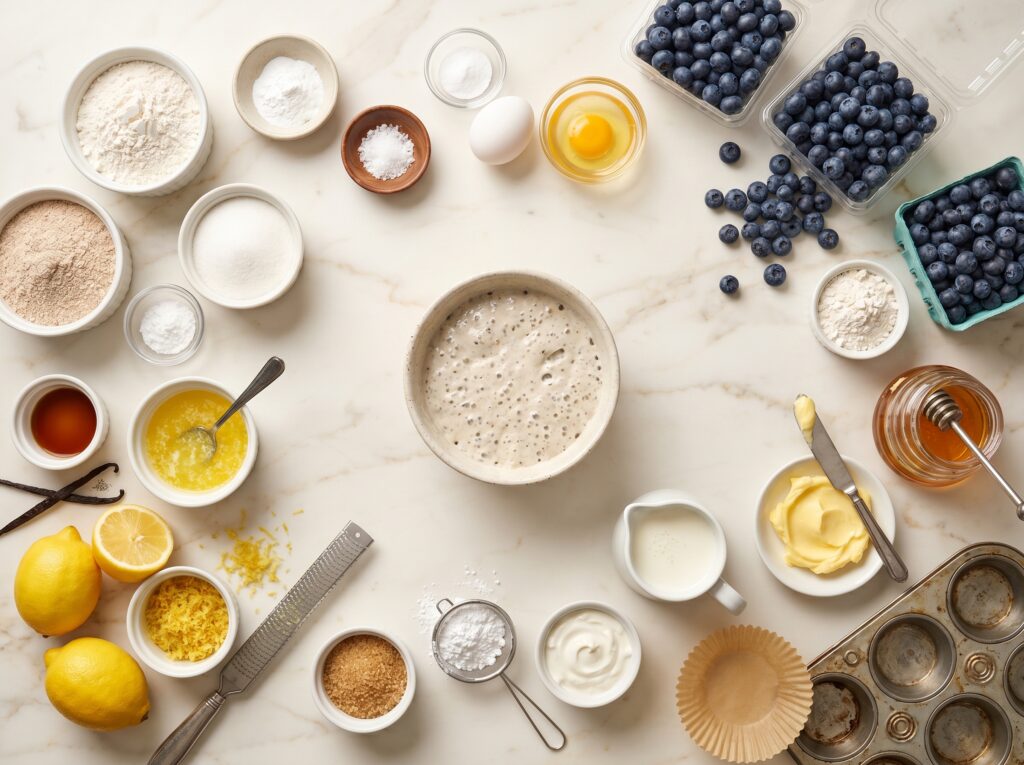
- Pull your discard out of the fridge and let it sit at room temperature for 20–30 minutes while you gather everything else. Cold discard straight from the fridge is thicker and doesn’t incorporate as smoothly into the batter — a brief warm-up makes it looser and easier to work with. This is also a good time to bring your eggs to room temperature if they’re cold, which you can speed up by submerging them in a bowl of warm water for 5 minutes.
💡 Pro Tip: Before you do anything else, preheat your oven to 425°F. Yes, that’s hotter than most muffin recipes call for. That initial blast of high heat is exactly what creates the dramatic domed top — the batter rises rapidly before the crust sets, pushing the center up into that beautiful bakery-style peak. Don’t skip the high heat and don’t open the oven for the first 8 minutes.
- Line a standard 12-cup muffin tin with paper liners or grease it generously with butter. For jumbo bakery-style muffins, use a 6-cup jumbo tin instead. Whichever you use, fill any empty cups halfway with water — this creates steam in the oven, which helps the muffins bake more evenly and stay moist. It also prevents the empty metal cups from scorching.
- In a large bowl, whisk together all your dry ingredients. Combine the flour, sugar, baking powder, baking soda, and salt and whisk for a full 30 seconds to make sure the leavening is evenly distributed throughout the flour. Uneven leavening distribution is one of the most common causes of muffins that rise unevenly or have dense pockets — this step costs you nothing and fixes that problem entirely.
💡 Pro Tip: Zest your lemon directly over the bowl of dry ingredients so the fragrant oils land right in the flour. Give the zest a quick rub into the sugar with your fingertips — this releases even more lemon oil and perfumes the whole batter in a way that smells absolutely incredible and tastes even better in the finished muffin.
- In a separate medium bowl, whisk together all the wet ingredients. Combine the sourdough discard, eggs, milk, sour cream, oil, and vanilla extract. Whisk until completely smooth and homogenous — the discard can be a little lumpy at first, so give it a good minute of whisking to make sure everything is fully incorporated. The mixture should look creamy and uniform with no streaks of discard visible.
- Pour the wet ingredients into the dry ingredients and fold together with a spatula until just barely combined. Stop the moment you can’t see dry flour streaks. I mean it — stop. There will still be a few small lumps and that is exactly right. Overmixed muffin batter develops too much gluten and gives you tough, tunneled muffins with a rubbery texture. The lumps bake out. The toughness from overmixing does not. Put the whisk down and use the spatula.
- Toss your blueberries with 1 tablespoon of flour in a small bowl, then fold them gently into the batter. Use no more than 8–10 gentle folds to incorporate the blueberries — just enough to distribute them without completely deflating the batter. If you’re using frozen blueberries, work quickly here; the cold berries will start to stiffen the batter as they freeze the fat around them, which is actually fine and produces a slightly denser, fudgier crumb that many people prefer.
💡 Pro Tip: Once the batter is mixed, let it rest for 15 minutes before scooping it into the tin. This rest period lets the flour fully hydrate, which improves the texture and — most importantly — gives the batter time to thicken slightly, which means it holds its shape better in the oven and rises higher rather than spreading flat. It also gives the baking soda a head start reacting with the acids in the discard and sour cream, creating more lift. Set a timer and walk away.
- Divide the rested batter evenly among your prepared muffin cups, filling each one all the way to the top. This is not the time to be conservative. Full cups — right to the rim — are what give you that dramatic domed top. An ice cream scoop makes this easy and keeps the portions consistent. Sprinkle a generous pinch of turbinado sugar over each muffin before they go in the oven.
- Bake at 425°F for 8 minutes, then — without opening the oven — reduce the temperature to 375°F and bake for another 12–15 minutes. The high-heat start creates the dome; the lower temperature finishes the bake gently without drying the muffins out or over-browning the tops. They’re done when a toothpick inserted in the center comes out clean or with just a few moist crumbs — not wet batter. The tops should be deep golden brown and the turbinado sugar should look like it’s crackling and sparkling.
- Let the muffins cool in the tin for exactly 5 minutes, then transfer them to a wire rack. Leaving them in the hot tin too long causes the bottoms to steam and go soggy — 5 minutes is enough time for them to set up and firm enough to handle without falling apart. They’re wonderful warm but reach their absolute peak flavor and texture about 30 minutes after coming out of the oven, once the crumb has had time to settle and the blueberry pockets have stopped being molten lava.
From the moment you pull your discard out of the fridge to the moment you bite into a warm muffin, you’re looking at just about an hour — and most of that time is hands-off. These come together faster than a trip to the bakery and taste better than almost anything you’d find there.
How to Serve It
These sourdough discard blueberry muffins are wonderful on their own, straight off the cooling rack — but here are five ways to serve them that make the experience feel even more intentional and special.
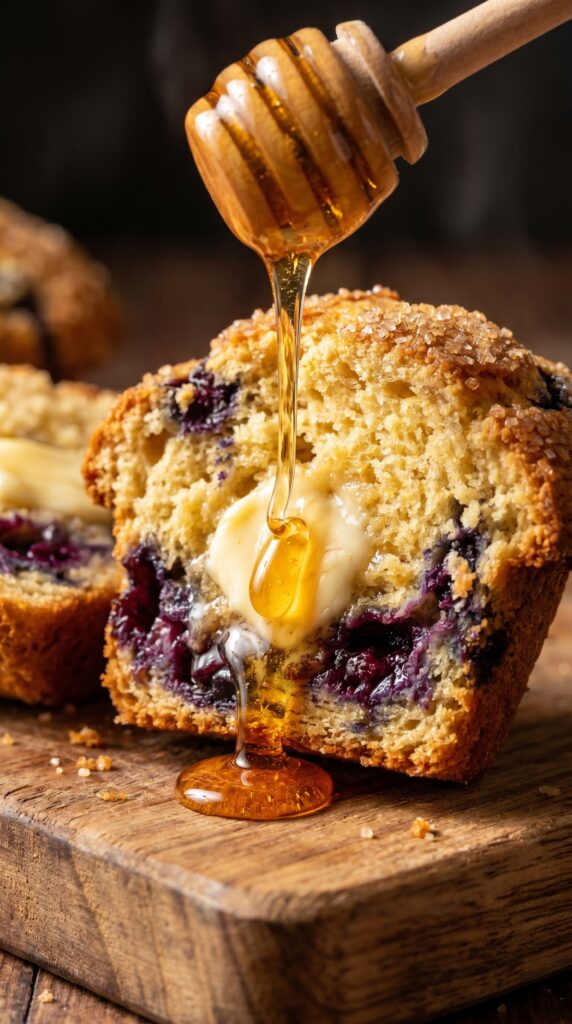
- ☕ Classic Weekend Breakfast Spread: Arrange the muffins on a wooden board alongside a pot of good coffee, a small dish of softened salted butter, and a jar of Bonne Maman blueberry preserves. The butter melts into the warm muffin in a way that is genuinely one of life’s small pleasures. This is Sunday morning done right.
- 🥞 Brunch Table Centerpiece: Stack the muffins on a tall cake stand and scatter a handful of fresh blueberries and lemon zest around the base. They look stunning without any real effort — the domed tops and sparkly sugar crust do all the work for you. Set them next to a fruit salad and a quiche and you have a brunch spread that looks like it took all morning.
- 🌸 Split and Toasted the Next Day: Slice a day-old muffin in half and toast the cut side in a dry skillet over medium heat for about 2 minutes until it’s golden and slightly crispy. Spread with cream cheese or honey butter. The caramelized cut side and the warm, tender interior is arguably better than the muffin fresh from the oven — the flavors have developed overnight and the tang from the discard really comes through.
- 📚 Lunchbox and School Morning Win: Wrap individual muffins in parchment and tuck them into lunchboxes or backpacks for a breakfast on the go that actually has some nutritional substance to it. Pair with a string cheese and a piece of fruit and you’ve got a full morning meal that took you zero effort beyond the initial bake.
- 🎃 Holiday Baking Gift: Stack three muffins in a clear cellophane bag, tie with a ribbon in a seasonal color, and tuck a handwritten tag with the recipe name on it. Homemade muffins in a pretty bag are one of those gifts that make people genuinely happy — especially during the holiday season when everyone is eating too many cookies and nobody expects a beautiful blueberry muffin to show up at their door.
However you serve them, a tiny pinch of flaky sea salt sprinkled over the top right as they come out of the oven is a finishing touch that sounds unnecessary but tastes absolutely essential.
Storage & Make-Ahead Tips
Baked muffins — Room Temperature: Store cooled muffins in an airtight container at room temperature for up to 3 days. The trick to keeping them from going soggy is to place a sheet of paper towel in the bottom of the container before adding the muffins — it absorbs any excess moisture that would otherwise make the bottoms damp and gummy. Add a second paper towel on top if you’re stacking them.
Baked muffins — Freezer: These muffins freeze exceptionally well for up to 3 months. Let them cool completely, then wrap each one individually in plastic wrap and place them in a zip-top freezer bag. To reheat, unwrap and microwave for 45–60 seconds from frozen, or let them thaw at room temperature for about an hour. They come out of the freezer tasting remarkably close to fresh-baked — the sourdough discard seems to help preserve the texture through freezing better than a standard muffin recipe does.
Pre-batching the batter for fresh muffins on demand: Mix the batter through step 6 — everything except baking — then scoop it into a lined muffin tin, cover tightly with plastic wrap, and refrigerate overnight. Bake straight from the fridge the next morning, adding 2–3 extra minutes to the bake time. The overnight rest actually improves the flavor even further, and you get warm fresh muffins on a weekday morning with almost zero morning effort.
📅 Make-Ahead Tip: Mix and portion the batter into muffin tins on Saturday evening, cover, and refrigerate. Sunday morning, slide the tin straight into the preheated oven while your coffee brews. By the time the coffee is ready, so are the muffins. That is a weekend morning done absolutely correctly.
Pre-baked muffins left out too long: Don’t leave these at room temperature for more than 3 days — the moisture from the blueberries starts to migrate into the crumb and the muffin base gets progressively damper as the days go on. If you’re not going to eat them within 3 days, freeze them on day one while they’re at their best rather than waiting until they start to decline.
Helpful Tips & Common Mistakes
I’ve made every one of these mistakes in my own kitchen before figuring out what was going wrong. Each fix is simple once you know what to look for.
✗ Mistake: Overmixing the batter until it’s smooth and lump-free.
✓ Fix: Stop mixing the moment the dry flour streaks disappear and fold in the blueberries with as few strokes as possible. Lumpy batter is correct batter for muffins. Overdeveloped gluten from over-stirring gives you tough, rubbery muffins with long vertical tunnels running through the crumb — and no amount of great discard will save a batter that’s been stirred too hard.
✗ Mistake: Filling the muffin cups only two-thirds full like most recipes say.
✓ Fix: Fill them all the way to the top — flush with the rim of the tin. Two-thirds full gives you flat-topped muffins that look homemade in the worst way. Full cups give you that tall, impressive bakery dome. The batter is thick enough from the discard and sour cream that it won’t overflow; it rises up and crowns beautifully instead.
✗ Mistake: Skipping the batter rest period and baking immediately after mixing.
✓ Fix: Rest the batter for 15 minutes after mixing. This is one of the most impactful things you can do for muffin texture and rise. The flour hydrates fully, the batter thickens, and the leavening gets a head start. Muffins baked from rested batter are measurably taller, more tender, and more evenly textured than muffins baked immediately. Set a timer. Make your coffee. Come back.
✗ Mistake: Baking at 350°F for 20–25 minutes because that’s what other muffin recipes say.
✓ Fix: Start at 425°F for the first 8 minutes, then drop to 375°F without opening the oven door. The high initial heat is what creates the dome — it causes rapid steam expansion before the exterior sets, pushing the top upward. A steady moderate temperature from the start bakes the exterior before the center has a chance to rise, and you end up with flat, sad muffin tops every time.
✗ Mistake: Using cold eggs and cold sour cream straight from the refrigerator.
✓ Fix: Room temperature dairy and eggs emulsify into the batter more smoothly and evenly, resulting in a more uniform crumb with better rise. Cold ingredients can cause the fat in the batter to seize up and create an uneven, slightly greasy texture. Pull your eggs and sour cream out 30 minutes before you start, or use the warm water bath trick for the eggs if you forget.
Recipe Variations
This base recipe is a blank canvas that takes beautifully to all kinds of variations. Here are four directions worth exploring once you’ve got the classic version down.
🍋 Lemon Blueberry Sourdough Muffins: Double the lemon zest to 2 full teaspoons and add 2 tablespoons of fresh lemon juice to the wet ingredients. Once the muffins have cooled completely, drizzle a simple lemon glaze over the tops — just powdered sugar whisked with enough fresh lemon juice to make a thick, pourable icing. The combination of the sourdough tang, the bright lemon, and the sweet blueberries is one of the best flavor combinations in all of baking. This is the variation I make most often and the one that gets the most recipe requests.
🫐 Streusel-Topped Blueberry Muffins: Skip the turbinado sugar topping and instead make a quick streusel: combine ⅓ cup all-purpose flour, ¼ cup brown sugar, ¼ teaspoon cinnamon, and 3 tablespoons cold cubed butter, then work it together with your fingers until it resembles coarse, clumpy crumbs. Pile a generous spoonful on top of each unbaked muffin before going into the oven. The streusel bakes into a buttery, crumbly crown that makes these muffins look and taste like something from the display case at a serious coffee shop.
🫚 Brown Butter Blueberry Muffins: Swap the neutral oil for an equal amount of brown butter — just melt your butter in a light-colored saucepan over medium heat, swirling constantly, until it smells nutty and the milk solids at the bottom turn deep golden brown, about 5–7 minutes. Let it cool slightly before adding it to the wet ingredients. Brown butter adds a deep, toasty, almost caramel-like richness that plays off the sourdough tang in the most extraordinary way. This is the version I make when I want to genuinely impress someone.
🫐 Mixed Berry Sourdough Muffins: Replace half the blueberries with frozen raspberries and add a handful of fresh blackberries if you have them. The mix of berry flavors — blueberry’s sweetness, raspberry’s brightness, blackberry’s depth — creates a more complex flavor profile than any one berry alone. The batter will turn a gorgeous deep purple from the raspberries as you fold, which bakes into a beautiful marbled interior. Use frozen raspberries straight from the bag; fresh ones are too delicate and tend to break apart completely during folding.
Final Thoughts
This recipe came out of a simple determination not to waste something, and it turned into the most-requested bake in my house — requested by my husband, my neighbors, and the friends I’ve gifted them to at the holidays. The sourdough discard is genuinely transformative here: it adds depth of flavor, improves the texture in ways that are hard to fully explain until you taste it, and gives you a muffin that stays soft and moist for days in a way that standard blueberry muffins simply don’t. It is better because of the discard, not in spite of it — and once you make this version, going back to a regular blueberry muffin recipe will feel like a step backward.
If you bake these, I want to see them — tag @zippydishes on Pinterest and show me those gorgeous domed tops and sparkly sugar crusts. Leave a ⭐⭐⭐⭐⭐ rating below if they earned it, and share this recipe with every sourdough baker you know who’s still pouring their discard down the drain. Their muffin life is about to change. 🫐✨
Frequently Asked Questions
What do sourdough discard blueberry muffins taste like?
They taste like a blueberry muffin that went to culinary school. The base flavor is familiar — sweet, buttery, studded with juicy blueberries — but there’s an extra layer of complexity underneath it all, a subtle tang from the sourdough discard that makes every bite more interesting than a standard muffin. The crumb is more tender and moist than you’d expect, the blueberries are intensely fruity, and the turbinado sugar top adds a crackly sweetness that contrasts with the slight sourness of the interior. If you’ve ever had a muffin from a genuinely good artisan bakery and thought “why can’t mine taste like that” — this is the answer.
Can I make these muffins without sourdough discard?
You can, but they’ll essentially just be standard blueberry muffins at that point — still good, but missing that special depth of flavor and the extra tenderness the discard provides. If you want to approximate the tang without a starter, add 1 tablespoon of apple cider vinegar or an extra 2 tablespoons of buttermilk to the wet ingredients. It won’t be identical, but it moves in the right direction. Honestly though, if you bake regularly at all, a sourdough starter is worth keeping. Even if you only use the discard for recipes like this one, the reward-to-effort ratio is exceptional.
How much sourdough discard should I use, and does hydration matter?
This recipe uses ½ cup of discard, which is about 113 grams if you’re working by weight. A 100% hydration starter — equal parts flour and water by weight, which is the most common home baker’s ratio — works perfectly here. If your starter is stiffer (less water) or more liquid (more water) than 100% hydration, you may need to adjust the milk by a tablespoon or two in either direction to keep the batter at the right consistency. It should be thick and scoopable — not pourable — when you load it into the muffin tin. A thicker starter means slightly less milk; a thinner, more liquid starter means slightly more flour or slightly less milk.
How do I store sourdough discard blueberry muffins?
Store cooled muffins in an airtight container at room temperature for up to 3 days, with a paper towel in the bottom of the container to absorb excess moisture. For longer storage, freeze them individually wrapped in plastic for up to 3 months — they reheat beautifully in the microwave in about 45 seconds. The sourdough discard actually helps these muffins stay fresher longer than standard blueberry muffins, likely because of the acids in the starter that act as a mild preservative. Day-two muffins are arguably better than day-one muffins once the flavors have had time to develop fully.
Can I make these muffins without eggs?
Yes, with a small adjustment. Replace each egg with a flax egg — 1 tablespoon of ground flaxseed mixed with 3 tablespoons of water, rested for 5 minutes until it becomes gel-like. Two flax eggs in this recipe produces muffins that are slightly denser and less springy than the egg version, but still very good — the sourdough discard and sour cream provide enough structure and moisture to carry them. A mashed ripe banana (about ¼ cup) can also replace one egg and adds a subtle sweetness that plays nicely with the blueberries. The turbinado sugar topping and high-heat baking technique still work perfectly with the egg-free version.
Can I make these dairy-free?
Absolutely. Replace the whole milk with unsweetened oat milk (Oatly is my go-to) or full-fat coconut milk for the richest result. Swap the sour cream with a full-fat dairy-free yogurt — Kite Hill’s plain almond milk yogurt works well, as does Forager Project’s cashew yogurt. Use melted coconut oil or a neutral vegetable oil instead of butter if your recipe version calls for butter. The muffins will be slightly less rich than the dairy version but still wonderfully moist and flavorful — the sourdough discard does so much heavy lifting in terms of flavor that the dairy substitutions don’t leave a noticeable gap.
Can I make jumbo bakery-style muffins instead of standard size?
Yes, and honestly, jumbo is the move if you have the tin for it. Use a 6-cup jumbo muffin tin, fill each cup all the way to the top, and bake at 425°F for 8 minutes, then reduce to 375°F for 18–22 minutes until a toothpick comes out clean. The larger size gives you an even more dramatic dome and a better ratio of crackly sugar top to tender interior. If you don’t have a jumbo tin, you can also use a standard tin and just make fewer muffins — divide the batter between 8 cups instead of 12 for muffins that are slightly larger than standard but not quite jumbo. Same baking time as the standard 12.
What can I do with leftover muffins that have gone a little stale?
Day-old or slightly stale sourdough discard blueberry muffins are genuinely one of the best things you can put in a bread pudding. Cube them roughly, let them dry out for an hour on a baking sheet, then soak in a custard of 2 eggs, 1 cup of milk, 2 tablespoons of sugar, and a splash of vanilla, and bake at 350°F for 25–30 minutes. The sourdough tang in the muffin crumb makes the bread pudding taste more complex and interesting than one made with plain bread or even brioche. You can also crumble stale muffins over vanilla ice cream as a quick crispy topping, or toast slices in butter for a caramelized snack that tastes like a blueberry pancake. Nothing in this house goes to waste.