
Easy Sheet Pan Pancakes for a Brunch Crowd That Are Ready All at Once Without Standing at the Stove
We’ve all been there — you volunteered to make pancakes for a brunch crowd, and now it is Sunday morning, there are twelve hungry people sitting around your kitchen table, the coffee is ready, the bacon is done, and you are still standing at the stovetop in your pajamas, flipping one lonely pancake at a time while everyone else is already on their second cup and politely pretending they are not absolutely starving. That is the pancake problem that every home cook who has ever tried to feed a crowd with a griddle knows intimately — and it is the exact problem these easy sheet pan pancakes were invented to solve completely, permanently, and deliciously.
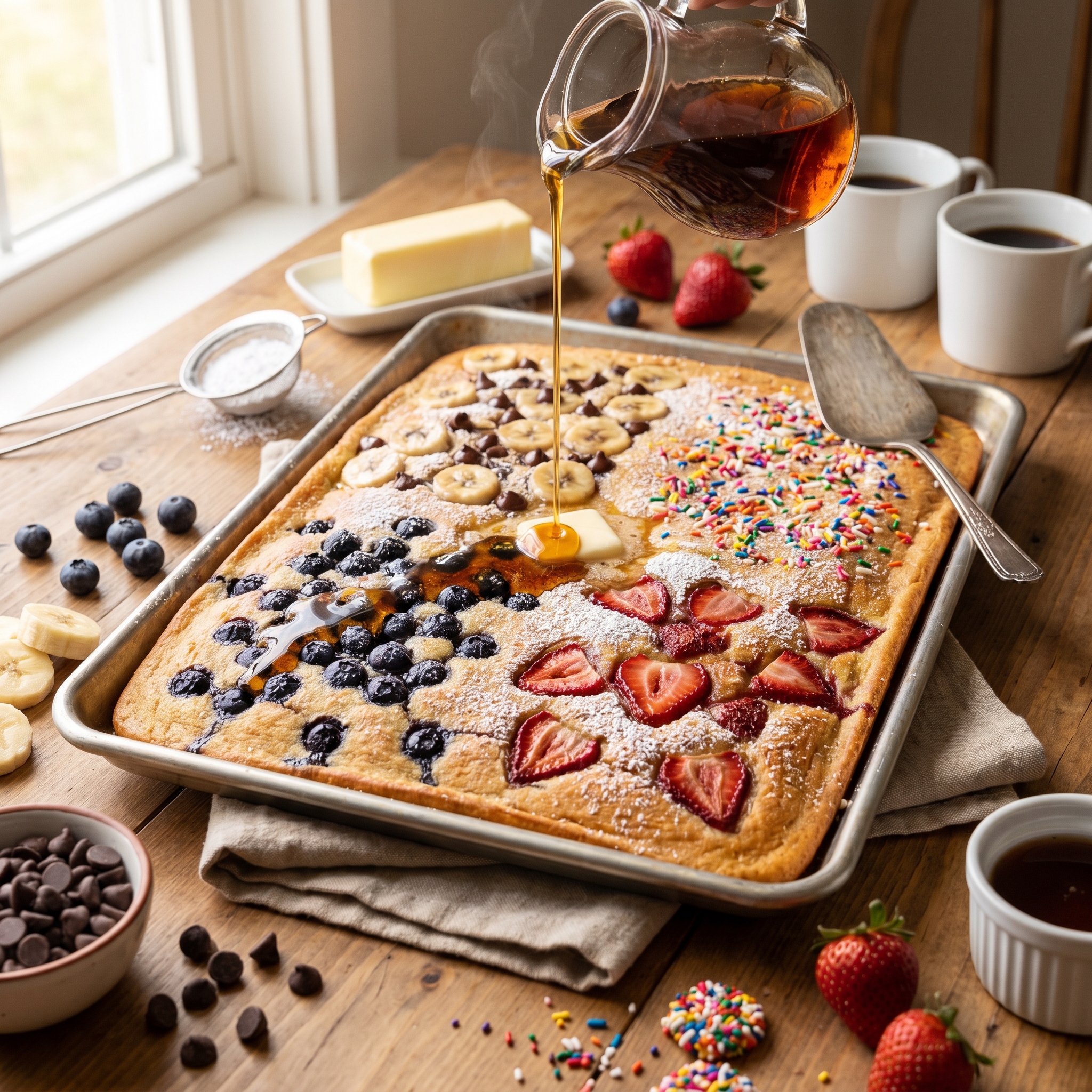
Here is a question worth asking yourself — what if you could make twenty-four perfectly golden, fluffy, ready-all-at-the-exact-same-moment pancakes in a single sheet pan, in a single oven, in about twenty minutes, while you sat at the table with your guests drinking your coffee and actually enjoying the morning you planned this brunch for? Because that is exactly what sheet pan pancakes do. You make the batter, pour it into a greased sheet pan, scatter your toppings across the top in whatever combination your heart desires, slide it into the oven, and walk away. Twelve to fifteen minutes later the whole pan comes out golden and beautiful and you cut it into squares and serve the entire crowd simultaneously — no waiting, no cold pancakes, no stand-at-the-stove martyrdom whatsoever.
This is the sheet pan pancakes for a brunch crowd recipe that I pull out for every Easter morning, every Christmas breakfast, every Mother’s Day brunch, every time family is visiting and I need to feed eight people at once without losing my mind. It is the recipe that makes guests genuinely ask “how did you make all of these at the same time?” — and the answer is so satisfyingly simple it makes everyone laugh. Keep reading — every tip, every topping idea, and every technique detail that makes this recipe completely foolproof is right here waiting for you.
Why This Recipe Works
There are sheet pan recipes and then there are sheet pan recipes that genuinely change the way you cook for a crowd. Here is exactly why these sheet pan pancakes earn a permanent spot in your brunch hosting repertoire:
- ✔ Feeds 8 to 12 people all at the exact same time — no cold pancakes, no one waiting while others eat, no standing at the stove missing the entire brunch you worked to host
- ✔ Ready in about 20 minutes from batter to table — including batter prep, the whole thing is faster than making individual pancakes for six people on a griddle
- ✔ One batter, infinite topping combinations — divide the pan into sections and load each with a different topping so every guest gets exactly what they love without any extra work
- ✔ Uses your regular pancake batter — this is not a special recipe you have to memorize, it is a technique that works with any pancake batter you already love, including store-bought mix
- ✔ Completely make-ahead friendly — the dry ingredients can be prepped the night before so the morning involves nothing more than adding wet ingredients, pouring, topping, and baking
- ✔ Kid-approved and crowd-pleasing without exception — there has never been a brunch guest of any age who did not smile when a sheet pan of golden, fluffy, topping-loaded pancake squares arrived at the table
- ✔ Cheaper and more impressive than any brunch restaurant — feeds twelve people for less than the cost of four restaurant pancake orders and produces a result that looks genuinely stunning on the table
Ready to make the pancake revelation that saves every future brunch you will ever host? Good. Let’s talk ingredients — and please do not skip either of the Chef’s Notes, because the pan preparation tip in the first one is the entire reason these pancakes come out of the pan cleanly instead of sticking and tearing into an unusable mess.
Table of Contents
What You’ll Need
Makes one full 18×13-inch sheet pan — serves 8 to 12 people generously as part of a brunch spread
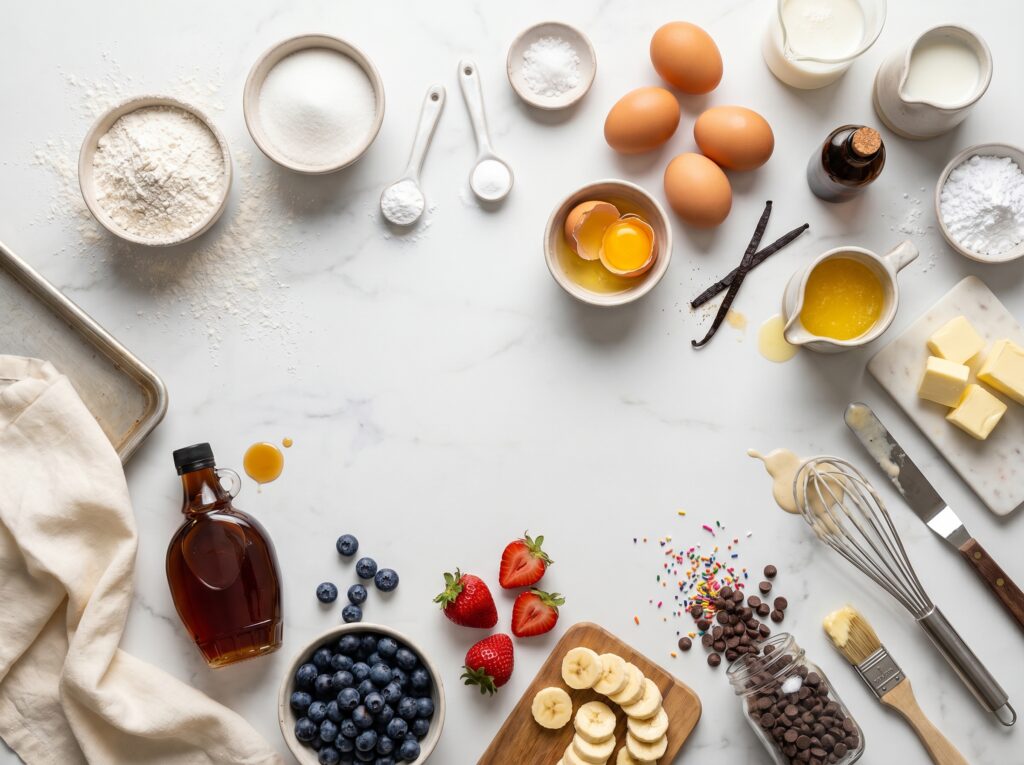
For the Pancake Batter
- 3 cups all-purpose flour
- 3 tablespoons granulated sugar
- 1 tablespoon plus 1 teaspoon baking powder
- ¾ teaspoon fine sea salt
- 2¾ cups whole milk
- 3 large eggs
- 6 tablespoons unsalted butter, melted and cooled slightly
- 2 teaspoons pure vanilla extract
- 1 tablespoon fresh lemon juice or white vinegar (activates the baking powder for extra fluff)
For the Pan
- 3 tablespoons unsalted butter, softened (for greasing the pan — do not use cooking spray alone)
- 2 tablespoons all-purpose flour (for dusting after buttering — the extra insurance step)
Topping Ideas — Mix and Match Across the Pan
- 🫐 Blueberry Lemon: 1 cup fresh blueberries + 1 teaspoon lemon zest scattered over one section
- 🍓 Strawberry: 1 cup fresh strawberries, hulled and thinly sliced
- 🍌 Banana Walnut: 1 ripe banana, thinly sliced + 3 tablespoons chopped toasted walnuts
- 🍫 Chocolate Chip: ½ cup mini chocolate chips scattered over one section
- 🍎 Cinnamon Apple: ½ cup peeled diced apple + 1 teaspoon cinnamon + 1 tablespoon brown sugar
- 🍑 Peach Brown Sugar: ½ cup peeled diced fresh or canned peaches + 1 tablespoon brown sugar
- 🫐 Mixed Berry: A combination of blueberries, raspberries, and blackberries
- ✨ Classic Plain: Just a dusting of powdered sugar after baking for the purists at your table
For Serving
- Pure maple syrup, warmed
- Powdered sugar, for dusting
- Freshly whipped cream
- Extra fresh berries
- Softened butter
- Lemon curd
Substitutions
Want to use a boxed pancake mix? Absolutely — this technique works perfectly with any store-bought pancake mix. Prepare the batter according to the package directions for the equivalent of about 3 cups of dry mix and pour directly into the prepared pan. Store-bought mix saves time and produces excellent results, making this recipe even faster on a busy holiday morning when you have a hundred other things happening simultaneously.
No whole milk? Two-percent milk works well. For an extra fluffy, tangy batter, substitute the whole milk with full-fat buttermilk and reduce the baking powder to 1 tablespoon while adding ½ teaspoon of baking soda. Buttermilk sheet pan pancakes are extraordinary — slightly more tender, slightly more flavorful, and with a beautiful golden color from the lactic acid reacting with the leavening during baking.
No unsalted butter in the pan? A combination of melted butter and parchment paper is actually the most foolproof pan preparation method of all — line the sheet pan with parchment, grease the parchment generously with butter, and you have an essentially non-stick surface that the pancake releases from cleanly without any possibility of sticking. If you use parchment, you can skip the flour-dusting step entirely since the parchment provides complete insurance on its own.
Want to make it dairy-free? Use oat milk or full-fat canned coconut milk in place of whole milk — both produce excellent, fluffy batter. Replace the melted butter in the batter with melted coconut oil and use dairy-free butter or coconut oil to grease the pan. The resulting sheet pan pancakes are genuinely delicious and completely accessible to dairy-free guests without any compromise in texture or flavor.
🧑🍳 Chef’s Note — Pan Preparation Is Everything: Sheet pan pancakes live and die by how well the pan is prepared, and I want to be very specific about this because it is the step that most people under-invest in and then wonder why their pancake tore apart when they tried to cut and serve it. Use softened — not melted — butter applied with a pastry brush or a folded paper towel to coat every inch of the sheet pan interior, including the corners and all the way up the sides. Then dust the buttered pan lightly with flour, tilt and rotate the pan to distribute the flour evenly across every buttered surface, and tap out any excess flour over the sink. This butter-flour combination creates a non-stick coating that is more reliable than cooking spray alone for a batter-based preparation that bakes at oven temperature rather than searing at pan temperature. Better yet — line the buttered pan with parchment paper and then butter the parchment as well for absolute, complete, guaranteed non-stick insurance. The thirty seconds you invest in this step saves you from the heartbreak of a beautifully baked pancake that tears apart on serving.
🧑🍳 Chef’s Note — Do Not Overmix the Batter: The cardinal rule of pancake batter applies here exactly as it does for individual stovetop pancakes — mix until the dry ingredients are just incorporated and the flour has just disappeared, then stop immediately regardless of how many lumps you see. A few lumps in the batter are not only acceptable, they are desirable evidence that you did not overmix. Overmixed pancake batter develops gluten strands that produce a tough, dense, almost rubbery texture in the finished pancake — the opposite of the light, fluffy, tender texture you are after. Stir gently, stop early, and let the oven do the rest of the work. This applies whether you are making individual griddle pancakes or a full sheet pan — the batter does not care about the cooking method when it comes to gluten development.
Pan is prepped, batter rules are memorized, toppings are chosen? Perfect. Let’s make the most effortless, most crowd-pleasing brunch main course you have ever pulled out of your oven — and there is a batter resting tip in the instructions that adds a level of fluffiness to the finished pancake that most sheet pan recipes never bother mentioning.
How to Make Sheet Pan Pancakes for a Crowd — Step by Step
- Preheat the oven and prepare the pan first. Set your oven to 425°F and let it preheat fully — at least 15 minutes, not just until the oven beeps that it is ready, which often happens before the oven has truly stabilized at temperature. A fully preheated oven produces a pancake that rises quickly and evenly from the moment the batter hits the hot pan environment. While the oven preheats, prepare the sheet pan using the softened butter and flour method described in the Chef’s Note above, or line with parchment and butter the parchment. This step happens first, before the batter, so the prepared pan is waiting and ready the moment the batter is mixed.
- Whisk the dry ingredients in a large bowl. In a large mixing bowl, whisk together the flour, sugar, baking powder, and salt until completely combined and evenly distributed. Whisking the dry ingredients separately first ensures the baking powder and salt are distributed evenly throughout the flour — uneven distribution of leavening produces a pancake that rises dramatically in one section and stays flat in another, which is both visually odd and texturally inconsistent. One minute of thorough dry-ingredient whisking prevents that problem entirely.
- Whisk the wet ingredients in a separate bowl. In a medium bowl or large measuring cup, whisk together the milk, eggs, melted cooled butter, vanilla extract, and lemon juice or vinegar until completely smooth and uniform. The acid — whether lemon juice or vinegar — reacts with the baking powder in the flour to produce extra carbon dioxide bubbles during baking, which translates directly into a lighter, fluffier, more dramatically risen sheet pan pancake. Do not skip this ingredient. It costs nothing and adds meaningful lift.
- Combine wet and dry ingredients — gently and briefly. Pour the wet ingredients into the bowl with the dry ingredients and fold together with a rubber spatula using slow, gentle strokes. Stop the moment you can no longer see dry flour — the batter will still look lumpy, slightly rough, and uneven. That is correct and exactly what you want. Do not stir out the lumps. Do not switch to a whisk for the final few strokes. Set the spatula down and step away from the batter.
- Pour the batter into the prepared pan and spread evenly. Pour the rested batter into the center of the prepared sheet pan and use an offset spatula or the back of a large spoon to spread it into an even, uniform layer that reaches all four corners and edges of the pan. The batter should be about ¼ to ⅓ of an inch thick across the entire surface. Uneven batter depth produces sections that are over-baked and dry at thin spots and under-baked and doughy at thick spots — take the extra thirty seconds to spread it completely and uniformly.
- Add the toppings in sections — this is the fun part. Working quickly before the batter begins to set in the warm oven environment, scatter your chosen toppings across the surface of the batter. If you are doing multiple topping sections for a variety crowd, divide the pan visually into quarters or thirds and add a different topping to each section. Gently press the toppings down very slightly with clean fingertips so they are partially embedded in the batter rather than just sitting on top where they might roll off when the pancake is cut and served. Add any cinnamon and brown sugar toppings last since they go on top of the fruit.
- Bake at 425°F for 12 to 15 minutes. Slide the loaded pan into the fully preheated oven and bake for 12 to 15 minutes. The pancake is done when the surface looks set and matte rather than wet and shiny, the edges are visibly golden and pulling slightly away from the sides of the pan, and a toothpick inserted into the thickest section of the plain batter area comes out clean with no wet batter clinging to it. The top will not be deeply golden-brown the way a griddle pancake is — it will be pale golden and set, because the top of a sheet pan pancake bakes rather than sears. The bottom, however, will be beautifully golden where it touched the buttered pan.
- Rest for 2 minutes, then cut and serve. Remove the pan from the oven and let it rest on a wire rack or a folded kitchen towel for 2 full minutes before cutting. This brief rest allows the pancake to firm up slightly and pull away from the edges of the pan completely, making it significantly easier to cut into clean, even squares. Use a sharp knife or a pizza wheel to cut the pancake into squares or rectangles — whatever size makes sense for your crowd and your serving style. Slide a thin spatula under each piece to lift it cleanly from the pan and transfer to plates or a serving platter. Add the fresh garnishes now — powdered sugar, extra berries, a drizzle of warm maple syrup over the platter — and bring it to the table immediately while it is still warm and fragrant and gorgeous.
You just fed your entire brunch crowd simultaneously with one pan and one oven while you sat comfortably at the table with everyone else. That is the sheet pan pancake revolution, and there is absolutely no going back. Now let’s talk about all the wonderful ways to build the perfect brunch spread around it.
How to Serve It
These sheet pan pancakes for a brunch crowd are the anchor that every great brunch spread has been missing. Here are five ways to build an unforgettable morning around them:
- 🌸 Easter and Mother’s Day brunch centerpiece — slide the finished sheet pan pancake onto a large wooden board or bring the pan itself to the table lined with parchment. Set out small pitchers of warm maple syrup, a bowl of fresh mixed berries, softened butter, lemon curd, and a dusting of powdered sugar across the whole pan right before serving. Surround the pancake board with a fruit salad, crispy bacon, a mimosa bar with orange juice and sparkling water alongside the champagne, and fresh flowers on the table. This is the Mother’s Day brunch spread that takes about forty-five minutes of total morning effort and looks like you planned it for a week.
- 🎄 Christmas and holiday morning tradition — the absolute genius of sheet pan pancakes for holiday mornings is that they allow you to be present for the gift opening, the stocking sorting, and every excited moment of the morning instead of standing at the stovetop. Mix the dry ingredients into a bowl the night before. Set the sheet pan with parchment in the oven while it preheats. Christmas morning, add the wet ingredients, stir briefly, pour, top, bake, and you are back at the tree in fifteen minutes with enough pancakes for the entire family hot and ready simultaneously. This is the holiday breakfast habit that makes Christmas morning actually feel like a morning off.
- 🥂 Weekend houseguest breakfast — when family or friends are staying with you and you need to feed four to eight people breakfast without making it a full-time job, sheet pan pancakes are the single smartest choice in your repertoire. The multiple topping sections mean every guest — the blueberry lovers, the chocolate chip loyalists, the plain-with-extra-syrup traditionalists — gets exactly what they want from a single pan with zero extra effort on your part. Set out a full topping and syrup bar and let guests customize their squares at the table.
- 🎓 Graduation and celebration brunch spread — for a party of twelve to twenty people, make two full sheet pans simultaneously in a standard oven (both fit side by side on separate racks) with completely different topping loadouts on each pan — one savory-leaning and one sweet — for a brunch spread that looks extravagant and feeds a large crowd from just two pans and thirty minutes of oven time. Cut into small 2-inch squares and serve as part of a buffet spread with everything from scrambled eggs to fresh fruit to smoked salmon and bagels alongside.
- ☀️ Summer pool and backyard brunch party — load the sheet pan with summer fruit toppings — fresh peaches, mixed berries, sliced strawberries — and serve the cut squares on a big platter alongside a pitcher of fresh-squeezed orange juice and yogurt parfaits. The combination of warm, fruity sheet pan pancake squares and cold, creamy yogurt parfaits is a summer brunch pairing that feels simultaneously luxurious and refreshing. Make it the morning of a pool party and serve it before anyone gets in the water for a full, energizing start to the day.
Before you preheat that oven, let me walk you through the storage details and make-ahead strategies that make this recipe even more useful for busy holiday mornings and repeat weekend brunches.
Storage & Make-Ahead Tips
Dry ingredients — make-ahead: Combine the flour, sugar, baking powder, and salt in a large bowl or zip-top bag the night before and cover or seal. The next morning, all you need to do is add the wet ingredients — a prep shortcut that saves five minutes and one measuring session on a busy holiday morning when every minute counts. This is the move for Christmas morning, Easter Sunday, and every holiday brunch where morning time is precious.
Baked sheet pan pancake — room temperature: The baked pancake can sit at room temperature, loosely covered with foil, for up to two hours without losing significant quality. For a brunch buffet where guests arrive at different times, keep the pan covered and bring it to the table when the last guests arrive — it holds remarkably well and still tastes fresh and delicious at room temperature.
Baked sheet pan pancake — fridge: Store leftover cut squares in an airtight container or zip-top bag in the refrigerator for up to 3 days. They reheat beautifully and make genuinely excellent weekday breakfasts all week from a single Sunday bake — a batch of sheet pan pancakes made on Sunday feeds the family hot breakfasts through Wednesday morning with almost zero effort.
Baked sheet pan pancake — freezer: Sheet pan pancake squares freeze exceptionally well for up to 2 months. Let them cool completely on a wire rack, then freeze in a single layer on a parchment-lined sheet until solid, about 1 hour. Transfer to a zip-top freezer bag with parchment between layers. Reheat from frozen in the toaster, microwave, or oven — no thawing required. Having a bag of frozen sheet pan pancake squares in your freezer is one of the smartest breakfasts-on-demand investments a family can make.
Reheating — toaster (best for crispiness): Pop individual squares directly into the toaster on a medium-high setting for the crispiest, most golden-edged reheated pancake possible. The toaster re-crisps the edges and bottom beautifully while keeping the interior warm and fluffy — this method produces a reheated pancake that is genuinely close to freshly baked.
Reheating — microwave (fastest): Place 2 to 3 squares on a microwave-safe plate covered with a damp paper towel and microwave on medium power for 45 to 60 seconds. The steam from the damp towel keeps the pancake soft and moist rather than dried out. Drizzle with fresh maple syrup immediately after reheating to restore the just-baked feeling.
Reheating — oven (best for a full batch): Arrange squares on a baking sheet and warm in a 325°F oven for 8 to 10 minutes. Cover loosely with foil to prevent drying. This method is ideal when reheating a large number of squares simultaneously for a repeat brunch the next day.
🗓️ Holiday Brunch Make-Ahead Game Plan: Here is the exact strategy that makes this recipe completely stress-free on even the busiest holiday morning. The night before: combine all dry ingredients in the large mixing bowl, cover with plastic wrap, and leave on the counter. Set the sheet pan on the stovetop lined with parchment and already buttered, ready to go. Chop and portion any fresh fruit toppings into small bowls covered with plastic wrap in the refrigerator. Morning of: preheat the oven, whisk the wet ingredients, combine with the dry ingredients in 30 strokes, let rest 5 minutes, pour into the pan, add toppings, bake 12 to 15 minutes. Total active morning time: under 8 minutes. Total result: a full sheet pan of gorgeous, fresh-baked pancakes for twelve people ready simultaneously while you enjoyed your coffee. This is the definition of holiday morning done right.
One more section before you head to the kitchen — the five most important mistakes to avoid so your sheet pan pancakes come out perfectly on the very first try.
Helpful Tips & Common Mistakes
Sheet pan pancakes are one of the most forgiving brunch recipes in existence — but a few small missteps produce results that are dense, sticky, or unevenly baked. Here is how to avoid every single one:
✗ Mistake: Under-preparing the pan and having the pancake stick
✓ Fix: Cooking spray alone is not reliable enough for a sheet pan pancake — it does not provide the same non-stick insurance as softened butter applied thoroughly to every surface, or better yet, parchment paper plus butter. Use the butter-and-flour method or the parchment-and-butter method described in the Chef’s Note and in the ingredients section. Under-greased pan means torn, ragged, impossible-to-serve pancake pieces and a ruined brunch centerpiece. Over-greased pan means perfect, clean, beautiful squares that slide effortlessly onto the spatula. Always err toward more preparation rather than less.
✗ Mistake: Overmixing the batter until smooth
✓ Fix: Smooth, lump-free pancake batter is overworked batter with developed gluten that bakes into a dense, tough, chewy pancake rather than the light, fluffy, tender one everyone came to brunch for. Mix until the dry flour is just gone, accept the lumps as evidence of correct technique, and put the spatula down. The lumps hydrate and disappear during the five-minute batter rest. Do not chase them.
✗ Mistake: Not preheating the oven fully before baking
✓ Fix: An oven that has not fully stabilized at 425°F produces a sheet pan pancake that rises slowly and unevenly, bakes longer than expected, and often develops a dense, rubbery bottom layer before the top has fully set. Wait the full fifteen minutes after the oven signals it has reached temperature before putting the pan in — the oven’s internal signal is often premature by several minutes. A fully stabilized 425°F oven gives the batter the immediate, even heat it needs to rise quickly and bake uniformly from edge to center.
✗ Mistake: Adding wet toppings that release too much liquid during baking
✓ Fix: Very juicy fruits — particularly thawed frozen berries, very ripe peaches, or heavily macerated strawberries — can release so much liquid during baking that the area of batter beneath them never fully sets, producing wet, undercooked spots in an otherwise perfect pancake. Pat wet fruit dry with paper towels before adding it to the batter. Use frozen fruit straight from frozen rather than thawed. Keep very juicy fruits as garnishes added after baking rather than toppings baked into the pancake.
✗ Mistake: Cutting and serving immediately from the oven
✓ Fix: A sheet pan pancake cut the moment it comes out of the oven has not had time to firm up and set from the flexible, slightly fragile state it is in immediately post-bake. The squares tear, smear, and lose their shape rather than cutting cleanly and lifting out in neat, Instagram-worthy pieces. Two minutes of resting on a wire rack allows the structure to stabilize completely. Two minutes. Set a timer, add your fresh garnishes during that time, and then cut. The difference between a just-out-of-the-oven cut and a two-minute-rested cut is immediately and dramatically visible.
Every mistake avoided and every technique locked in — here are four spectacular flavor variations that make this recipe work for every season, every crowd, and every brunch occasion on your calendar.
Recipe Variations
🍋 Lemon Ricotta Sheet Pan Pancakes: Replace ½ cup of the whole milk with ½ cup of whole-milk ricotta cheese whisked smooth into the wet ingredients. Add 1 tablespoon of additional lemon juice and 1 tablespoon of lemon zest to the wet ingredients. Top the batter with fresh blueberries and an extra shower of lemon zest before baking. The ricotta makes the batter extraordinarily creamy and the finished pancake unbelievably tender — almost custardy at the center — while the lemon zest and blueberries give every square a bright, fresh, sunshine-forward flavor that is absolutely perfect for a spring brunch. Dust generously with powdered sugar immediately after baking and serve with lemon curd and whipped cream alongside.
🎃 Pumpkin Spice Sheet Pan Pancakes: Whisk ½ cup of pure pumpkin purée and 1½ teaspoons of pumpkin pie spice into the wet ingredients. Reduce the milk by ¼ cup to compensate for the extra moisture from the pumpkin. Top the batter with a mixture of 3 tablespoons of brown sugar, 1 teaspoon of cinnamon, and 2 tablespoons of melted butter drizzled across the surface for a caramelized, crackled streusel-like top. Bake as directed and serve with warm maple syrup and a dollop of cinnamon whipped cream alongside. This is the October and November version that fills the whole house with the smell of a fall bakery and produces the most enthusiastic brunch table reaction of the entire year — warm, spiced, deeply comforting, and absolutely ideal for a Thanksgiving morning crowd.
🫐 Blueberry Cornmeal Sheet Pan Pancakes: Replace ½ cup of the all-purpose flour with fine yellow cornmeal for a slightly heartier, more rustic batter with a subtly sweet corn flavor and a more interesting texture that many people find even more satisfying than the all-flour version. Add 1 cup of fresh blueberries across the entire surface of the batter before baking and top with a tablespoon of honey drizzled in a zigzag pattern. The cornmeal absorbs moisture slightly differently than flour, so add an extra two tablespoons of milk to the wet ingredients to maintain the correct batter consistency. Serve with warm honey and fresh blueberry compote alongside for a Southern-inspired sheet pan pancake that tastes like the best blueberry cornbread and the best pancake you have ever had somehow became one extraordinary thing.
🍫 Double Chocolate Sheet Pan Pancakes: Add 3 tablespoons of unsweetened cocoa powder to the dry ingredients and increase the sugar to ¼ cup. Add ½ cup of mini dark chocolate chips folded into the finished batter right before pouring into the pan, and scatter another ¼ cup of chocolate chips and 2 tablespoons of chocolate sprinkles across the top of the batter. Bake as directed and serve dusted with powdered sugar and with warm chocolate fudge sauce and whipped cream for dipping alongside. This is the birthday morning version, the snow day version, the “this week has been genuinely hard and we all deserve chocolate pancakes” version — deeply, unabashedly chocolatey and guaranteed to produce the widest smiles at any brunch table of any age group whatsoever.
Make This for Your Next Brunch and Never Look Back
These easy sheet pan pancakes for a brunch crowd are the recipe that genuinely changes the way you think about hosting breakfast and brunch for the people you love. They prove that feeding twelve people a hot, beautiful, made-from-scratch breakfast simultaneously — while staying calm, being present, and actually enjoying the morning yourself — is not only possible but completely easy once you know this one simple technique. Make them this weekend for whoever is lucky enough to be at your table, and watch the look on their faces when every single plate arrives hot at the exact same moment. That look is worth every word of this recipe.
Tried these sheet pan pancakes? I would genuinely love to hear about your topping combinations and see your gorgeous pan — drop a comment and a star rating below, or tag me on Pinterest with your brunch masterpiece! Seeing your holiday morning tables and weekend brunch spreads is truly the best part of sharing recipes. Happy baking and even happier brunching! 🥞✨
Frequently Asked Questions
What size sheet pan do I need for this recipe?
A standard half-sheet pan — 18×13 inches with 1-inch sides — is the ideal size for this recipe and the most common sheet pan size in home kitchens. It produces a pancake of the right thickness to cook through evenly in 12 to 15 minutes at 425°F. A quarter-sheet pan (13×9 inches) can be used to make a half-batch for a smaller crowd of 4 to 6 people — reduce all ingredient quantities by half and check for doneness at the 10-minute mark since the smaller pan size does not significantly change the bake time. Do not use a jelly roll pan with very low sides — the batter can overflow and the lack of side height makes the batter too thin and fragile to cut and serve cleanly.
Can I use boxed pancake mix for sheet pan pancakes?
Yes — absolutely, completely, and without any compromise in the final result. Prepare the boxed pancake mix according to package directions for the volume equivalent of 3 cups of dry mix, then pour the prepared batter into the buttered sheet pan and proceed exactly as directed in this recipe. Boxed mix is an excellent shortcut on busy holiday mornings and the technique works identically regardless of whether the batter is from scratch or from a box. Krusteaz, Bisquick, and most store-brand pancake mixes all produce excellent sheet pan pancakes. The technique is the recipe — the batter is just the vehicle.
Why are my sheet pan pancakes dense instead of fluffy?
Dense sheet pan pancakes are almost always caused by one of three things: overmixed batter that developed too much gluten, baking powder that has expired and lost its leavening power, or an oven that was not fully preheated to 425°F before the pan went in. Check your baking powder by dropping a teaspoon into hot water — it should bubble vigorously and immediately. If it barely fizzes or does nothing at all, replace it before baking. Mix the batter until just combined with visible lumps, rest it for five minutes, and make sure the oven has been at full temperature for at least fifteen minutes before baking. All three of these things together produce the lightest, fluffiest possible sheet pan pancake.
How do I keep the sheet pan pancakes warm while I get everything else ready?
Place the baked sheet pan pancake, loosely covered with foil, in a 200°F oven for up to 30 minutes after baking. The low oven temperature keeps it warm without continuing to cook it or drying it out. Remove the foil for the last five minutes before serving to refresh the slightly softened surface. Alternatively, for a buffet-style setup, bring the pan to the table immediately after baking and cutting — a full sheet pan retains heat remarkably well on a trivet or folded kitchen towel and stays pleasantly warm for 15 to 20 minutes at room temperature, which is plenty of time for a seated brunch.
Can I make sheet pan pancakes the night before and reheat in the morning?
Yes — and this is actually one of the most practical holiday morning strategies available. Bake the full sheet pan the evening before, let it cool completely on a wire rack, cover tightly with plastic wrap, and refrigerate overnight. In the morning, remove the plastic wrap and reheat the entire pan covered loosely with foil in a 325°F oven for 12 to 15 minutes until warmed through. Remove the foil for the last three minutes to re-freshen the surface. Add fresh toppings, dust with powdered sugar, and serve. The texture after overnight refrigeration and oven reheating is genuinely very good — slightly denser than freshly baked but still fluffy, still flavorful, and requiring approximately zero active morning effort beyond turning on the oven.
Can I make sheet pan pancakes gluten-free?
Yes — substitute the all-purpose flour with an equal amount of a quality gluten-free 1-to-1 baking flour blend such as Bob’s Red Mill Gluten-Free 1-to-1 or King Arthur Measure for Measure. These blends contain xanthan gum as a binder that replaces the structural role of gluten in the batter and produce a sheet pan pancake that is very close in texture and quality to the original wheat flour version. Do not use almond flour, coconut flour, or oat flour as direct substitutes without significant recipe modifications — these flours absorb liquid very differently from all-purpose flour and require completely different ratios and leavening amounts to work correctly in a pancake batter.
What is the best temperature to bake sheet pan pancakes?
425°F is the sweet spot for sheet pan pancakes — high enough to create immediate rise from the baking powder and brown the bottom of the pancake against the hot buttered pan, but not so high that the outside sets and browns before the interior has time to cook through completely. Some recipes call for 400°F, which also works but extends the bake time to 18 to 22 minutes and produces slightly less rise and slightly less golden color on the bottom. Avoid going above 450°F — at very high temperatures the edges and bottom brown aggressively before the center is fully cooked, producing an unevenly baked result with overcooked edges and a potentially doughy center.
How many people does one sheet pan pancake serve?
Cut into 12 equal pieces, one full sheet pan serves 6 people generously at 2 large pieces per person as a standalone breakfast. Cut into 16 to 20 smaller squares, the same pan serves 8 to 10 people as part of a full brunch spread that also includes eggs, bacon, fruit, and other accompaniments. For a crowd of 12 or more, make two sheet pans simultaneously — a standard home oven holds two half-sheet pans side by side on separate racks, and both bake in exactly the same time. Rotate the pans halfway through baking if your oven has uneven heat distribution.