

Easy Mother’s Day Brunch Egg Casserole — The Make-Ahead Recipe That Feeds Everyone at Once
Imagine sliding a bubbling, golden-topped egg casserole out of the oven on Mother’s Day morning while the whole house fills with the smell of melted cheese, crispy bacon, and fresh herbs — and the most incredible part? You made the whole thing the night before and all you did this morning was turn on the oven. That’s the gift this Mother’s Day brunch egg casserole gives you — a stunning, crowd-feeding, absolutely delicious breakfast that requires almost zero morning effort so you can actually enjoy the holiday instead of spending it chained to the stove.
Here’s a question for all the dads, kids, and family members reading this right now — how many times have you tried to make Mom a special breakfast only to hand her a plate of lukewarm eggs while yours got cold because you were still cooking? Sound painfully familiar? This recipe completely solves that problem. One dish, one oven, everyone eats hot at the same time, and Mom gets to sit down and actually enjoy her own Mother’s Day brunch. Have you ever given a gift that tasted this good?
Whether you’re hosting the whole family for a big Mother’s Day celebration, making a special weekend brunch for just the two of you, feeding a houseful of overnight guests, or looking for the ultimate Easter morning make-ahead breakfast — this egg casserole recipe is the one that makes everyone feel taken care of, celebrated, and completely satisfied. Keep reading — I’m sharing every tip and trick I’ve learned to make this recipe absolutely foolproof and genuinely spectacular.
Table of Contents
Why This Recipe Works
This isn’t just breakfast — this is the make-ahead brunch centerpiece that completely changes how you host on special mornings. Here’s why this Mother’s Day brunch egg casserole is about to become your most reliable holiday recipe:
- ✔ 100% make-ahead — assemble the night before and simply bake the morning of
- ✔ Feeds 10–12 people from one dish — no cooking in shifts, no cold eggs, no chaos
- ✔ Uses simple pantry and fridge staples that come together into something truly special
- ✔ Endlessly customizable — swap the mix-ins to match everyone’s tastes and dietary needs
- ✔ Kid-approved AND elegant enough for company — it works beautifully at every kind of table
- ✔ Perfect for Mother’s Day, Easter, Christmas morning, and holiday brunches
- ✔ Budget-friendly enough to feed a crowd without breaking the bank on a holiday weekend
Fluffy eggs, crispy bacon, sweet caramelized onions, melted cheese, and a custardy bread base that soaks up every single drop of flavor overnight — this is the brunch recipe Mom actually deserves. Let’s make sure you have everything you need.
What You’ll Need
For the Egg Casserole Base
- 12 large eggs
- 2 cups whole milk
- ½ cup heavy cream
- 1 teaspoon salt
- ½ teaspoon black pepper
- ½ teaspoon garlic powder
- ½ teaspoon onion powder
- ½ teaspoon dry mustard powder
- ¼ teaspoon smoked paprika
- Pinch of cayenne pepper (optional — just a tiny one)
For the Fillings
- 1 lb thick-cut bacon, cooked and crumbled (or 1 lb breakfast sausage, cooked and crumbled)
- 1 medium yellow onion, diced and sautéed until soft and golden
- 1 red bell pepper, diced
- 1 cup fresh baby spinach, roughly chopped
- 1 cup mushrooms, sliced and sautéed until golden (optional)
- 3 garlic cloves, minced
- 2 tablespoons unsalted butter (for sautéing the vegetables)
For the Bread Layer
- 1 loaf (about 12 oz) day-old French bread or sourdough, cut into 1-inch cubes (about 8 cups)
- 2 tablespoons unsalted butter, melted (for tossing the bread cubes)
For the Cheese Topping
- 2 cups sharp cheddar cheese, freshly shredded — divided
- ½ cup Gruyère or Swiss cheese, shredded (optional but magnificent)
- 2 tablespoons fresh chives or green onions, thinly sliced (for garnish)
- Fresh parsley, roughly chopped (for garnish)
For Greasing the Pan
- 1 tablespoon softened butter or non-stick cooking spray
Substitutions
No French bread? Croissants torn into pieces, brioche cubes, or even plain sandwich bread all work beautifully — just make sure the bread is slightly stale or day-old for the best absorption. No heavy cream? Substitute with half-and-half or just use all whole milk — the casserole will be slightly less rich but still incredibly delicious. No bacon? Ham cubes, cooked breakfast sausage, crumbled turkey sausage, or even smoked salmon work wonderfully as protein swaps. Making it vegetarian? Simply skip the meat entirely and double up on the vegetables — it’s just as satisfying and deeply flavorful.
Chef’s Note — Day-Old Bread Is Non-Negotiable: Fresh bread is too moist and too soft to hold up to the overnight egg soak — it turns to mush and creates a dense, gummy casserole that nobody wants on Mother’s Day morning. Day-old or slightly stale bread has dried out just enough to absorb the egg custard like a sponge while still holding its structure, giving you those distinct, custardy bread cubes in every bite. If your bread is fresh, spread the cubes on a baking sheet and dry them in a 300°F oven for 10–15 minutes before using. Problem completely solved.
Chef’s Note — Freshly Shredded Cheese Only: Please step away from the pre-shredded bags for this one. Pre-shredded cheese is coated with anti-caking agents like cellulose that prevent it from melting smoothly — you end up with a grainy, oily top instead of that gorgeous, bubbly, golden-brown cheese layer that makes this casserole look like it came straight out of a five-star brunch kitchen. Two minutes of shredding a block of sharp cheddar makes an absolutely enormous difference in the finished dish.
Everything prepped and ready? Let’s build this beautiful make-ahead masterpiece.
How to Make Mother’s Day Brunch Egg Casserole — Step by Step
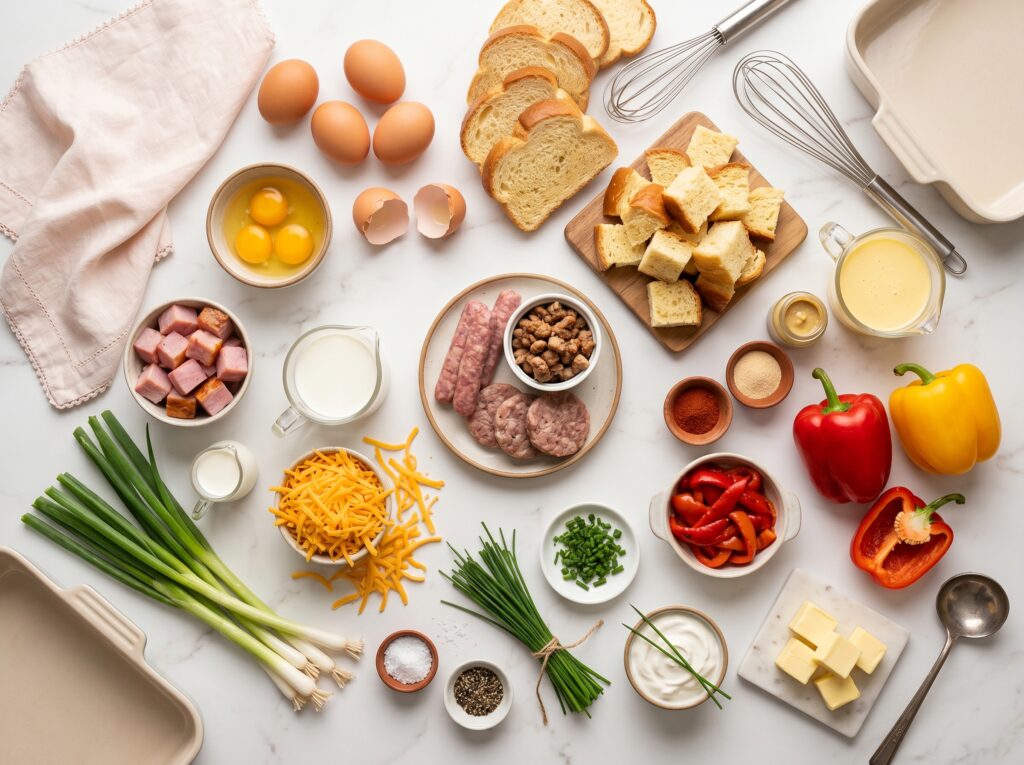
- Cook the bacon and sauté the vegetables. Cook the bacon in a large skillet over medium heat until crispy. Drain on paper towels, then crumble into generous pieces — not tiny bits, but satisfying chunky crumbles that you’ll actually find in every forkful. In the same skillet with 1–2 tablespoons of the bacon drippings (or use fresh butter), sauté the diced onion and bell pepper over medium heat for 6–8 minutes until softened and lightly golden. Add the garlic and cook for 1 more minute. Add the spinach and stir just until wilted — about 30 seconds. Remove from heat and let the vegetable mixture cool slightly.
- Prepare the bread cubes. Cut your day-old bread into 1-inch cubes and toss them in 2 tablespoons of melted butter until lightly coated. This butter coating gives the bread cubes a subtle richness and helps the top layer get slightly golden and crisp during baking instead of just staying soft throughout. Set aside.
- Whisk the egg custard mixture. In a very large bowl, whisk together the eggs, whole milk, heavy cream, salt, pepper, garlic powder, onion powder, dry mustard, smoked paprika, and cayenne until completely smooth and well combined. The dry mustard is a small but mighty addition here — it doesn’t make the casserole taste like mustard, it amplifies the savory, cheesy flavors in a way that makes everyone ask what your secret ingredient is.
💡 Pro Tip: For the fluffiest, most evenly cooked egg casserole, whisk the egg mixture really well — a full 60 seconds of vigorous whisking incorporates air into the eggs and creates that light, almost soufflé-like texture that makes this casserole feel luxurious rather than dense and rubbery. A hand blender pulsed for 15 seconds works even better if you have one handy.
- Grease the baking dish generously. Butter a 9×13-inch baking dish thoroughly on the bottom and all four sides. This casserole has cheese and egg that will stick and burn on any ungreased surface — don’t be shy with the butter. Set the dish on a rimmed baking sheet to catch any potential overflow during baking.
- Layer the casserole. Spread half of the buttered bread cubes in an even layer across the bottom of the prepared baking dish. Scatter half of the bacon crumbles and half of the sautéed vegetable mixture over the bread. Sprinkle ¾ cup of the shredded cheddar over this layer. Add the remaining bread cubes on top, followed by the remaining bacon and vegetables. This layering method ensures that every single forkful of this casserole contains bread, meat, vegetables, and cheese in perfect proportion — no sad bites of plain bread.
- Pour the egg custard over everything. Slowly and evenly pour the whisked egg custard mixture over the entire layered casserole. Use a spatula or the back of a large spoon to gently press down on the bread cubes so they start absorbing the liquid. Every piece of bread should have contact with the egg mixture. Scatter the remaining 1¼ cups of shredded cheddar and the Gruyère evenly across the entire top surface.
💡 Pro Tip: After pouring the egg mixture and adding the top cheese layer, cover the dish tightly with plastic wrap and press down gently on the surface one more time to ensure maximum bread absorption. Then refrigerate overnight — a minimum of 8 hours and up to 24 hours. The longer it soaks, the more custardy, cohesive, and deeply flavored the finished casserole becomes. This overnight rest is where the magic truly happens.
- Bake low and slow to golden perfection. The next morning, remove the casserole from the refrigerator and let it sit on the counter for 20–30 minutes while your oven preheats to 350°F — bringing it slightly toward room temperature ensures more even cooking throughout. Uncover the dish, place it on the center rack, and bake for 50–60 minutes until the top is deeply golden brown, the cheese is bubbling around the edges, and the center is completely set — a knife inserted in the very center should come out clean with no liquid egg running.
- Rest, garnish, and serve. Remove the casserole from the oven and let it rest for 10 full minutes before cutting — this resting time lets the egg custard finish setting and makes for clean, beautiful slices instead of a runny, collapsing mess on the serving plates. Scatter fresh chives and parsley over the top, slice into generous squares, and serve straight from the baking dish. Happy Mother’s Day — breakfast is served and it is absolutely stunning.
Now let’s talk about all the beautiful ways to build the perfect Mother’s Day brunch around this casserole.
How to Serve It
This Mother’s Day brunch egg casserole is the anchor of a truly spectacular brunch spread. Here are our favorite ways to round out the table:
- 🌸 Mother’s Day brunch centerpiece — serve on a beautiful trivet right in the baking dish surrounded by fresh flowers, mimosas, and fruit for the most effortlessly elegant holiday table you’ve ever hosted
- 🍓 Pair with fresh fruit and pastries — a simple bowl of strawberries, raspberries, and melon alongside store-bought croissants or muffins rounds this out into a full and completely satisfying brunch spread in under 10 minutes of additional effort
- 🥗 Add a simple green salad — a light arugula salad with lemon vinaigrette alongside the rich, cheesy casserole cuts through the richness beautifully and makes the meal feel complete and balanced
- 🐣 Easter morning breakfast — assemble on Saturday night, slide into the oven Sunday morning while the kids hunt for eggs, and have a hot, homemade breakfast waiting when everyone comes inside
- 🎄 Christmas and holiday morning tradition — this recipe has converted more families to make-ahead holiday breakfasts than any other dish I know — once you make it, it becomes the tradition everyone looks forward to all year
Set it out, let everyone serve themselves, and actually sit down to enjoy the celebration instead of working through it. You absolutely deserve that too. Now let’s talk about making the most of every last square.
Storage & Leftovers
Refrigerator: Store leftover baked egg casserole tightly covered with plastic wrap or aluminum foil in the refrigerator for up to 4 days. The casserole actually holds up remarkably well as leftovers — the flavors continue to meld and it reheats beautifully without falling apart.
Freezer: This casserole freezes surprisingly well for up to 2 months. Cut the completely cooled casserole into individual portions, wrap each piece tightly in plastic wrap, and place in a zip-lock freezer bag. Thaw overnight in the refrigerator and reheat as directed below. It’s a genuinely wonderful freezer breakfast option for busy weekday mornings throughout the month after your holiday brunch.
Unbaked Make-Ahead: The assembled but unbaked casserole can be refrigerated for up to 24 hours before baking — this is the intended make-ahead method and the overnight soak is actually what makes the casserole taste best. Do not exceed 24 hours unbaked or food safety becomes a concern with the raw egg mixture.
Make-Ahead Tip: Here is the Mother’s Day morning game plan that will make you feel like the most organized, thoughtful, and together host on the entire block. Saturday evening after dinner — 20 minutes to assemble the casserole, cover it, and slide it into the fridge. Sunday morning — preheat the oven, pull the casserole out to rest on the counter, make the coffee, set the table, and arrange the flowers while the oven heats up. Then bake while everyone opens cards and spends time together. By the time brunch is ready, the whole morning has been warm, relaxed, and full of actual togetherness instead of kitchen stress. That is the real Mother’s Day gift.
Reheating:
— Oven (best method): Cover individual portions or the whole casserole loosely with foil and reheat at 325°F for 15–20 minutes until warmed through and the cheese is bubbly again. This method restores the texture almost completely to its just-baked glory.
— Microwave: Place a square on a microwave-safe plate, cover with a damp paper towel, and heat in 45-second intervals on medium power until heated through. Quick and easy for weekday morning leftovers — it won’t be quite as crispy on top but it’ll be perfectly delicious.
Just ahead — the five most common egg casserole mistakes that lead to soggy bottoms, rubbery eggs, and stuck-on cheese, and exactly how to avoid every single one of them.
Helpful Tips & Common Mistakes
Want a perfectly golden, perfectly set, perfectly sliceable brunch egg casserole every single time? Dodge these very common mistakes:
✗ Mistake: Using fresh bread instead of day-old bread.
✓ Fix: Fresh bread is too moist to absorb the egg custard properly — it disintegrates into a gummy, dense, unappetizing layer at the bottom of the dish. Always use day-old or slightly stale bread. No stale bread on hand? Spread the cubes on a baking sheet and dry them in a 300°F oven for 10–15 minutes. Five extra minutes of prep time, dramatically better results.
✗ Mistake: Skipping the overnight soak and baking immediately.
✓ Fix: The overnight refrigerator soak isn’t just a convenience — it’s what transforms a pile of layered ingredients into a cohesive, deeply flavored, custardy casserole. A minimum of 8 hours of soaking time is essential. Assembled and baked immediately, you get dry bread patches and uneven egg distribution. Assembled and refrigerated overnight, you get a casserole that tastes like it took all day to prepare.
✗ Mistake: Adding vegetables to the casserole raw without pre-cooking them.
✓ Fix: Raw vegetables — especially onions, bell peppers, and mushrooms — release significant amounts of water as they cook inside the casserole, creating pockets of liquid that make the surrounding egg custard watery and prevent it from setting properly. Always sauté your vegetables until they’re softened and any excess moisture has cooked off before layering them into the dish. This step takes 8 minutes and makes an enormous difference.
✗ Mistake: Pulling the casserole out of the oven before it’s fully set in the center.
✓ Fix: The top of a casserole browns and looks done long before the center is actually cooked through. Always test the center with a knife or instant-read thermometer — the knife should come out clean with no liquid egg, and the internal temperature should reach 160°F. If the top is browning too fast before the center sets, tent it loosely with aluminum foil and continue baking until fully done.
✗ Mistake: Cutting into the casserole the moment it comes out of the oven.
✓ Fix: A freshly baked egg casserole needs a 10-minute resting period before it’s sliced — just like a roast or a lasagna. Cutting too soon releases the steam and causes the custard to collapse and run, giving you a sloppy, unsliceable mess on the plate instead of those clean, beautiful squares. Ten minutes of patience delivers a casserole that holds together perfectly and looks absolutely stunning on the plate.
Nail all five of these and you will put a brunch casserole on the Mother’s Day table that earns a standing ovation from everyone at the table.
Recipe Variations
Once you’ve mastered the classic version, here are some irresistible directions to take your egg casserole to match any crowd, occasion, or flavor craving:
🌿 Vegetarian Garden Version: Skip the bacon entirely and load the casserole with a full vegetable medley — sautéed zucchini, cherry tomatoes halved and roasted, sun-dried tomatoes, caramelized onions, artichoke hearts, and a generous handful of fresh baby spinach. Swap the cheddar for a combination of feta and mozzarella. This version is bright, fresh, and completely beautiful — and no one at the table misses the meat for a single second.
🌶️ Southwest Spicy Version: Add 1 can of drained green chiles, 1 cup of canned black beans (rinsed and drained), ½ cup of corn kernels, and 1 teaspoon of cumin to the filling. Swap the cheddar for pepper jack cheese throughout. Serve with fresh salsa, sour cream, sliced avocado, and hot sauce on the side. This version turns a Mother’s Day brunch into a full-on Tex-Mex celebration that the whole family absolutely goes wild for.
🥂 Elegant Ham and Gruyère Version: Replace the bacon with ½ lb of good quality deli ham cut into small cubes. Use all Gruyère cheese instead of cheddar and add 2 teaspoons of fresh thyme leaves to the egg custard mixture. This sophisticated, French-inspired version is quieter and more refined — perfect for an intimate Mother’s Day brunch for two or a small, elegant gathering where the occasion calls for something a little more special and grown-up.
🍄 Mushroom Brie and Herb Version: Sauté 2 cups of mixed mushrooms (cremini, shiitake, and oyster) in butter with garlic and fresh thyme until deeply golden and caramelized. Scatter cubed Brie (rind removed) throughout the casserole layers instead of shredded cheddar. Finish the top with fresh thyme sprigs before baking. The Brie melts into the egg custard and creates the most luxurious, creamy, deeply savory casserole that tastes like something from a very upscale brunch restaurant — for a fraction of the price.
Each variation uses the exact same base method — master the classic once and you have four completely different showstopping brunch casseroles in your repertoire forever.
Ready to Give Mom the Brunch She Actually Deserves?
This Mother’s Day brunch egg casserole is the kind of make-ahead, feeds-a-crowd, genuinely delicious recipe that makes the whole holiday feel effortless and warm and full of the kind of togetherness that Mother’s Day is actually supposed to be about. No frantic morning cooking, no cold eggs, no one left out — just a beautiful dish, a full table, and a mom who feels completely celebrated and cherished.
If you make this recipe for your family this Mother’s Day, I would absolutely love to hear how it went! Drop a comment below with your experience, leave a star rating so other families can find this recipe, or tag me on Pinterest with your gorgeous brunch spread — nothing fills my heart more than seeing your holiday tables. Now go assemble that casserole tonight, get a good night’s sleep, and let the oven do all the work in the morning. Mom is going to love every single bite. 🌸🍳
Frequently Asked Questions
Can I assemble this egg casserole the night before?
Yes — and that’s exactly how this recipe is designed to be made. Assembling the night before isn’t just convenient, it’s what makes the casserole taste its absolute best. The bread cubes absorb the egg custard overnight, the flavors meld and deepen, and the whole dish becomes that gorgeous, cohesive, custardy texture that makes everyone ask for seconds. Assemble Saturday evening, bake Sunday morning — Mother’s Day brunch becomes completely stress-free.
How long can the unbaked casserole sit in the fridge?
Up to 24 hours is the sweet spot — and honestly the more time it has to soak, the better it tastes. Do not go beyond 24 hours with raw eggs in the mixture for food safety reasons. If you need to get further ahead than that, you can prep and freeze all the cooked components separately — bacon, sautéed vegetables — and assemble the full casserole the night before baking.
Can I make this egg casserole without bread?
Absolutely — a breadless egg casserole is essentially a baked frittata and is naturally gluten-free and lower carb. Simply grease your baking dish, layer your cooked fillings and cheese directly in the dish, and pour the egg custard mixture (you may want to reduce it slightly to 10 eggs and 1½ cups of milk) over the top. Bake at 350°F for 35–45 minutes until set. The texture will be denser and more quiche-like without the bread, but still incredibly delicious.
How do I know when the egg casserole is fully cooked?
Three reliable tests — first, insert a thin knife into the very center of the casserole and it should come out clean with no liquid egg clinging to it. Second, gently shake the pan and the center should be fully set with no jiggling or sloshing. Third, an instant-read thermometer inserted into the center should read 160°F. The top will be deeply golden brown and you’ll see the cheese bubbling actively around the edges of the dish. All three signs together mean your casserole is perfectly done.
Can I freeze this egg casserole?
Yes — the baked and fully cooled casserole freezes well for up to 2 months. Cut into individual squares, wrap each piece tightly in plastic wrap, and place in a labeled zip-lock freezer bag. Thaw overnight in the refrigerator and reheat covered in a 325°F oven for 15–20 minutes. The texture is very good after freezing — slightly less custardy than fresh-baked but still deeply delicious and far better than most frozen breakfast options.
Can I make this casserole gluten-free?
Yes! Simply substitute the French bread or sourdough with your favorite gluten-free bread — look for a hearty, crusty variety rather than a soft sandwich-style loaf for the best texture. Dry the cubes in a low oven first since gluten-free bread tends to be softer and moister than regular bread. All other ingredients in this recipe — eggs, milk, cream, cheese, bacon, and vegetables — are naturally gluten-free. It’s a simple swap that makes this dish accessible for everyone at the table.
My casserole top is browning but the center is still jiggly — what do I do?
This is a very common situation with egg casseroles and the fix is simple — tent the dish loosely with aluminum foil to shield the top from direct oven heat, then continue baking until the center is fully set. Check every 10 minutes with a knife test. The foil prevents the cheese from over-browning or burning while giving the custard the additional time it needs to cook through completely. This usually adds 10–15 extra minutes of baking time.
Can I make individual egg casseroles in muffin tins instead of one large dish?
Yes — and it’s a wonderful option for brunches where people have different dietary preferences or where grab-and-go portioning would be helpful. Use a standard 12-cup muffin tin generously greased with butter. Fill each cup about ¾ full with your layered ingredients and egg custard mixture. Bake at 350°F for 20–25 minutes until puffed, set in the center, and golden on top. They pop out beautifully and make an adorable, individually portioned presentation that guests absolutely love.