
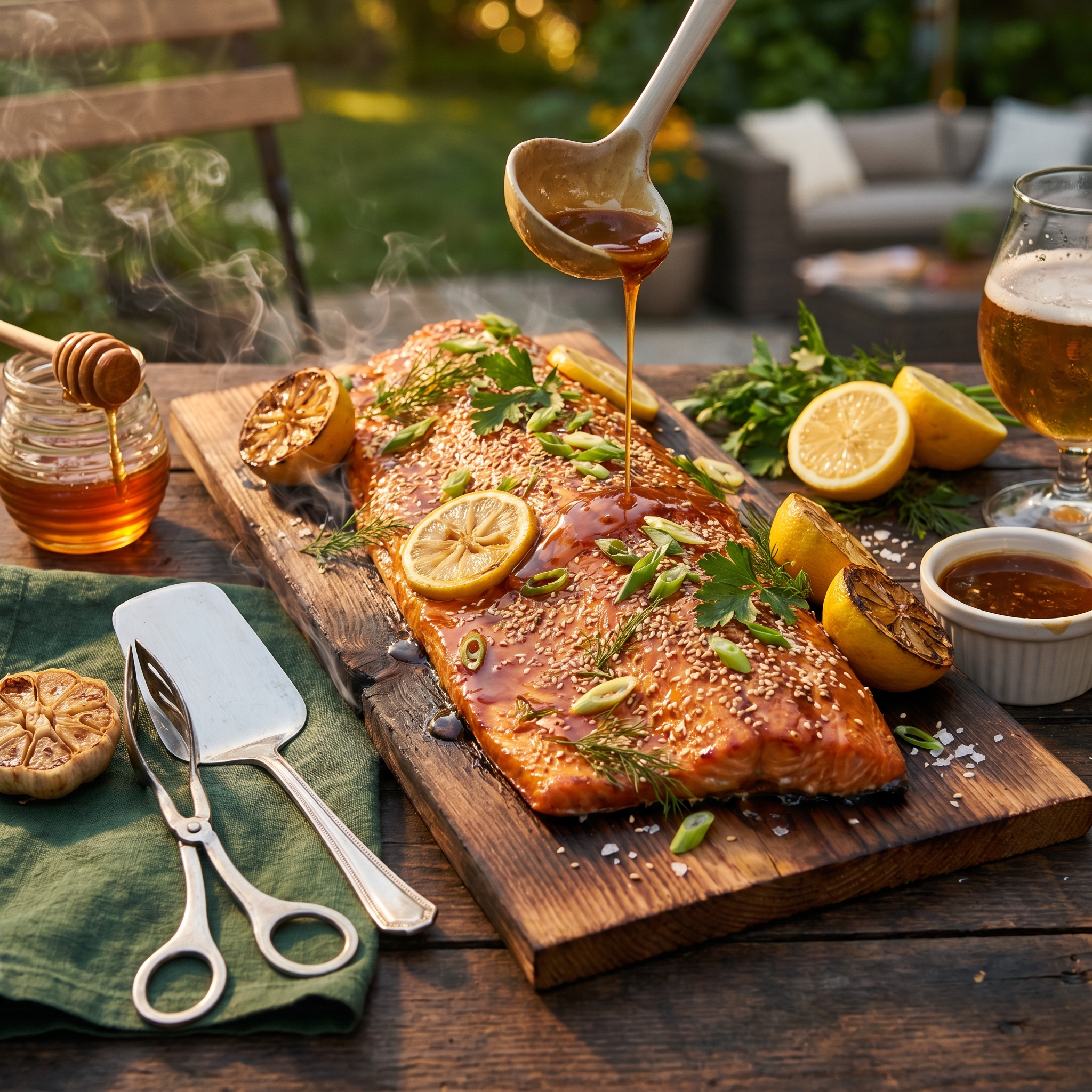
Show-Stopping Cedar Plank Salmon with Honey Garlic Glaze: 9 Reasons This Is the Only Father’s Day Recipe You Need
It started the Father’s Day my husband declared he was done with store-bought steaks and wanted something that felt like a real occasion — something that looked impressive, smelled incredible coming off the grill, and tasted like it took more skill than it actually did. He’d had cedar plank salmon at a restaurant in Nashville the summer before and talked about it for months afterward. So that June Sunday I soaked a cedar plank overnight, whisked together a honey garlic glaze with things I already had in my pantry, and set that beautiful side of salmon on the grill with a cold beer in my hand and about forty minutes to spare. When I carried it to the table still on the plank — fragrant with cedar smoke, glistening with that amber glaze, the edges just starting to caramelize — his face said everything. That was four Father’s Days ago. We have not done anything else since.
Have you ever wanted to make something for the dad in your life that actually feels special — not just dinner, but a moment — without spending six hours in the kitchen or dropping a hundred dollars at a steakhouse? If you’ve been searching for a Father’s Day recipe that looks like a serious culinary achievement but comes together with about 20 minutes of active work, then cedar plank salmon with honey garlic glaze is exactly what you’ve been looking for. The cedar plank does most of the heavy lifting — it infuses the salmon with a deep, smoky woodsy flavor that no amount of liquid smoke or seasoning can replicate — and the honey garlic glaze does the rest.
Whether you’re the one planning the Father’s Day cookout this year, a dad who wants to make this for yourself because frankly you deserve it, or someone who has cooked salmon a hundred times and wants a version that finally feels worthy of a celebration — keep reading. This recipe has earned its place as our family’s most-requested special occasion meal, and once you make it, you’ll understand why completely.
Table of Contents
Why This Recipe Works
Cedar plank salmon works because of a beautiful piece of food science: the soaked cedar plank sits between the salmon and the direct heat of the grill, gently steaming the fish from below while the wood slowly smolders and perfumes everything above it. The result is salmon that is impossibly moist and tender in a way that direct-grilled salmon never quite achieves — and layered with a smoky cedar complexity that makes every bite taste like it came from a serious restaurant kitchen.
- ✔ Looks like a million dollars on the table — Carrying a whole side of salmon to the table still on the cedar plank, glistening with honey garlic glaze and scattered with fresh herbs, is one of the most visually dramatic things you can do at a backyard cookout. It earns a reaction every single time.
- ✔ Only about 20 minutes of active work — Soak the plank, make the glaze, put the salmon on the grill, close the lid. The grill does the rest. This is a recipe that gives you a lot of impressive output for a modest amount of effort.
- ✔ The honey garlic glaze is genuinely extraordinary — Honey, minced garlic, soy sauce, Dijon mustard, a splash of bourbon, fresh lemon juice, and a pinch of red pepper flakes. It caramelizes against the heat of the grill into something deeply savory, sweet, and slightly smoky that coats every inch of the fish.
- ✔ The cedar plank keeps the salmon perfectly moist — No more dry, overcooked grilled salmon. The plank creates a gentle, even cooking environment that practically eliminates the risk of ruining an expensive piece of fish.
- ✔ Works on any grill — Gas, charcoal, or pellet grill — the technique is identical and the results are equally spectacular across all three. You can even do this in the oven if the weather doesn’t cooperate.
- ✔ Feeds a crowd without drama — One large salmon fillet on a full-size plank feeds four to six people comfortably. Scale up by using two planks side by side and you’re feeding a party of ten with the same effort.
- ✔ Father’s Day worthy in every way — This is the kind of recipe that feels like a gift. It communicates effort and thoughtfulness without requiring either in overwhelming amounts — which is exactly the balance a great Father’s Day meal should strike.
Let’s get into everything you need to pull this off, starting with the plank — because the plank is where this whole recipe begins.
What You’ll Need
This recipe serves 4 to 6 people and is built around one large salmon fillet — the kind of centerpiece piece that makes a table feel like a celebration. Everything here is available at Walmart, Costco, or your local grocery store, and the cedar planks are easy to find at any hardware store, Walmart, or online.
For the Cedar Plank Setup
- 1 untreated cedar grilling plank, approximately 7 x 15 inches (Western Cedar or similar — food-grade, never pressure-treated)
- Water for soaking (enough to fully submerge the plank)
- A heavy bowl, pot, or full water bottle to weigh the plank down while it soaks
For the Salmon
- 1 large salmon fillet, skin-on, approximately 2 to 2½ lbs (Atlantic or King salmon preferred — the higher fat content keeps it moist and rich)
- 1 teaspoon kosher salt
- ½ teaspoon black pepper
- ½ teaspoon garlic powder
- ½ teaspoon smoked paprika
- 1 tablespoon olive oil (to coat the salmon before glazing)
For the Honey Garlic Glaze
- ⅓ cup good honey (local wildflower honey or clover — something with real flavor)
- 4 cloves garlic, finely minced or pressed
- 2 tablespoons low-sodium soy sauce
- 1 tablespoon Dijon mustard
- 2 tablespoons bourbon (optional but deeply, deeply recommended — Jim Beam or Maker’s Mark both work beautifully)
- 1 tablespoon fresh lemon juice
- 1 teaspoon lemon zest
- ½ teaspoon crushed red pepper flakes
- 1 tablespoon unsalted butter, melted
- Salt and black pepper to taste
For Finishing and Serving
- Fresh dill or flat-leaf parsley, roughly chopped
- Thinly sliced scallions
- Lemon wedges for squeezing
- Flaky sea salt for finishing (Maldon if you have it)
- Extra honey for a final drizzle, optional
Optional Add-Ins and Upgrades
- Thin slices of fresh lemon laid under the salmon before grilling for extra citrus perfume
- Fresh thyme or rosemary sprigs placed on the plank around the salmon
- A tablespoon of brown sugar added to the glaze for deeper caramelization
- Sriracha or sambal oelek stirred into the glaze for a spicy honey garlic version
- Toasted sesame seeds scattered over the finished salmon
- Sliced almonds pressed lightly into the glaze before grilling
- A smear of cream cheese and capers under the salmon for a smoked salmon-inspired base layer
Substitutions
What if I can’t find cedar planks? Cedar planks are genuinely the best option here and are more widely available than most people realize — hardware stores like Home Depot and Lowe’s carry untreated western red cedar boards that you can cut to size for a fraction of the cost of grocery store grilling planks. Walmart and Target both carry pre-cut grilling planks in the outdoor cooking section, usually around $5 to $8 for a two-pack. Alder wood planks are a beautiful alternative — they give a lighter, more delicate smokiness that pairs elegantly with salmon. Avoid hickory or mesquite planks for fish; they’re too aggressive and will overpower the delicate flavor of the salmon.
What if I don’t want to use bourbon in the glaze? The bourbon adds a warm, caramel depth that plays beautifully against the honey and garlic, but it’s easy to leave out or substitute. Apple juice or apple cider vinegar (reduce to 1 teaspoon if using vinegar) adds a similar fruity complexity without the alcohol. A tablespoon of Worcestershire sauce deepens the umami in a different direction and works really well. Or simply leave it out entirely — the glaze is excellent without it, just slightly less complex.
Can I use salmon fillets instead of a whole side? Individual salmon fillets work perfectly on a cedar plank — just arrange them skin-side down on the soaked plank with a little space between each one, glaze them the same way, and reduce the total cook time slightly since thinner individual portions cook faster than a thick whole fillet. Plan for about 12 to 15 minutes for standard 6-oz fillets versus 18 to 22 minutes for a full side. Individual portions also make plating easier if you’re serving a formal sit-down Father’s Day dinner.
🧑🍳 Chef’s Note — Soak Time: One hour is the minimum soak time for your cedar plank — but two hours is better and overnight is best of all. A thoroughly soaked plank smolders slowly and imparts steady, even cedar smoke throughout the entire cook. An under-soaked plank catches fire too quickly, chars unevenly, and can actually ignite and ruin your cook. If you’re pressed for time, submerge the plank in hot water to accelerate absorption — 45 minutes in hot water is roughly equivalent to 90 minutes in cold.
🧑🍳 Chef’s Note — Salmon Temperature: Pull the salmon off the grill when it reaches an internal temperature of 125°F to 130°F for medium — slightly translucent in the very center, flaking beautifully at the edges. The USDA recommends 145°F for food safety, which produces fully cooked salmon. Both are correct; the lower end is the restaurant standard for optimal texture and moisture.
How to Make Cedar Plank Salmon with Honey Garlic Glaze — Step by Step
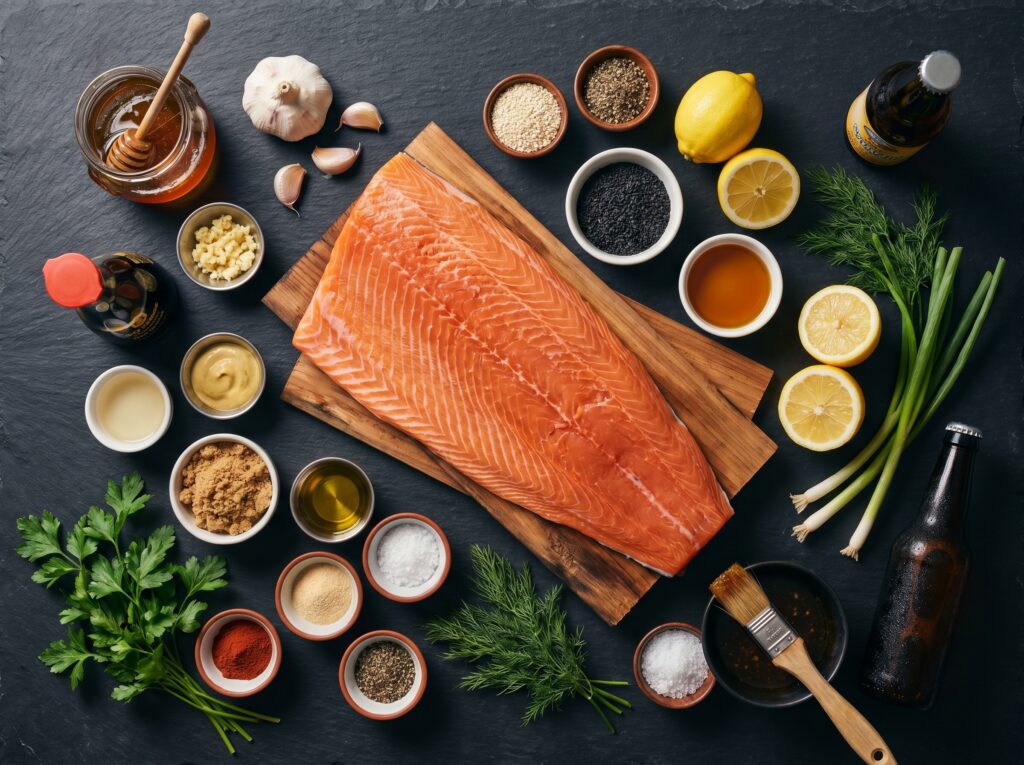
- Soak the cedar plank for at least 1 hour — longer if you have it. Submerge the plank completely in a large baking dish, a clean sink, or a bucket filled with cold water. It will float unless you weigh it down — use a heavy bowl, a full water bottle, or a cast iron skillet set on top to keep it fully submerged. The plank needs to absorb enough water that it smolders slowly on the grill rather than igniting. This step cannot be rushed and cannot be skipped. Plan your soak time into your Father’s Day prep schedule and treat it as the first step of the recipe, not an afterthought.
💡 Pro Tip: Soak the plank in something other than plain water for an added layer of flavor. Beer — a light lager or a wheat beer works especially well — is a classic choice that imparts a subtle malty depth. Apple cider adds sweetness that complements the honey garlic glaze beautifully. White wine with a few peppercorns and a bay leaf turns the plank itself into a flavor vehicle. Any of these takes two seconds to set up and makes a noticeable difference in the finished dish.
- Make the honey garlic glaze and let it rest at room temperature. Combine the honey, minced garlic, soy sauce, Dijon mustard, bourbon if using, fresh lemon juice, lemon zest, red pepper flakes, and melted butter in a small bowl. Whisk everything together until completely smooth and emulsified. Taste it — it should be sweet, garlicky, tangy, and slightly spicy all at once. Adjust salt if needed, though the soy sauce brings significant sodium so add carefully. Set the glaze aside and let it rest while you prep the salmon; the garlic blooms into the honey over time and the glaze deepens in flavor even at room temperature.
- Pat the salmon completely dry and prep it for the plank. Remove the salmon fillet from the refrigerator about 20 minutes before cooking — bringing it closer to room temperature helps it cook more evenly from edge to center. Pat every surface completely dry with paper towels; moisture on the surface of the salmon creates steam and prevents the glaze from adhering properly. Check the fillet for pin bones by running your fingers along the flesh — if you feel any, remove them with clean tweezers or needle-nose pliers. Drizzle the flesh side with olive oil and rub it evenly across the surface, then season with kosher salt, black pepper, garlic powder, and smoked paprika.
💡 Pro Tip: Score the skin side of the salmon fillet with three or four shallow diagonal cuts before placing it on the plank. This prevents the skin from curling and buckling as it hits the heat, which keeps the fillet lying flat and cooking evenly across its entire surface. The scoring also allows a small amount of the cedar smoke to penetrate slightly further into the thicker parts of the fillet.
- Preheat your grill to medium-high heat — 400°F to 450°F. Whether you’re using gas, charcoal, or a pellet grill, you want the grill hot and stable before the plank goes on. For a gas grill, preheat all burners on high for 10 to 15 minutes, then reduce to medium-high before cooking. For charcoal, build a two-zone fire with coals banked to one side — you’ll start the plank over direct heat briefly to get it smoking, then move it to the indirect side for the main cook. A grill thermometer is your best friend here; guessing at temperature is the single biggest variable that leads to overcooked or undercooked salmon.
- Place the soaked plank on the hot grill and close the lid for 3 to 4 minutes. Put the plank directly on the grill grates over medium-high heat and close the lid. In 3 to 4 minutes you’ll start to smell cedar smoke and see wisps of smoke coming from the edges of the plank — this is exactly what you want. The plank is now preheated and actively smoking, which means the moment the salmon goes on, it starts receiving cedar flavor from the first second of cooking. Don’t skip this pre-smoking step — it’s what separates a properly cedar-planked salmon from one that just sat on a piece of wood.
- Place the salmon skin-side down on the smoking plank and apply the first coat of glaze. Open the grill, lay the seasoned salmon fillet skin-side down on the center of the smoking plank, and immediately brush a generous layer of honey garlic glaze over the entire flesh-side surface. Close the grill lid and do not open it for 10 minutes. The salmon needs uninterrupted heat to cook evenly; every time you open the lid you lose temperature and add cook time. Set a timer and walk away.
💡 Pro Tip: Keep a spray bottle of water near the grill during cooking. If you see actual flames licking up around the edges of the plank — not just smoke, but actual fire — a quick spritz of water will knock them down without dropping the grill temperature significantly. Some charring of the plank edges is normal and adds to the smokiness; outright burning needs to be managed or it will turn the cedar flavor acrid and bitter.
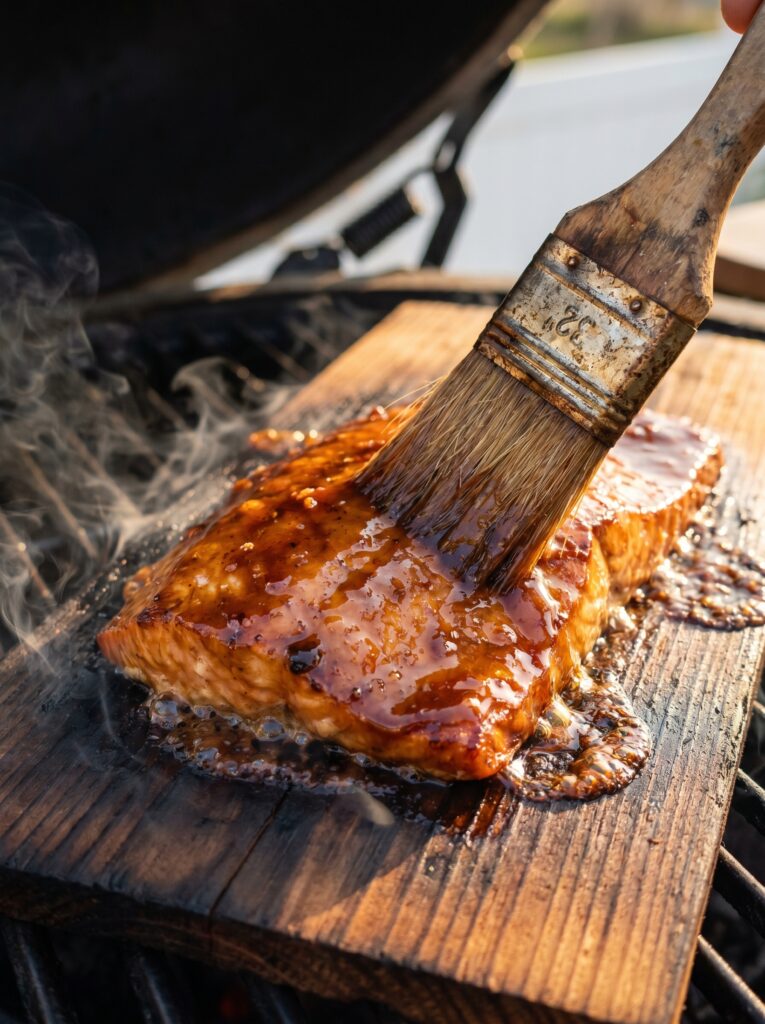
- After 10 minutes, apply a second coat of glaze and check the plank. Open the grill and brush another generous layer of honey garlic glaze over the salmon. At this point the first glaze coat should have started caramelizing against the heat — you’ll see the edges darkening and the surface becoming glossy and lacquered. Check that the plank edges are smoldering but not flaming; adjust the grill temperature slightly if needed. Close the lid and cook for another 8 to 12 minutes depending on the thickness of your fillet.
- Check for doneness and apply a final glaze coat. The salmon is done when it flakes easily with a fork at the thickest part and reaches your preferred internal temperature — 125°F to 130°F for medium, 145°F for fully cooked. Apply one final coat of glaze in the last 2 minutes of cooking, close the lid, and let that last layer set and caramelize into a beautiful lacquered finish. Remove the plank from the grill using long tongs or heat-resistant gloves — the plank will be extremely hot — and place it on a heat-safe surface like a sheet pan or a wooden cutting board.
- Finish, rest for 3 minutes, and carry it to the table on the plank. Scatter the chopped fresh dill or parsley over the salmon, add the sliced scallions, finish with a pinch of flaky Maldon sea salt, and set lemon wedges alongside. Let the salmon rest on the plank for 3 minutes before serving — it continues cooking slightly from residual heat and the juices redistribute through the flesh. Then carry the whole thing to the table still on the plank. This is the moment. Watch the faces around the table when that fragrant, smoky, honey-glazed salmon arrives. That’s Father’s Day done right.
From the moment the plank goes on the grill to the moment you carry it to the table, the active cooking time is about 25 minutes. Add your soak time and your glaze prep and the total recipe investment is roughly 90 minutes — most of which is completely hands-off. For a Father’s Day meal that earns a standing ovation, that is an extraordinary return on a modest investment of time.
How to Serve It
This cedar plank salmon with honey garlic glaze is a centerpiece that commands the whole table, and the sides you put around it should complement without competing. Here are five ways to bring it to a Father’s Day table.
- ☕ Classic Father’s Day Backyard Cookout: Serve the salmon on the plank in the center of a picnic table surrounded by grilled corn on the cob brushed with herb butter, a big bowl of creamy coleslaw, and a platter of sliced heirloom tomatoes with flaky salt and olive oil. Ice cold beer — a good IPA or a crisp lager — in a cooler nearby. This is the version that feels effortless and abundantly generous at the same time, which is exactly the tone Father’s Day should strike.
- 🥞 Elevated Sit-Down Dinner: Serve individual portions plated on warmed dishes with a scoop of lemon herb risotto, a handful of wilted garlicky spinach, and a lemon wedge on the side. Drizzle extra honey garlic glaze around the plate just before serving. Light a candle, open a good bottle of white Burgundy or a Willamette Valley Pinot Noir, and turn a backyard cookout into a proper dinner occasion. Dads who appreciate the finer things will notice every detail.
- 🌸 Pacific Northwest Inspired Spread: Pair the cedar salmon with a wild rice pilaf cooked with toasted almonds and dried cranberries, roasted asparagus with lemon zest, and a simple cucumber dill salad dressed with white wine vinegar and a touch of cream. This pairing leans into the cedar and salmon’s natural affinity for Pacific Northwest flavors and creates a cohesive, thoughtful menu that feels intentional rather than assembled.
- 📚 Simple Weeknight-Style Father’s Day: If you’re keeping things relaxed, serve the salmon alongside a big green salad with creamy avocado dressing, a loaf of crusty sourdough from Trader Joe’s for soaking up the extra glaze, and roasted baby potatoes tossed with olive oil, garlic, and fresh rosemary. Simple, satisfying, and deeply good — the salmon does all the impressive work and the sides just need to show up.
- 🎃 Father’s Day Feast for a Crowd: Use two cedar planks side by side on the grill and double the recipe to feed eight to ten people. Add a whole grilled side of lemon pepper chicken thighs for anyone who doesn’t eat fish, set out big communal bowls of sides in the center of the table, and let the meal feel abundant and festive. The two cedar planks carried to the table together is genuinely one of the most impressive presentations you can do at a home cookout.
Whatever you serve alongside it, always bring the salmon to the table on the plank — the theatrical presentation is half of what makes this recipe so memorable. Let everyone see it before you start serving.
Storage & Make-Ahead Tips
Cooked salmon — Refrigerator: Leftover cedar plank salmon keeps in an airtight container in the refrigerator for up to 3 days. The cedar smoke flavor actually deepens as it sits, which makes leftover salmon genuinely wonderful the next day in a way that most leftover fish isn’t. Eat it cold over a salad, flaked into scrambled eggs, or gently warmed in a 275°F oven for 10 minutes with a splash of water in the pan to keep it moist.
Honey garlic glaze — Refrigerator: The glaze stores in a sealed jar in the refrigerator for up to 2 weeks. It will thicken slightly as it chills — just let it come to room temperature for a few minutes or microwave it for 10 seconds and stir before using. A double batch of this glaze is worth making; it’s excellent on grilled chicken, pork tenderloin, roasted carrots, and as a dipping sauce for everything from egg rolls to grilled shrimp.
Pre-batching for Father’s Day: The glaze can be made up to three days in advance and stored in the fridge — in fact, making it ahead is actively better since the flavors develop beautifully over time. Soak the cedar plank the night before Father’s Day and keep it submerged in water in the fridge or in a bucket outside. Season the salmon up to 4 hours in advance and keep it covered in the fridge. On the day itself, all you need to do is light the grill and cook.
📅 Make-Ahead Tip: Write out your Father’s Day cooking timeline the day before — soak time, preheat time, cook time, rest time — so the day itself is relaxed and you’re not scrambling. Cedar plank salmon is an impressive recipe but it is not a complicated one. The planning is what makes it look effortless when it hits the table.
Reusing the cedar plank: If the plank isn’t too charred after cooking, it can be reused once or twice more. Scrub it clean with hot water and a stiff brush — no soap, which absorbs into the wood — and let it dry completely before storing. Once it’s heavily charred or cracked, retire it. Cedar planks are inexpensive enough that using a fresh one each time is completely reasonable, and a fresh plank always gives you the most cedar flavor.
Helpful Tips & Common Mistakes
Cedar plank salmon is forgiving by nature, but these five mistakes show up regularly and are all simple to sidestep with a little foreknowledge.
✗ Mistake: Not soaking the plank long enough and having it catch fire on the grill.
✓ Fix: Soak for a minimum of one hour — two is better, overnight is best. A properly saturated plank smolders slowly and steadily for the entire cooking time without flaming up. Keep a spray bottle of water nearby during cooking just in case any edges start to flame rather than smoke. The plank should glow and smoke at the edges, not burn.
✗ Mistake: Skipping the plank pre-smoking step and putting the salmon on a cold plank.
✓ Fix: Always place the soaked plank on the preheated grill for 3 to 4 minutes before the salmon goes on. You want to see and smell cedar smoke rising from the plank before the fish touches it. Salmon placed on a cold plank doesn’t start receiving cedar flavor until the plank heats up enough to smoke — which takes several minutes of cooking time you’re not getting back.
✗ Mistake: Opening the grill lid repeatedly to check on the salmon.
✓ Fix: Close the lid and leave it closed for the first 10 minutes. Every time you open the grill you drop the internal temperature and lose the accumulated smoke — both of which slow the cook and reduce the cedar flavor infusion. Set a timer, trust the process, and open the lid only to apply the second glaze coat at the 10-minute mark.
✗ Mistake: Cooking the salmon to 145°F and ending up with dry, chalky fish.
✓ Fix: Use an instant-read thermometer and pull the salmon at 125°F to 130°F for medium — this is the restaurant standard for salmon and produces flesh that is moist, silky, and just barely set at the center. The residual heat from the plank will carry it a few more degrees after you remove it from the grill. If you need to cook to the USDA’s 145°F recommendation, do so, but watch it closely — the window between 145°F and overcooked is narrow.
✗ Mistake: Using the wrong type of cedar or a treated wood plank.
✓ Fix: Always use untreated western red cedar that is specifically sold for grilling or food use — never pressure-treated lumber, which contains chemicals that are genuinely dangerous when burned near food. Hardware store cedar boards work perfectly as long as they are untreated and unpainted. When in doubt, buy planks specifically labeled for grilling from the cooking section of the store.
Recipe Variations
Once you’re comfortable with the cedar plank technique, it opens up into a whole world of flavor directions. Here are four variations that all belong in a Father’s Day repertoire.
🥃 Whiskey Brown Sugar Cedar Salmon: Swap the bourbon in the glaze for a full 3 tablespoons of your best whiskey and add 2 tablespoons of dark brown sugar to the glaze base. The brown sugar caramelizes against the heat of the grill into a deep, almost molasses-like crust that tastes simultaneously like barbecue and elegance. Finish with a sprinkle of coarse black pepper and a drizzle of extra whiskey over the top right as it comes off the grill — just a teaspoon, straight from the glass. This is the version for dads who take their whiskey seriously, and it will be remembered.
🌿 Herb and Lemon Cedar Salmon: Skip the honey garlic glaze entirely and coat the salmon in a paste made from softened butter, fresh dill, fresh flat-leaf parsley, minced garlic, lemon zest, capers, and a heavy pinch of salt. Lay thin slices of lemon directly on the plank under the salmon before cooking and tuck fresh herb sprigs alongside. The butter melts slowly into the fish as it cooks, basting it from within, and the herbs perfume everything around them. It’s a cleaner, more refined flavor profile — beautiful for a Father’s Day dinner that leans elegant rather than bold.
🌶️ Spicy Miso Honey Cedar Salmon: Add 2 tablespoons of white miso paste and 1 tablespoon of sambal oelek to the honey garlic glaze base, and reduce the soy sauce to 1 tablespoon since the miso brings its own saltiness. The miso adds a deep, fermented umami richness that makes the glaze taste like something a professional chef would charge $35 a plate for, and the sambal heat plays beautifully against the sweet honey and salty miso. Top with toasted sesame seeds and thinly sliced scallions and finish with a drizzle of toasted sesame oil. This is the variation that gets the most recipe requests.
🍋 Teriyaki Pineapple Cedar Salmon: Replace the honey garlic glaze with a quick homemade teriyaki — equal parts soy sauce and pineapple juice, a tablespoon of honey, a tablespoon of rice vinegar, a teaspoon of sesame oil, and a teaspoon of cornstarch whisked in cold — cooked briefly in a small saucepan until glossy and slightly thickened. Brush it over the salmon exactly as you would the honey garlic glaze. Top the finished salmon with grilled pineapple rings and thinly sliced red chili. The combination of cedar smoke, teriyaki glaze, and sweet char-grilled pineapple is a summer flavor combination that belongs on every Father’s Day table.
Final Thoughts
This recipe started as an attempt to recreate a restaurant memory on a Father’s Day Sunday, and it became one of our family’s most cherished cooking traditions. There is something about carrying a whole cedar-planked salmon to a table full of people you love — the smoke still rising, the glaze still glistening, the cedar fragrance filling the whole backyard — that feels like a genuine occasion rather than just dinner. It communicates care. It says: I wanted this to be special, and I made it special. And the fact that it comes together in under two hours with 20 minutes of real effort is the kind of secret that makes a cook look like a genius.
If you make this cedar plank salmon for Father’s Day this year, I want to hear all about it. Leave a ⭐⭐⭐⭐⭐ rating below, tag @zippydishes on Pinterest so I can see your beautiful planks coming off the grill, and share this with anyone who is still trying to figure out what to make this year. The answer is this. It’s always this. 🐟🔥🍋
Frequently Asked Questions
What does cedar plank salmon taste like?
Cedar plank salmon has a flavor that’s difficult to achieve any other way — the salmon itself is richer and more moist than any other grilling method produces, because the plank acts as a barrier between the fish and the direct heat, essentially steaming and smoking simultaneously rather than searing. The cedar smoke imparts a woodsy, slightly sweet, resinous fragrance that permeates every bite without being overpowering — it’s a background note that makes you aware you’re eating something cooked over real wood. Combined with the honey garlic glaze, which caramelizes into a glossy, sweet-savory-garlicky lacquer, the total flavor experience is complex, deeply satisfying, and genuinely restaurant-caliber. People who claim they don’t like salmon frequently discover they love cedar plank salmon — the cooking method eliminates the things they didn’t like and amplifies the things they did.
Can I make cedar plank salmon in the oven instead of on the grill?
You absolutely can, and it produces a wonderful result — different from the grill version but still genuinely excellent. Soak the plank the same way, preheat your oven to 400°F, and place the soaked plank directly on the center oven rack for 5 minutes to preheat. Lay the glazed salmon on the plank and bake for 20 to 25 minutes, applying a second coat of glaze at the halfway mark, until the salmon reaches your preferred internal temperature. You won’t get the same outdoor smoke flavor from the oven, but the cedar still imparts its characteristic woodsy aroma and the gentle indirect heat keeps the salmon beautifully moist. Open a window before you start — the cedar and glaze create a fragrant smoke inside the oven that sets off sensitive smoke detectors.
Where do I buy cedar grilling planks?
Cedar grilling planks are more widely available than most people realize. Walmart, Target, and Costco all carry them in the outdoor cooking or grilling section, usually in two-packs for around $5 to $8. Most grocery stores with a grilling section carry them seasonally. Amazon has them year-round in bulk packs if you plan to use them regularly. Hardware stores like Home Depot and Lowe’s sell untreated western red cedar boards in the lumber section that you can cut to size yourself — this is by far the most economical option if you grill on planks frequently. Just confirm the wood is untreated and food-safe before using any lumber-section wood near food.
How do I know when the cedar plank salmon is done?
The most reliable method is an instant-read thermometer inserted at the thickest part of the fillet — 125°F to 130°F for medium, 145°F for fully cooked per USDA guidelines. Visual cues are helpful secondary indicators: the flesh changes from translucent deep orange to opaque lighter pink as it cooks, and it should flake easily when you press it gently with a fork at the thickest part. The edges will be more cooked than the center — this is correct and expected. A 2-pound fillet about 1 inch thick at its thickest point generally takes 20 to 22 minutes total on a medium-high grill. Thicker fillets take longer; thinner fillets cook faster. An instant-read thermometer removes all the guesswork and is worth the $15 investment for this recipe alone.
Can I use a different type of fish on the cedar plank?
Cedar planks work beautifully with any fatty, firm fish that can stand up to grill heat without falling apart. Halibut is an excellent choice — its firm, white flesh takes cedar smoke wonderfully and the honey garlic glaze is extraordinary on it. Trout, sea bass, and mahi-mahi are all excellent plank candidates. Swordfish steaks work well on a plank and pair particularly well with the herb and lemon variation. Shrimp threaded on skewers and laid on a cedar plank is a fun and impressive appetizer application. Avoid very delicate, thin fish like tilapia or sole — they overcook too quickly and don’t have enough fat to benefit from the plank method the way salmon and other fatty fish do.
What is the best type of salmon to use for cedar plank grilling?
King salmon — also called Chinook — is the gold standard for cedar plank grilling. It has the highest fat content of any Pacific salmon species, which translates to the richest, most buttery texture and the most forgiving cooking window. Sockeye salmon is a close second — it’s slightly leaner with a more intensely flavored, deeper red flesh that many people prefer for its assertive character. Atlantic salmon, which is what you’ll find most readily at Costco, Walmart, and most grocery stores, is an excellent everyday choice — reliable, widely available, and rich enough for this application. Whatever species you use, look for fillets that are bright in color, firm to the touch, and smell clean and ocean-fresh rather than fishy.
Is cedar plank salmon good for Father’s Day if some guests don’t eat fish?
Make the cedar plank salmon as your centerpiece and add a second protein alongside it for non-fish eaters. Bourbon brown sugar chicken thighs on the grill use virtually the same flavor profile as the salmon glaze and cook in a similar time window — you can essentially run both proteins simultaneously without extra effort. A cedar plank can also be used for a whole pork tenderloin rubbed with the same honey garlic glaze, which is a spectacular option that cooks in about 20 to 25 minutes and impresses even confirmed fish-avoiders. Setting out both options side by side makes the Father’s Day spread feel genuinely abundant and inclusive without complicating your cooking day.
What do I do with leftover honey garlic glaze?
The leftover glaze is one of the best bonuses of this recipe, and making a double batch specifically for leftover purposes is genuinely worth doing. It keeps for two weeks in a sealed jar in the refrigerator and is extraordinary as a marinade for chicken thighs or pork chops — let the meat sit in it for at least two hours before grilling. Toss roasted Brussels sprouts or carrots in a spoonful of it right before they come out of the oven for a caramelized vegetable side that disappears immediately. Use it as a dipping sauce for grilled shrimp, spring rolls, or chicken satay skewers. Brush it over a wheel of brie in a cast iron skillet and bake at 375°F for 15 minutes for an appetizer that makes a room go completely silent. It is a remarkably versatile condiment and the extra five minutes it takes to double the batch pays off for days afterward.